
What a Florida Apostille Looks Like
This is a real Florida apostille, issued in Tallahassee on October 26, 2026. Here is what each numbered line means, the security features to look for, and how to check that one is genuine.
This example
- Issued
- October 26, 2026, in Tallahassee
- Issued by
- Cord Byrd, Secretary of State
- Form
- DSDE 99
- Certificate no.
- Blurred for privacy
The certificate, marked up
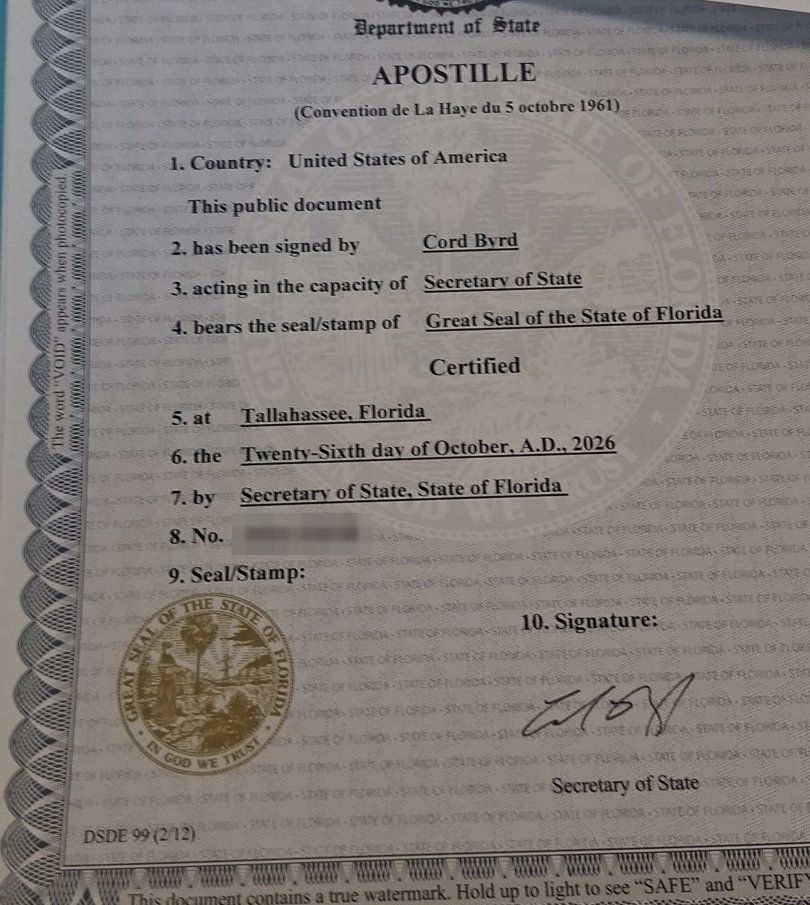
Lines 1 to 10 are printed on every apostille. The letters mark the parts worth checking:
- Marker A: The heading. “APOSTILLE,” followed by “Convention de La Haye du 5 octobre 1961” in French. The Hague Convention requires that heading in French on every apostille, whatever language the rest is in.
- Marker B: The seal in box 9: the gold Great Seal of the State of Florida.
- Marker C: The signature in box 10, signed as Secretary of State.
- Marker D: The certificate number on line 8. We blurred this one.
- Marker E: The margin note: the word “VOID” appears when the certificate is photocopied.
- Marker F: The form number, DSDE 99, in the lower left corner.
- Marker G: The watermark note along the bottom edge: the paper carries a true watermark you can see by holding it up to the light.
- Marker H: The background: “STATE OF FLORIDA” printed over and over across the security paper.
What each numbered line means
| Line | In this example | What it means |
|---|---|---|
| 1. Country | United States of America | The country issuing the apostille. A Florida apostille names the United States here, not Florida. |
| 2. Has been signed by | Cord Byrd | Whoever signed the document underneath, such as the State Registrar on a birth certificate, the notary on a notarized document or the clerk on a certified court copy. Here it’s the Secretary of State, whose signature appears on Department of State documents such as certificates of status. |
| 3. Acting in the capacity of | Secretary of State | That person’s role, such as State Registrar, Notary Public or Deputy Clerk. |
| 4. Bears the seal/stamp of | Great Seal of the State of Florida | The seal on the document underneath. On a notarized document, it’s the notary’s seal. |
| 5. At | Tallahassee, Florida | Where the apostille was issued. Florida issues its apostilles in Tallahassee. |
| 6. The | Twenty-Sixth day of October, A.D., 2026 | The date of issue, written out in words. |
| 7. By | Secretary of State, State of Florida | Who issued the apostille. Florida’s Secretary of State is the competent authority for Florida documents. |
| 8. No. | Blurred for privacy | The certificate number. Here it begins with the year of issue. |
| 9. Seal/Stamp | Gold Great Seal of the State of Florida | The seal of the issuing authority. |
| 10. Signature | Signed as Secretary of State | The signature of the issuing official. |
“This public document” and “Certified” are printed wording that joins the lines into one statement. They sit between lines 1 and 2, and between lines 4 and 5.
How to check it’s genuine
According to the Florida Department of State:
- Apostilles and notarial certificates are issued on security paper that can’t be photocopied. A photocopy shows the word “VOID” throughout.
- Each certificate has a unique identification number on the back, in the lower left corner.
- The Department will verify a certificate if you send a copy of it with a written request to its Apostille/Certification Section. Its apostille line is (850) 245-6053.
What it travels with
An apostille certifies one signature on one document, so it stays with that document: the birth certificate, notarized affidavit, certified court copy or certificate of status it was issued for. Keep them together as the state returned them. If the country needs a translation, have it done after the apostille is attached, so the translation covers the apostille too. See certified translation.
Apostille or notarial certificate
You only get a certificate headed “APOSTILLE” for countries that are part of the Hague Apostille Convention. For other countries, Florida issues a notarial certificate instead, and the document usually goes on to the U.S. Department of State and the destination’s embassy. Our Washington, D.C. office handles those steps. See embassy legalization.
Frequently asked questions
Why is part of the apostille in French?
The Hague Convention of October 5, 1961 requires the heading “Apostille (Convention de La Haye du 5 octobre 1961)” to be in French. The rest of a Florida apostille is in English.
Why doesn’t line 2 show my name?
Line 2 names the official or notary who signed your document, not the person the document is about.
Why does line 1 say United States of America?
Line 1 names the country that issued the apostille. The United States is the party to the Hague Convention, and Florida’s Secretary of State is one of the authorities it designated, so every Florida apostille names the United States there.
Can I use a photocopy of my apostille?
No. The security paper can’t be photocopied; a copy shows the word “VOID” throughout. Send the original with your document.
How much does a Florida apostille cost?
The state’s fee is $10 per document, or $20 for documents certified by a county clerk. With us it starts at $120 per apostille, filed in person in Tallahassee and ready the next business day.
Get your Florida apostille
From $120 per apostille, filed in person in Tallahassee and ready the next business day.
Federal Apostille and Notary Processing is a private document service, not affiliated with the Florida Department of State. The example shown is a real certificate; its number is blurred for privacy.