

Certificate of Nonexistence of Record Apostille
Federal authentication of your USCIS, U.S. Department of State, or FBI Certificate of Nonexistence of Record (CNR) — for use in any country worldwide.
Hand-delivered submission in Washington, D.C. Pre-submission review by federal-document specialists. Embassy legalization handled in-house for non-Hague countries.
What This Document Is
A Certificate of Nonexistence of Record (CNR) — sometimes informally called a "no record letter," "negative certificate," or "certification of no record" — is an official federal document confirming that, after a diligent search of the issuing agency's records systems, no record exists for the named subject within the scope of that search.
CNRs are an unusual category of federal record because they document the absence of a fact rather than its existence. For foreign authorities, a CNR provides legally authoritative evidence that a person has not, as of the date of the search, been registered, naturalized, indexed, or otherwise recorded in a particular U.S. federal system.
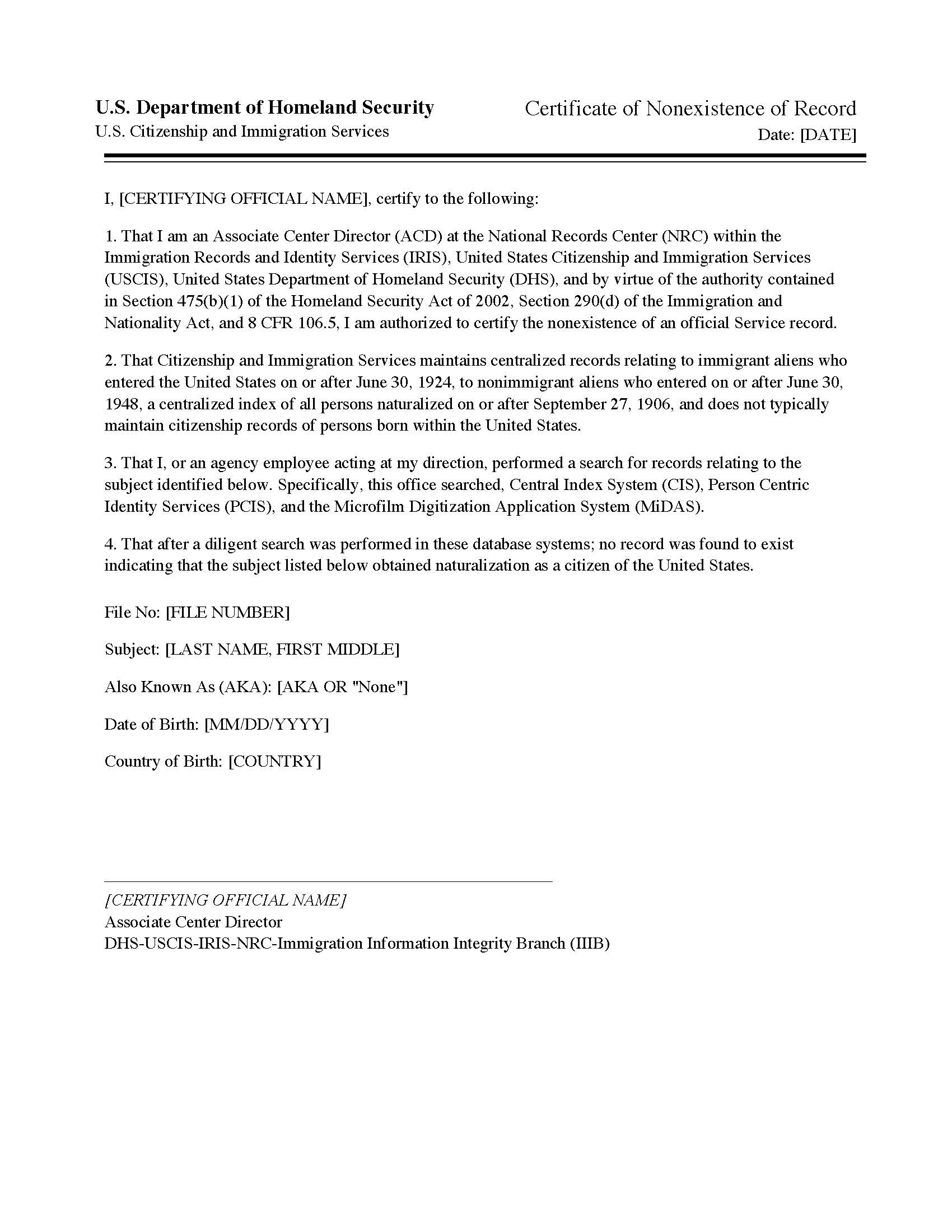
The most common CNR — and the one shown in the sample document at the top of this page — is the USCIS Certificate of Nonexistence of Record, issued by U.S. Citizenship and Immigration Services to confirm that no U.S. naturalization or related immigration record exists for the subject. A USCIS CNR contains:
- U.S. Department of Homeland Security / USCIS letterhead in the upper-left
- Document title: "Certificate of Nonexistence of Record"
- Issue date in the upper-right
- Certifying paragraph 1: the certifying official's name, title, statutory authority (Section 475(b)(1) of the Homeland Security Act of 2002, Section 290(d) of the Immigration and Nationality Act, and 8 CFR 106.5)
- Certifying paragraph 2: a description of the scope of USCIS centralized records (immigrant aliens since June 30, 1924; nonimmigrant aliens since June 30, 1948; naturalization records since September 27, 1906)
- Certifying paragraph 3: the systems searched — Central Index System (CIS), Person Centric Identity Services (PCIS), and the Microfilm Digitization Application System (MiDAS)
- Certifying paragraph 4: the conclusion that, after a diligent search, no record was found
- Subject identification: File No., Subject (Last, First Middle), AKA, Date of Birth, Country of Birth
- Signature block of the Associate Center Director, Immigration Information Integrity Branch (IIIB), National Records Center
Because CNRs are issued by federal agencies under federal authority, they are authenticated for international use exclusively by the U.S. Department of State, Office of Authentications.
What It Is Used For Internationally
CNRs are most frequently required by foreign governments and institutions when proving the absence of a U.S. record is necessary to advance an application or proceeding abroad. Common use cases include:
- Foreign citizenship and dual nationality applications — particularly when the destination country prohibits, restricts, or requires disclosure of foreign citizenship. A USCIS CNR proves the subject has not naturalized as a U.S. citizen, which is often a prerequisite for retaining or claiming citizenship in another country.
- Reclamation of original citizenship — countries such as Mexico, the Philippines, Korea, and certain European nations require formal proof that the applicant has not become a U.S. citizen before reinstating original-country citizenship rights.
- Foreign immigration and residency applications — establishing that no disqualifying U.S. record exists for visa, residency, or work-permit purposes.
- Foreign inheritance and estate proceedings — establishing the citizenship status of a deceased individual for foreign succession law purposes.
- International family law and custody matters — proving the absence of certain U.S. records when a foreign court requires it.
- Foreign government employment and security clearances — confirming the absence of U.S. naturalization or criminal records for sensitive foreign positions.
- International adoption proceedings — particularly under the Hague Adoption Convention, where CNRs may supplement other federal records.
- Foreign tax residency claims — supporting claims of non-U.S. tax residency in jurisdictions that require formal documentary evidence.
- Birth and vital records corrections abroad — when a CNR from the U.S. Department of State (Form DS-1351) is required to support a corrective filing in a foreign civil registry.
Foreign authorities require federal authentication because they cannot independently verify that a CNR is a legitimate U.S. government document.
CNR Variants by Federal Issuer
The phrase "Certificate of Nonexistence of Record" describes a category of federal document, not a single form. Multiple federal agencies issue CNRs, and the correct issuer depends on the type of record being verified as nonexistent.
| Issuing Agency | Type of Record Searched | Common Use Case |
|---|---|---|
| USCIS (U.S. Department of Homeland Security) | Naturalization, immigration, and alien-file records held by U.S. Citizenship and Immigration Services | Proving the subject has not naturalized as a U.S. citizen — the most common CNR variant for foreign citizenship and dual nationality matters. (This is the type shown in the sample image at the top of this page.) |
| U.S. Department of State (Form DS-1351 / no record letter) | U.S. consular birth records, passport records, and Consular Reports of Birth Abroad (CRBAs) | Proving the subject was not registered as a U.S. citizen at birth abroad — used in dual citizenship matters and foreign civil registry corrections. |
| Federal Bureau of Investigation (FBI) | National criminal history records held by the FBI Criminal Justice Information Services (CJIS) Division | Proving the subject has no FBI-level criminal arrest record. The FBI's standard "no record" Identity History Summary serves this purpose — see our FBI Background Check Apostille page for details on this variant. |
| Other federal agencies | Records held by IRS, SSA, federal courts, military branches, and other agencies, depending on the request | Specialized matters — e.g., proving no IRS tax filing exists, no SSA earnings record, or no federal court matter for a specific identity. |
All federally issued CNRs follow the same authentication pathway: federal apostille by the U.S. Department of State. Our team handles all CNR variants — confirm with us at order intake which agency issued your CNR, and we will route it accordingly.
How to Obtain a Certificate of Nonexistence of Record
Each federal agency has its own request process for CNRs. The most commonly requested CNR is the USCIS variant.
USCIS CNR (Most Common)
USCIS CNRs are typically obtained by submitting a Freedom of Information Act (FOIA) request to USCIS. The request must specifically ask for a Certificate of Nonexistence of Record (rather than a copy of an existing record), include identifying information about the subject (full name, AKA, date of birth, country of birth), and explain the purpose for which the CNR is needed.
- Where to file: Through the USCIS FOIA online portal at uscis.gov/g-639 or by mail using Form G-639.
- Filing fee: No fee for a basic FOIA request from the subject of the records (verify current USCIS fee policy).
- Processing time: Routine requests currently take 3 to 6 months; expedited processing may be available for time-sensitive immigration matters.
- Result: A formal CNR signed by an Associate Center Director or other authorized USCIS official at the National Records Center, ready for federal apostille processing.
U.S. Department of State CNR (Form DS-1351 / no record letter)
State Department CNRs concerning consular birth records (CRBA-related) are requested through the Department of State's Vital Records Section. Routine processing typically takes 6 to 8 weeks.
FBI CNR (Identity History Summary — no record result)
FBI CNRs take the form of an Identity History Summary that confirms no prior arrest data exists at the FBI. Submit fingerprints through the FBI eDO system at edo.cjis.gov or through an approved FBI channeler. See our FBI Background Check Apostille page for full details.
Federal Apostille Eligibility — Federally Signed & Certified vs. Notary + State Apostille
Federal apostilles by the U.S. Department of State are only available for documents that have been signed and certified by a federal official. This is the core eligibility rule and the most common point of confusion. There are two valid pathways depending on how the document was issued — and choosing the wrong one is the most frequent reason apostille submissions are rejected.
| Pathway | When It Applies | How It Works | Who Authenticates |
|---|---|---|---|
| Pathway A — Federal Apostille | Document is signed and certified by a federal official (e.g., a USCIS Associate Center Director, a State Department records officer, an FBI section chief) | Document submitted directly to the U.S. Department of State as-is — no notary, no state involvement. | U.S. Department of State, Office of Authentications (Washington, D.C.) |
| Pathway B — Notary + State Apostille | Document is not federally signed (e.g., a self-declared statement, an attorney letter asserting nonexistence, or an unofficial document the applicant prepared to assert that no U.S. record exists) | A notary public certifies the signature on the document; the document is then submitted to the Secretary of State of the state where the notary is commissioned. | State Secretary of State (the state where the document was notarized) |
Pathway A — When the CNR Qualifies for Federal Apostille
A Certificate of Nonexistence of Record qualifies for a federal apostille only when it has been issued by the federal agency itself — that is, an authentic CNR on official agency letterhead, bearing the federal seal and the wet or digital signature of an authorized federal officer. In this form, the document is already a federally certified record, and it is submitted to the U.S. Department of State without any notary involvement.
This is the standard pathway for most CNRs. If your CNR was issued by USCIS (signed by an Associate Center Director), the U.S. Department of State (signed by a records officer), or the FBI (signed by the Section Chief, Biometric Services Section), you are on this pathway.
Pathway B — When the Notary + State Apostille Route Is Required Instead
If a document concerning the absence of a record is not federally signed and certified — for example, a self-prepared affidavit asserting that no U.S. naturalization exists, or an attorney's declaration on private letterhead claiming the absence of a federal record — it cannot be federally apostilled. In that case, the proper route is:
- The applicant signs the document in front of a notary public, who certifies the signature.
- The notarized document is submitted to the Secretary of State of the state where the notary is commissioned for a state apostille.
- The state apostille certifies the notary's commission, which in turn certifies the applicant's signature.
The state apostille route is internationally valid under the same Hague Apostille Convention as the federal route — but the authenticating authority is the state, not the federal government, because the underlying document does not bear a federal officer's signature. (Note that a state-apostilled affidavit is generally a weaker evidentiary instrument than a true federal CNR — most foreign authorities will not accept self-declared assertions of nonexistence as a substitute for an agency-issued CNR.)
If you are unsure which pathway applies to your specific document, our team will review it as part of order intake and route it correctly — either through the U.S. Department of State for federally signed records, or through the appropriate state for notary-based documents.
Why Federal Authentication Is Required
Apostille and authentication authority in the United States is divided between state Secretaries of State and the U.S. Department of State based on the issuing authority of the document.
| Issuing Authority | Examples | Where Authenticated |
|---|---|---|
| State or local government | State birth certificates, marriage licenses, notarized affidavits, state-licensed professional records | Secretary of State of the issuing state |
| Federal government | Certificates of Nonexistence of Record (USCIS, State Department, FBI), FBI Identity History Summary, Certificate of Naturalization (USCIS), Certificate of Citizenship, Consular Report of Birth Abroad, IRS letters, SSA letters, federal court documents, DD-214 military records | U.S. Department of State, Office of Authentications — Washington, D.C. |
Because CNRs are issued by federal agencies, they cannot be apostilled at the state level. State authorities have no jurisdiction to authenticate federal documents, and any state apostille placed on a federally signed CNR is invalid and will be rejected by the receiving foreign government.
Federal authentication is required to:
- Verify that the document was issued by a legitimate U.S. federal agency
- Confirm the authenticity of the federal seal and certifying official's signature
- Enable formal recognition by foreign governments under international law
travel.state.gov — Authenticate Your Document
Document Preparation Requirements
To be eligible for federal authentication, the CNR must meet all federal submission standards. Even minor deviations can cause rejection.
Acceptable Format
- Original federal-agency–issued CNR on official agency letterhead, with federal seal and authorized officer's signature.
- Certified copies issued and signed directly by the issuing federal agency are also acceptable, provided the certification language explicitly states the document is a true copy issued by the agency.
Strict Preparation Rules
- Submit the document exactly as issued by the federal agency — no edits, modifications, or additions.
- Do not notarize the document. Notarization automatically invalidates a federal record.
- Do not add certification wording, cover letters, or apostille request stamps to the face of the document.
- Do not alter, cover, or "enhance" any signatures, seals, or letterhead elements.
- Do not reformat, resize, scan-and-reprint, or compress the file before submission.
- Printed copies must match the agency-issued PDF exactly — including margins, color, pagination, and certification language.
- Do not laminate, hole-punch, staple over the seal, or write on the document.
- For multi-page CNRs, all pages must be submitted in original order.
Step-by-Step Apostille Process
Obtain CNR from Federal Agency
Submit the appropriate request to USCIS (FOIA / Form G-639), the U.S. Department of State (Vital Records Section), or the FBI (eDO system or channeler) depending on the type of record being verified as nonexistent.
Order & Document Review
Submit your order online and send us the federally issued CNR. Our team verifies the document is in proper form before any submission to the Department of State.
Department of State Submission
We hand-deliver your document to the U.S. Department of State, Office of Authentications in Washington, D.C., along with the federal authentication request form (DS-4194) and the appropriate federal fee.
Apostille or Authentication Issued
The Department of State issues either an Apostille (Hague Convention countries) or an Authentication Certificate (non-Hague countries), affixed directly to your document.
Embassy Legalization (If Required)
For non-Hague countries, we forward the authenticated document to the destination country's embassy or consulate in Washington, D.C., for final legalization.
Certified Translation (Optional)
If your destination country requires the document in another language, we provide certified translations — commonly Spanish, Portuguese, French, Italian, German, Vietnamese, Arabic, Chinese, and others.
How to Visually Confirm the Document Is Ready
Before submitting your CNR for federal authentication, verify that all of the following are present and intact. (Refer to the sample image at the top of this page for what a properly issued USCIS CNR looks like — other federal agency variants follow similar structural conventions.)
- Issuing agency letterhead — for USCIS, "U.S. Department of Homeland Security / U.S. Citizenship and Immigration Services" in the upper-left
- Document title — "Certificate of Nonexistence of Record" (for USCIS) or equivalent agency-specific title
- Issue date in the upper-right corner
- Numbered certifying paragraphs setting out the certifying official's authority, the scope of records searched, and the conclusion of nonexistence
- Subject identification block (File No., Subject name, AKA, Date of Birth, Country of Birth)
- Signature line and signature block of the certifying federal official (e.g., Associate Center Director, IIIB, USCIS National Records Center)
- Federal seal — embossed, printed, or digital — depending on agency format
- Clean print quality with no fading, smudging, compression artifacts, or alignment issues
- No handwriting, highlighting, stamps, or annotations
Common Reasons CNR Submissions Are Rejected
The Department of State and foreign governments routinely reject CNR submissions for a small set of recurring issues. All are preventable.
1. Notarized Self-Declarations Submitted as Federal CNRs
The most common rejection. A notarized affidavit asserting that no federal record exists is not a federal CNR. Fix: request a true CNR from the appropriate federal agency (USCIS, State Department, or FBI).
2. Notarization Added to a Federal CNR
A notary public has no authority to certify federal records, and adding a notary stamp visibly alters the document. Fix: never notarize a federal CNR.
3. State-Level Apostille Attempts
Submissions routed to a state Secretary of State are returned unprocessed because federal CNRs are signed by federal officials. Fix: ensure submission is routed to the U.S. Department of State, Office of Authentications.
4. Missing Pages
Multi-page CNRs must be submitted in their entirety. Submitting only the signature page or only the certifying paragraphs is a frequent cause of rejection. Fix: always include all pages in original order.
5. Edited or Reformatted PDFs
Cropped, resized, or "flattened" PDF prints lose the federal letterhead alignment and digital integrity. Fix: print the original agency-issued PDF exactly as issued, in full color, on standard letter-size paper.
6. Wrong Federal Agency
Submitting a USCIS CNR when the foreign authority requires a State Department CNR — or vice versa — wastes time and money. Fix: confirm with the foreign authority which agency's CNR is required before initiating the federal request.
7. Damaged or Illegible Pages
Stained, torn, faded, or folded-across-text CNRs are commonly rejected. Fix: handle the document carefully and store flat in a clean envelope until submission.
Hague Convention vs. Non-Hague Countries
The final form of authentication depends on whether the destination country is a member of the 1961 Hague Apostille Convention:
| Destination Type | What You Receive | Additional Steps | Examples |
|---|---|---|---|
| Hague Convention country | Apostille issued by U.S. Department of State | None — document is ready for use abroad. | Mexico, Spain, Italy, Portugal, France, Germany, Netherlands, UK, Brazil, Argentina, Japan, South Korea, India, Australia, Philippines. |
| Non-Hague country | Authentication Certificate from U.S. Department of State | Embassy or consulate legalization required after authentication. | Saudi Arabia, Qatar, Kuwait, Egypt, Vietnam, Cambodia, Iran, Iraq. |
Hague Convention membership changes periodically. Federal Apostille and Notary Processing verifies the destination country's current status as part of every order. View our Country Guide for the latest list.
Processing Times & Validity
Total turnaround depends on three stages: federal agency issuance of the CNR, the U.S. Department of State's authentication processing, and (when required) embassy legalization.
- USCIS CNR (FOIA request): currently 3 to 6 months for routine processing. Expedited processing available in qualifying cases.
- State Department CNR (vital records): 6 to 8 weeks for routine processing.
- FBI CNR (Identity History Summary, no record result): 3 to 5 business days via eDO; 24 to 48 hours via channeler.
- U.S. Department of State authentication: currently 10–12 business days for routine processing (subject to government workload — expedited service available through our office).
- Embassy legalization: varies widely by country — typically 3 business days to 4 weeks.
- Validity for foreign use: CNRs typically must be issued within the last 3 to 6 months for foreign immigration purposes; some destinations accept up to 12 months. Confirm with the destination country's specific requirement before ordering.
Use our Processing Time Estimator for a country-specific projection.
Why Choose Federal Apostille and Notary Processing
We are a Washington, D.C.-based document processing service specializing exclusively in federal authentications. CNR apostilles are one of our most-requested services among individuals pursuing foreign citizenship reclamation, dual nationality recognition, and international civil registry filings.
- Hand-delivery to the U.S. Department of State, Office of Authentications — no mail delays.
- $120 flat-rate pricing with all government authentication fees included — no hidden costs.
- Pre-submission review by federal-document specialists who catch the most common rejection issues (notarized self-declarations, state-level routing attempts, missing pages) before they cost you time and money.
- Coverage of all CNR variants — USCIS, U.S. Department of State, FBI, and other federal agencies.
- Embassy legalization for non-Hague countries handled in-house in Washington, D.C.
- Certified translations in Spanish, Vietnamese, Arabic, Chinese, Portuguese, French, Italian, German, and other languages.
- Worldwide tracked shipping via FedEx, UPS, and DHL.
- Real-time order tracking from intake through delivery.
- Over 10 years of experience processing federal authentications.
Frequently Asked Questions
What is a Certificate of Nonexistence of Record?
A Certificate of Nonexistence of Record (CNR) is an official federal document confirming that, after a diligent search of the issuing agency's records, no record exists for the named subject. CNRs are issued by USCIS (for naturalization records), the U.S. Department of State (for CRBA / vital records), and the FBI (for criminal records), depending on what type of record is being verified as nonexistent.
How do I request a USCIS Certificate of Nonexistence of Record?
USCIS CNRs are typically obtained by submitting a Freedom of Information Act (FOIA) request to USCIS using Form G-639 or the online FOIA portal at uscis.gov/g-639. The request must specifically ask for a CNR (not a copy of an existing record) and include identifying information about the subject. Routine processing currently takes 3 to 6 months; expedited requests for time-sensitive immigration matters may be faster.
Can a state Secretary of State apostille my CNR?
No. CNRs issued by federal agencies (USCIS, State Department, FBI) are signed by federal officials and can only be apostilled by the U.S. Department of State, Office of Authentications. State apostilles on federally signed documents are invalid and will be rejected by foreign governments. (State apostilles are only the correct route for documents that are not federally signed — for example, a self-prepared affidavit notarized by a notary public.)
What is the difference between a federal apostille and a state apostille?
A federal apostille is issued by the U.S. Department of State and applies to documents signed and certified by a federal official — including CNRs from USCIS, the State Department, and the FBI, as well as USCIS certificates, FBI Identity History Summaries, and federal court documents. A state apostille is issued by a state Secretary of State and applies to documents that are not federally signed but are notarized by a notary public commissioned in that state — such as self-declared affidavits, powers of attorney, or copies certified by a notary. Both are recognized internationally under the Hague Apostille Convention; the difference is solely about who signed the underlying document. We handle both — see Federal vs. State Apostille Eligibility above for full details.
Why would a foreign government require a CNR?
Foreign governments often require a CNR as documentary proof that a person has not naturalized as a U.S. citizen — most commonly when claiming or maintaining citizenship in another country that prohibits or restricts dual citizenship. CNRs are also requested for foreign immigration, residency, inheritance, and civil registry proceedings where the absence of a U.S. federal record must be formally established.
Can I submit a notarized affidavit instead of a real CNR?
Generally, no — most foreign authorities will not accept a self-declared affidavit as a substitute for an agency-issued CNR. A federal CNR carries the legal weight of the issuing agency's diligent search of its own records, which a self-declaration cannot replicate. If a foreign authority specifically does accept an affidavit, that document would go through the notary + state apostille pathway rather than the federal apostille pathway.
Which federal agency issued my CNR?
Look at the letterhead and the certifying official's title. USCIS CNRs bear "U.S. Department of Homeland Security / U.S. Citizenship and Immigration Services" letterhead and are signed by an Associate Center Director or similar officer at the National Records Center. U.S. Department of State CNRs bear State Department letterhead and are signed by a records officer (often Form DS-1351 or a "no record" letter). FBI CNRs are issued as Identity History Summaries on FBI letterhead, signed by the Section Chief, Biometric Services Section. Each follows the same federal apostille pathway.
How long is my CNR valid for foreign use?
Most foreign authorities require CNRs that are between 3 and 6 months old at the time of foreign filing. Some accept up to 12 months. Validity rules vary widely by country and use case — confirm with the receiving authority before ordering, and request a fresh CNR if your existing one is older than the destination country requires.
Will I need a certified translation of the apostilled CNR?
Many countries require a certified translation into the official language of the destination country — particularly for foreign citizenship reclamation, civil registry filings, and immigration matters. We offer certified translations alongside the apostille service so that everything is delivered ready-to-file. Spanish, Italian, Portuguese, French, German, Vietnamese, Arabic, and Chinese are among the most commonly requested languages.
Can you help me obtain the CNR from the federal agency?
The federal agency requires the subject of the records (or an authorized representative) to initiate the request directly. We do not submit FOIA or vital records requests on your behalf, but we can provide guidance on the correct request process for the agency you need. Once you have the federally issued CNR in hand, we handle the federal apostille process from there.
Do I need to be in Washington, D.C. or visit your office in person?
No. We work with clients nationwide and internationally. You can submit your federally issued CNR by mail or courier, and we handle the in-person submission to the Department of State on your behalf.
Summary
The Certificate of Nonexistence of Record is a high-sensitivity federal document that proves a legally important negative fact — that a U.S. federal record (naturalization, vital, criminal, or other) does not exist for the named subject. CNRs are issued by USCIS, the U.S. Department of State, the FBI, or other federal agencies depending on the type of record involved. Because all federal CNRs are signed by federal officials, they can only be apostilled by the U.S. Department of State — never by a state Secretary of State.
Federal Apostille and Notary Processing handles every step — from document review through final embassy legalization — so that your CNR is delivered abroad in legally recognized form for foreign citizenship reclamation, dual nationality recognition, immigration matters, and international civil registry filings.
Ready to Get Your CNR Apostilled?
$120 flat rate. Hand-delivered to the U.S. Department of State. 10–12 business day turnaround. Available nationwide via our secure online portal or mail-in submission.
