Document Filter

DD Form 214 Apostille and Certified Copy Guide
The DD Form 214 — Certificate of Release or Discharge from Active Duty — is the federal record of a service member‘s separation from the U.S. armed forces. To use a DD-214 abroad, you need a certified copy issued by the National Personnel Records Center (NPRC) and a federal apostille from the U.S. Department of State. Your personal copy of the original (Member Copy 4) cannot be apostilled directly. This guide explains how to obtain the certified copy and how to apostille it.
We coordinate the full chain in Washington, D.C. — NPRC liaison, U.S. Department of State apostille, embassy legalization for non-Hague destinations, and certified translation — so your DD-214 is delivered ready for foreign use.
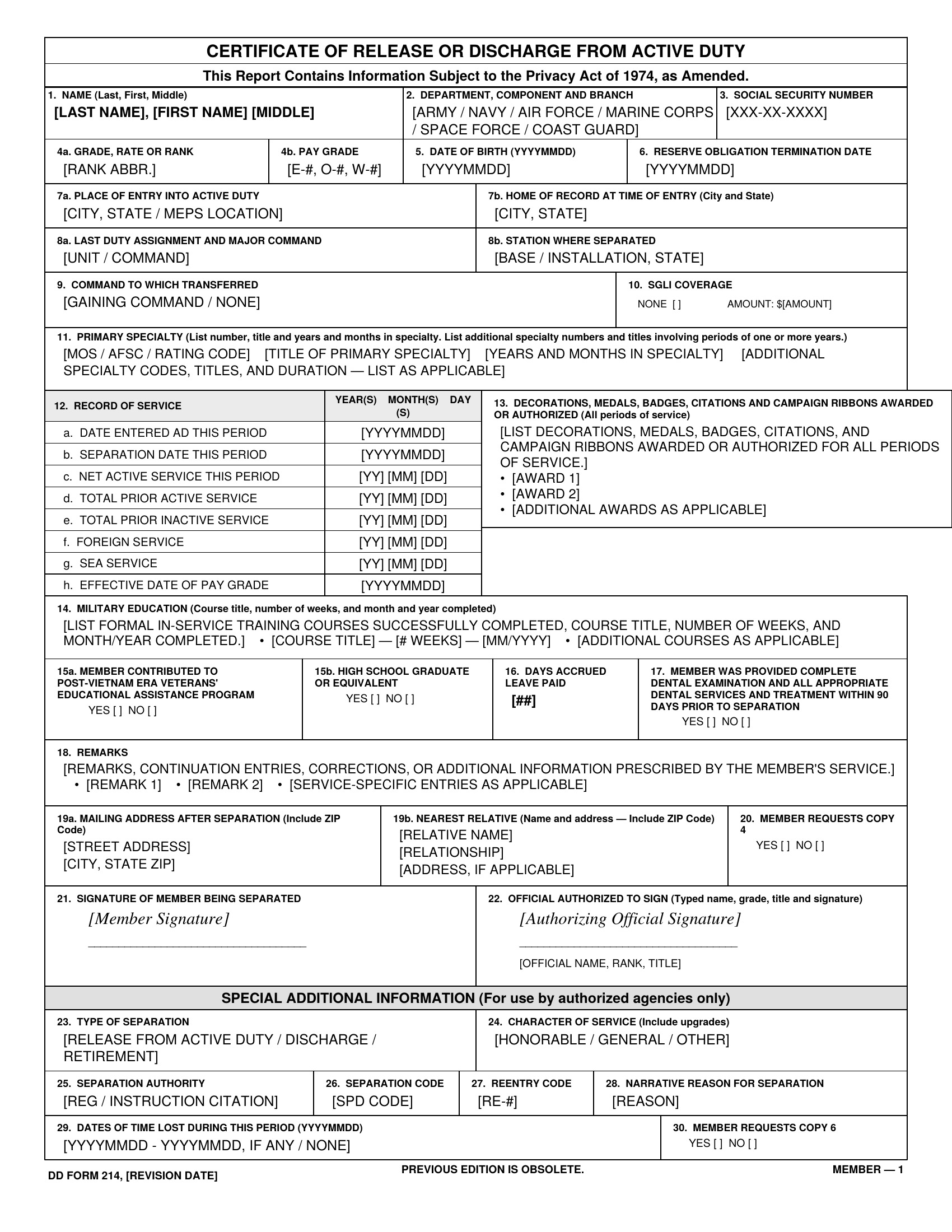
Sample DD Form 214. Your personal copy of this form (typically Member Copy 4) is your reference document, not the apostille-ready instrument. For apostille, you need a fresh certified copy from the National Personnel Records Center (NPRC) — bearing the NPRC certifying officer‘s signature and seal — and then the federal apostille from the U.S. Department of State.
10+ Years
Federal Experience
D.C. Based
Hand-Delivered Submissions
Full Coverage
All Federal Documents
Worldwide
Destination Coverage
On This Page
- What This Document Is
- Why You Cannot Apostille Your Personal Original
- Who Can Request a DD-214 (Privacy Rules)
- Methods to Obtain a Certified DD-214
- Method 1: eVetRecs (Online via National Archives)
- Method 2: milConnect (Recent Veterans)
- Method 3: Standard Form 180 (SF-180)
- Method 4: Direct from Your Service Branch
- Method 5: State Veterans Affairs Office
- Method 6: In-Person at NPRC
- Requesting as Next of Kin
- Emergency / Expedited Requests
- National Personnel Records Center Contact
- What a Certified DD-214 Looks Like
- The Federal Apostille Chain for DD-214
- Step-by-Step Apostille Process
- Common Reasons for Rejection
- Non-Hague Destinations: Embassy Legalization
- Processing Times & Validity
- Why Choose Us
- Frequently Asked Questions
What This Document Is
The DD Form 214, Certificate of Release or Discharge from Active Duty, is the official record issued by the U.S. Department of Defense upon a service member‘s separation from active duty in any branch of the U.S. armed forces (Army, Navy, Air Force, Marine Corps, Space Force, Coast Guard). It records the dates and character of service, primary specialty, awards and decorations, military education, and the reason for separation.
Abroad, the DD-214 is commonly required for:
- Long-stay visas and residency permits — many countries require proof of military service history as part of the visa background package.
- Foreign employment — particularly in security, defense-related, government-adjacent, or veteran-preference roles offered abroad.
- Dual citizenship and citizenship-by-descent applications — some countries credit military service in the application or require proof of discharge in good standing.
- Foreign benefits programs — certain reciprocity and benefits agreements between the U.S. and allied countries credit U.S. military service.
- Foreign professional licensing — when military training counts toward a foreign professional credential (transportation, medical, mechanical specialties).
- Foreign retirement and pension applications for U.S. veterans residing abroad.
Why You Cannot Apostille Your Personal Original
When a service member separates, several copies of the DD-214 are produced — Member Copy 1, Member Copy 4 (most often retained by the veteran), and other copies routed to the service branch, the VA, and the National Archives. None of the personal member copies are apostille-ready by themselves. The reason is technical but important:
- The U.S. Department of State Office of Authentications authenticates documents by verifying the certifying official‘s signature against signature samples on file.
- The signatures on your personal Member Copy 4 are those of your separating command and the service member from the date of separation — which may be years or decades old, and which are not maintained on signature file at the Department of State.
- To apostille a DD-214, the Department of State needs a current certified copy bearing the signature and seal of a federal records authority whose signature is on file — most commonly the National Personnel Records Center (NPRC) in St. Louis, Missouri.
The takeaway: hold onto your personal DD-214 as your
reference, but plan to obtain a fresh certified copy from NPRC (or an
equivalent federal records authority) before initiating any apostille
process. Submitting your personal Member Copy 4 directly will result in
rejection.
Who Can Request a DD-214 (Privacy Rules)
Federal privacy law restricts who can request a veteran‘s military service records. The categories of authorized requesters are:
| Requester | Authority & Requirements |
|---|---|
| The veteran (alive) | Full access to their own records. Must verify identity (via ID.me for online requests, or signature for paper requests). |
| Next of kin (veteran deceased) | Spouse, parent, child, or sibling. Must provide proof of death (death certificate or obituary) and proof of relationship (birth certificate, marriage certificate, etc.). |
| Authorized representative | Attorney, agent, or service organization acting under a written authorization signed by the veteran. The authorization must be specific and recent. |
| Federal government agency | For official purposes, with appropriate authorization. |
| General public (62 years post-separation) | After 62 years from the date of separation, records become archival and are open to the public — but for a fee, and typically requiring purchase of the entire Official Military Personnel File. |
Methods to Obtain a Certified DD-214
There are several recognized methods. For most veterans, methods 1 (eVetRecs) and 3 (SF-180) are the most practical. Method 2 (milConnect) is faster for recent veterans. Methods 4 through 6 are available in specific circumstances.
| Method | Best For | Typical Turnaround | Cost |
|---|---|---|---|
| 1. eVetRecs (online) | Most veterans and next of kin | Often 10 days to 90 days | Free |
| 2. milConnect (DoD portal) | Recent separations (within last few years) | Same day to a few days | Free |
| 3. SF-180 by mail/fax | Veterans without internet access or with complex requests | Typically 90 days or longer | Free |
| 4. Direct from service branch | Very recent separations | Varies by branch | Free |
| 5. State Veterans Affairs office | Veterans who filed copy with state at separation | Varies by state | Varies by state |
| 6. In-person at NPRC | Local to St. Louis, by appointment | Same day to a few days | Free |
Important about Method 5: If you obtain a certified copy
from a state Veterans Affairs office (where you filed the DD-214 at the
state or county level after separation), the certification is a
state certification — not a federal one. In that case the
apostille route runs through the state Secretary of State, not the U.S.
Department of State. For the federal apostille route described on this
page, you need a federal certified copy from NPRC.
Method 1: eVetRecs (Online via National Archives)
eVetRecs is the National Archives‘ online portal for requesting military service records, including DD-214s. It is generally the fastest and most reliable method for veterans and next of kin.
How to Use eVetRecs
- Go to vetrecs.archives.gov.
- Verify your identity through the third-party service ID.me. This is a one-time setup involving a government ID and a selfie.
- Click "Start Request Online." Follow the prompts to provide:
- Veteran‘s full name (any name changes)
- Date and place of birth
- Social Security number (if assigned during service) or service number
- Branch of service
- Approximate dates of service
- If next of kin: relationship to veteran, proof of death
- Specify what you need: a certified copy of the DD-214 for international use (apostille).
- Submit. You will receive a tracking request number.
What to Expect
- Standard processing: NPRC publishes targets, but actual turnaround varies. Plan for several weeks to 90 days for routine requests; emergency and natural disaster requests are faster.
- The certified copy arrives by U.S. mail to the address on the request.
- The certified copy will bear NPRC certification language, an NPRC certifying officer‘s signature, the NPRC seal, and the current date of certification.
- This is the apostille-ready document.
Method 2: milConnect (Recent Veterans)
milConnect is the U.S. Department of Defense‘s portal for service members, veterans, and dependents. For recently separated veterans, milConnect can provide a DD-214 faster than NPRC because the record is still active in DoD systems before transfer to the National Archives.
How to Use milConnect
- Go to milconnect.dmdc.osd.mil.
- Log in with your DS Logon (Department of Defense Self-Service Logon) or Common Access Card (CAC).
- Navigate to Correspondence/Documentation → Defense Personnel Records Information (DPRIS).
- Request your DD Form 214.
- Print the certified copy or request a hard-copy certified version for apostille purposes.
Apostille note: The milConnect-issued DD-214 may be an
electronic format suitable for benefits applications but not directly
apostille-ready. For apostille, you typically still need a hard-copy
certified document with original (wet) signature and seal from a recognized
federal records authority. Confirm the format before submitting for
apostille.
Method 3: Standard Form 180 (SF-180) by Mail or Fax
Standard Form 180, Request Pertaining to Military Records, is the paper alternative to eVetRecs. It works for any veteran or next of kin and is the fallback when online methods are not available.
How to Submit an SF-180
- Download the SF-180 from archives.gov or obtain a copy from a VA office, Veterans Service Officer, or veterans service organization.
- Complete all fields with as much detail as possible:
- Veteran‘s full name (and any other names used in service)
- Date and place of birth
- Social Security number and/or service number
- Branch of service
- Exact or approximate dates of service
- What you are requesting (a certified copy of the DD-214 for international use)
- Purpose (apostille for foreign use)
- Sign and date the form. The signature must be the veteran‘s own (or, for deceased veterans, the next of kin‘s, with proof of death and relationship attached).
- Mail or fax to the National Personnel Records Center:
- Mail: National Personnel Records Center, Military Personnel Records, 1 Archives Drive, St. Louis, MO 63138
- Fax: 314-801-9195
What to Expect
- Standard processing: typically 90 days, sometimes longer for records requiring search of older or pre-1973-fire archives.
- The certified copy arrives by U.S. mail to the address on the form.
- Express shipping (FedEx, UPS, Priority Mail) of your request to NPRC does not speed processing — the request is queued the same way regardless of how it arrived.
Method 4: Direct from Your Service Branch
For very recent separations (typically within the last 1 to 2 years), the service branch‘s personnel records office may still hold the DD-214 before transfer to NPRC. Each branch maintains its own records process:
- Army: U.S. Army Human Resources Command (HRC), Fort Knox, KY.
- Navy: Bureau of Naval Personnel (BUPERS), Millington, TN.
- Air Force / Space Force: Air Force Personnel Center (AFPC), Joint Base San Antonio-Randolph, TX.
- Marine Corps: Manpower Management Support Branch (MMSB), Quantico, VA.
- Coast Guard: Coast Guard Personnel Service Center (PSC), Washington, D.C.
Method 5: State Veterans Affairs Office
At separation, a copy of the DD-214 is sent to the state Veterans Affairs office of the veteran‘s home state. Many veterans also file their DD-214 with the county recorder or clerk of their home county for local recording.
These copies can be useful as a backup reference, but for federal apostille purposes there is an important distinction:
- If the certified copy is issued by a state agency (state veterans affairs office, county clerk, county recorder), the certification is a state act — and the apostille goes through the state Secretary of State, not the U.S. Department of State.
- If the certified copy is issued by the federal NPRC, the certification is a federal act — and the apostille goes through the U.S. Department of State.
Both routes are valid for foreign use, but they are different chains. Choose the route at intake based on which certified copy you can obtain most efficiently.
Method 6: In-Person at NPRC
For veterans local to St. Louis, in-person visits to the National Personnel Records Center are accepted on an appointment basis. Walk-ins are not generally permitted; call to schedule.
- Address: 1 Archives Drive, St. Louis, MO 63138
- Phone: 314-801-0800
- Appointment scheduling: via the phone number above or through the NPRC website.
An in-person visit can be faster than mail/online processing when the records are readily accessible and you can produce identity and (if applicable) next-of-kin documentation on the spot.
Requesting as Next of Kin
If the veteran is deceased, next of kin (spouse, parent, child, or sibling) may request the DD-214 with additional supporting documentation:
- Proof of veteran‘s death — a certified death certificate, obituary, or letter from the funeral director.
- Proof of relationship — birth certificate (for child or sibling), marriage certificate (for spouse), or other vital record establishing relationship.
- Identification of the requester — the next of kin‘s own government-issued ID.
Next-of-kin requests are accepted via eVetRecs, SF-180, and in-person at NPRC. Online requests will prompt for upload of the supporting documents during the ID.me process.
Emergency / Expedited Requests
NPRC accepts emergency requests for time-sensitive situations:
- Funeral / interment of the veteran: NPRC will expedite to provide the discharge document needed for military honors, burial at a national cemetery, or veterans benefits at death.
- Medical emergency: when the veteran‘s military medical history is urgently needed for treatment decisions.
- Natural disaster: if the veteran lost their DD-214 in a disaster (hurricane, flood, fire), NPRC offers priority service. Mark "Natural Disaster" on the SF-180 or eVetRecs comments section.
Emergency requests can sometimes be processed within days. To request emergency processing: call NPRC at 314-801-0800, or mark the request clearly as emergency on the SF-180 or in the eVetRecs comments. Funeral directors can also assist with emergency requests for burial purposes.
Apostille deadlines: a foreign filing deadline does not
qualify as an NPRC emergency. Plan your apostille timeline backward from
the foreign deadline, allowing typical NPRC time (10 days to 90 days), plus
federal apostille time (10 to 12 business days), plus embassy time if
non-Hague (3 days to 4 weeks).
National Personnel Records Center Contact
| Address | National Personnel Records Center Military Personnel Records 1 Archives Drive St. Louis, MO 63138 |
| Phone | 314-801-0800 |
| Fax | 314-801-9195 |
| Online portal | vetrecs.archives.gov |
| Information page | archives.gov/personnel-records-center |
| Records held | Generally, military service records less than 62 years past separation; older records become archival and require purchase of the full Official Military Personnel File. |
What a Certified DD-214 Looks Like
An apostille-ready certified DD-214 will display the following:
- The underlying DD-214 form, either as the original or a clear reproduction attached to the certification cover.
- An NPRC certification page (or certification stamp
on the document) containing:
- NPRC certifying officer‘s typed name and title.
- NPRC certifying officer‘s original (wet) signature.
- The NPRC official seal (raised, embossed, or inked).
- Recent date of certification.
- Certification language such as "I certify that this is a true and correct copy of the original document on file at the National Personnel Records Center..."
- The pages of the DD-214 securely attached to the certification.
If your certified copy does not contain all of these elements, it is likely not apostille-ready. Request a corrected certification or a replacement from NPRC.
The Federal Apostille Chain for DD-214
With the certified copy in hand, the apostille chain for a DD-214 is:
STEP 1
NPRC Certified Copy
Issued by National Personnel Records Center
→
STEP 2
U.S. Department of State
Federal apostille of NPRC signature
→
STEP 3
Embassy or Consulate
Only if destination is non-Hague
For Hague Convention destinations (Mexico, Spain, Italy, Germany, UK, Brazil, Japan, China since 2023, the UAE since 2024, and most other major economies), the chain ends at Step 2.
For non-Hague destinations (Saudi Arabia, Qatar, Kuwait, Egypt, Vietnam, Iran, Iraq, Pakistan, and others), the chain extends to Step 3 — embassy or consulate legalization in Washington, D.C., usually with certified translation.
Step-by-Step Apostille Process
1
Confirm Your Personal Copy Cannot Be Apostilled Directly
Your Member Copy 4 (or other personal copies) is your reference. For apostille, you need a fresh certified copy from a federal records authority (most commonly NPRC).
2
Request a Certified Copy from NPRC
Submit a request via eVetRecs (Method 1, fastest for most), milConnect (Method 2, for recent veterans), SF-180 by mail or fax (Method 3, paper fallback), or one of the other methods above. Specify the request is for international apostille use.
3
Receive and Verify the Certified Copy
When the certified copy arrives, verify that it contains the NPRC certifying officer‘s signature, NPRC seal, and recent date of certification. The NPRC certification page is what the U.S. Department of State will authenticate.
4
Submit for Federal Apostille
Send the NPRC-certified copy to us, or directly to the U.S. Department of State Office of Authentications in Washington, D.C. We hand-deliver the document and request the apostille (for Hague destinations) or authentication certificate (for non-Hague destinations).
5
Embassy Legalization (Non-Hague Destinations Only)
For non-Hague destinations, we submit the apostilled document to the destination country‘s embassy or consulate in Washington, D.C. for final legalization.
6
Certified Translation & Return Shipping
If your destination requires translation, we provide certified translations alongside the apostille. Final delivery is via tracked, insured shipping worldwide — to you, to your foreign address, or directly to the receiving foreign authority.
Common Reasons for Rejection
1. Personal Member Copy Submitted Without NPRC Certification
The most common rejection. Your personal copy of the DD-214 (Member Copy 4) bears the signatures from the original separation — not from a current federal records officer. The U.S. Department of State cannot authenticate it. Fix: request a fresh certified copy from NPRC.
2. Photocopy of an NPRC-Certified Copy
The U.S. Department of State authenticates original certifications, not photocopies of certified copies. Fix: request multiple originals from NPRC if you need multiple apostilles.
3. NPRC Certification Date Too Old
Many non-Hague country embassies require certifications issued within the last 3 to 6 months. Fix: request a fresh certified copy from NPRC shortly before initiating the apostille chain.
4. State Apostille Attempted on NPRC-Certified Copy
An NPRC-certified copy is a federal document — it must go to the U.S. Department of State, not to any state Secretary of State. Fix: route the federally-certified copy through the federal apostille process.
5. Federal Apostille Attempted on State-Certified Copy
Conversely, a DD-214 certified by a state veterans affairs office or county recorder is a state-certified document — it must go through that state‘s Secretary of State, not the U.S. Department of State. Fix: match the apostille route to the certifying authority.
6. Missing Embassy Translation (Non-Hague Destinations)
Many non-Hague embassies require certified translation into the destination language. Fix: coordinate certified translation alongside the apostille.
7. Records Could Not Be Located by NPRC
If NPRC reports the veteran‘s records cannot be located — particularly relevant for Army records affected by the 1973 NPRC fire — alternate reconstruction methods exist (Alternate Records Reconstruction). NPRC can identify substitute documents that may serve a similar purpose abroad. Fix: contact NPRC to discuss reconstruction options.
Non-Hague Destinations: Adding Embassy Legalization
For destinations that are not Hague Convention members, the federal apostille is not the final step. The document must also be legalized by the destination country‘s embassy or consulate in Washington, D.C. Common non-Hague destinations for DD-214 use include Saudi Arabia, Qatar, Kuwait, Egypt, Vietnam, Iran, Iraq, Pakistan, and certain African countries.
Most of these destinations also require certified translation into the destination‘s official language (Arabic for Gulf states, Vietnamese for Vietnam, Farsi for Iran, Urdu for Pakistan). Plan for translation time alongside the apostille and embassy stages.
Hague Convention membership shifts periodically — China joined in 2023, the UAE and Canada joined in 2024. Documents bound for those destinations no longer require embassy legalization.
Processing Times & Validity
- NPRC certified copy (Method 1 eVetRecs or Method 3 SF-180): typically 10 days to 90 days for routine requests. Plan for 60 to 90 days for older or complex records.
- NPRC certified copy via emergency request: sometimes within days for funeral, medical emergency, or natural disaster situations.
- milConnect (Method 2, recent veterans): often same-day to a few days.
- U.S. Department of State Office of Authentications: currently 10 to 12 business days for routine federal apostille. Expedited service available through our office.
- Embassy / consulate legalization (non-Hague only): 3 business days to 4 weeks, varies by destination country.
- Certified translation: typically 3 to 7 business days, depending on the destination language.
- Total realistic timeline — Hague destination: 4 to 14 weeks (mostly NPRC time).
- Total realistic timeline — non-Hague destination: 6 to 18 weeks (NPRC + apostille + embassy + translation).
Use our Processing Time Estimator for a destination-specific projection.
Why Choose Federal Apostille and Notary Processing
- End-to-end coordination. We can request the NPRC certified copy on your behalf (with your signed authorization) and carry the document through the federal apostille and embassy stages.
- Federal-document focus. Our workflow is built around the U.S. Department of State Office of Authentications — the only path for an NPRC-certified DD-214.
- D.C. proximity. Our office at 1050 Connecticut Ave NW is steps from the U.S. Department of State and the major embassies. We hand-deliver, not mail.
- Embassy legalization in-house for non-Hague destinations (Saudi Arabia, Qatar, Kuwait, Egypt, Vietnam, Iran, Iraq, Pakistan, and others).
- Certified translation in-house in Arabic, Vietnamese, Farsi, Urdu, Spanish, and other languages required by non-Hague destinations.
- Veteran and dependent friendly. Many of our clients are veterans living abroad, dependents of deployed service members, or families managing affairs of deceased veterans. We work with U.S. embassies abroad to receive and ship documents.
- Worldwide tracked shipping via FedEx, UPS, and DHL.
- Real-time order tracking from intake through delivery.
Frequently Asked Questions
Can I just apostille my personal copy of the DD-214 (Member Copy 4)?
No. Your personal copy bears signatures from the original separation date — not a current federal records officer whose signature is on file with the U.S. Department of State. You must obtain a fresh certified copy from NPRC (or equivalent federal records authority) before the apostille process can begin.
How long is an NPRC certified copy valid for apostille?
For the apostille itself, the NPRC certification does not formally expire. However, many non-Hague country embassies require the certification to be issued within the last 3 to 6 months. For Hague destinations, the apostille is generally accepted regardless of how recently the certification was issued, though some receiving foreign authorities may apply their own freshness rules.
I am the next of kin of a deceased veteran — what do I need?
You can request the DD-214 through eVetRecs, SF-180, or in-person at NPRC. You must provide proof of the veteran‘s death (death certificate or obituary), proof of your relationship to the veteran (birth certificate, marriage certificate), and your own identity documents. Eligible next of kin include spouse, parent, child, and sibling.
I have a state-certified copy from my state veterans affairs office — can that be apostilled?
Yes, but through a different route. A state-certified DD-214 goes to that state‘s Secretary of State for apostille — not to the U.S. Department of State. Both routes produce valid apostilles for foreign use; the choice depends on which certified copy is most efficient to obtain. The federal route described on this page is the one applicable to NPRC-certified copies.
The veteran‘s records were affected by the 1973 NPRC fire — what now?
The 1973 fire at the NPRC destroyed approximately 16 to 18 million military personnel files (predominantly Army records from 1912 to 1959 and Air Force records from 1947 to 1963). NPRC has an Alternate Records Reconstruction process that uses other federal records — payroll, hospital admission, unit morning reports, VA records — to reconstruct service history. If full reconstruction is possible, NPRC can issue a substitute document (such as an NA Form 13038, Certification of Military Service) that serves the same purpose as a DD-214 for many uses, including some apostille applications. Discuss your situation with NPRC and, if needed, with us.
Can a veteran living abroad request a DD-214?
Yes. eVetRecs is accessible from anywhere; the certified copy can be mailed internationally (though shipping times are longer). U.S. embassies and consulates abroad can assist with identity verification and forwarding of documents in some cases. For apostille work, the certified copy must reach a U.S. address to be carried into the U.S. Department of State — we can receive the document for you at our D.C. office.
What if the veteran‘s name changed (marriage, legal name change)?
Provide both names on the request: the name as it appeared in service (which is the name on the original DD-214) and any current name. NPRC will search under the service-era name. If you need the certified copy to reflect the current name, a legal name change document (marriage certificate, court order) can be requested alongside.
How many certified copies should I request from NPRC?
Request as many as you need — each will be a separately certified original. If you plan to apostille multiple copies (for use in multiple countries, multiple agencies, or different proceedings), request the full number of originals from NPRC at the outset. Photocopies of a single certified copy will not be accepted for apostille.
I have a hard foreign deadline — can the process be expedited?
The NPRC stage cannot be expedited for ordinary foreign deadlines — emergency processing is limited to funeral, medical, and natural disaster situations. The U.S. Department of State federal apostille stage can be expedited through our office (typically 1 to 5 business days). Embassy stages vary by country; some are fast (a few days), others are slow (several weeks). Plan backward from the deadline, and start the NPRC request as early as possible.
Does my VA disability rating decision work as a substitute for a DD-214?
No — they serve different purposes and are different documents. A VA disability rating decision (or VA Benefit Verification Letter) is useful for income and disability proof but does not establish dates and character of service the way a DD-214 does. For purposes requiring service-history proof, the DD-214 is the canonical document. VA documents follow a separate federal apostille route (see our VA document page).
Do you handle older WD AGO and NAVPERS discharge documents?
Yes. Before 1950, the armed services used several different discharge document forms (WD AGO 53, WD AGO 55, WD AGO 53-55, NAVPERS 553, NAVMC 78, and others). For veterans separated before the DD-214 era, the equivalent discharge document is the apostille-eligible record. NPRC can certify these older forms in the same way it certifies a DD-214, and the federal apostille process is the same.
Ready to Apostille Your DD-214?
Federal apostille of NPRC-certified DD-214s at the U.S. Department of State. Embassy legalization for non-Hague destinations handled in-house. Certified translation in Arabic, Vietnamese, Farsi, Urdu, and other languages. We can also coordinate the NPRC request on your behalf with your signed authorization.
Start My Order Call (760) 469-2997