Embassy Legalization — Notarization, State, Federal & Consular Authentication | Federal Apostille
Embassy Legalization & Consular Authentication
Need to use U.S. documents in a country that does not accept the Hague Apostille? Whether you are applying for a residency visa in the United Arab Emirates, getting married in Vietnam, registering a child's birth in Lebanon, opening a company in Qatar, or licensing a U.S. degree for employment in Egypt, your documents must be fully legalized through the destination country's embassy or consulate before they will be accepted abroad. Embassy legalization is a strict multi-stage chain that begins with notarization, passes through the state Secretary of State and the U.S. Department of State, and ends at the embassy or consulate of the receiving country.
At Federal Apostille and Notary Processing, we manage the entire legalization chain end-to-end. Our office is located in Washington, D.C., steps from the U.S. Department of State and within walking distance of most foreign embassies on Embassy Row. We notarize your documents in-house, route them through the appropriate state Secretary of State, hand-deliver to the U.S. Department of State Office of Authentications, and submit to the destination country's embassy or consulate using each mission's required intake method. Our nationwide network and Washington, D.C. proximity make this process fast, secure, and predictable regardless of where you are located.
🌍25+ Non-Hague Countries Served
✓Full Chain Handled In-House
⏱2–6 Weeks (Most Destinations)
🏛Steps from U.S. Dept. of State
25+
Non-Hague Countries
Routinely Processed
Routinely Processed
All 50
U.S. States
Covered Nationwide
Covered Nationwide
5-Stage
Legalization Chain
Managed End-to-End
Managed End-to-End
DC
Office Steps from
Dept. of State & Embassies
Dept. of State & Embassies
Who Needs Embassy Legalization?
Anyone using U.S. documents in a country that has not joined the Hague Apostille Convention — including the UAE, Egypt, Kuwait, Qatar, Lebanon, Iraq, Iran, Taiwan, Vietnam (until Sept 2026), Thailand, Cuba, and most of Sub-Saharan Africa for non-Hague destinations.
Why Apostille Is Not Enough
The Hague Apostille is recognized only between Contracting Parties to the 1961 Convention. For countries outside the treaty, an apostille has no legal effect. The destination country's embassy must apply its own legalization for the document to be accepted abroad.
Hague vs. Non-Hague Countries
The Hague Convention has 129 Contracting Parties as of 2026. Documents going to those countries need a single apostille. Documents going to non-Hague countries require the full embassy legalization chain described on this page.
Real Embassy Legalization & Consular Attestation Examples
Below are real examples of completed embassy legalizations and consular attestations from our active casework — including consular legalization seals applied by foreign embassies in Washington, D.C. and final destination-country ministry attestation certificates. Each represents the closing stage of a document's authentication chain, after the U.S. notarization, state Secretary of State certification, and U.S. Department of State authentication have been completed.
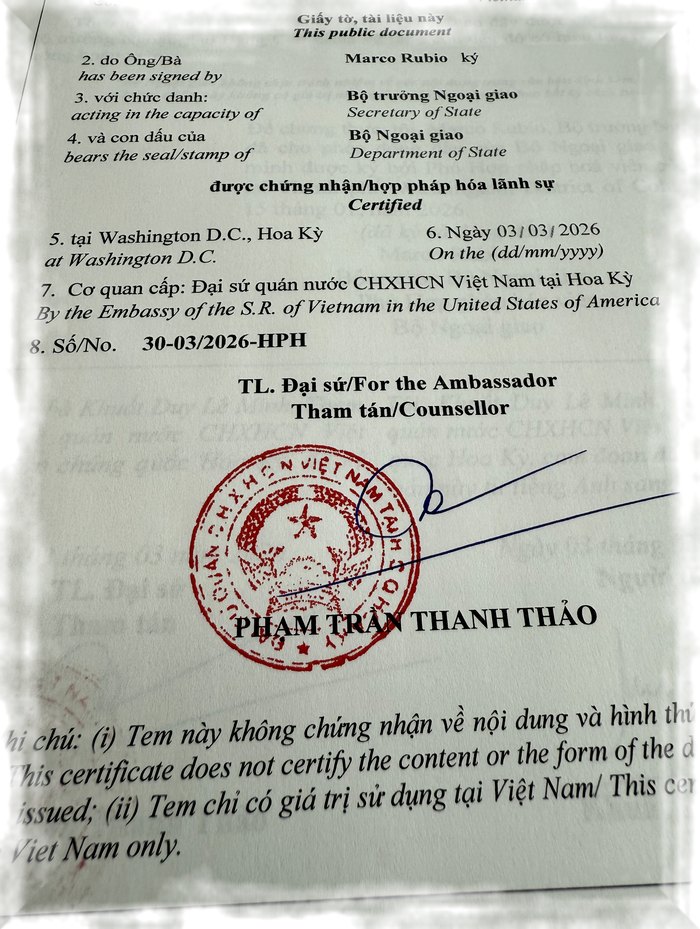
Embassy of Vietnam — Consular Legalization Seal
Washington, D.C. · Final stage for Vietnam-bound U.S. documents
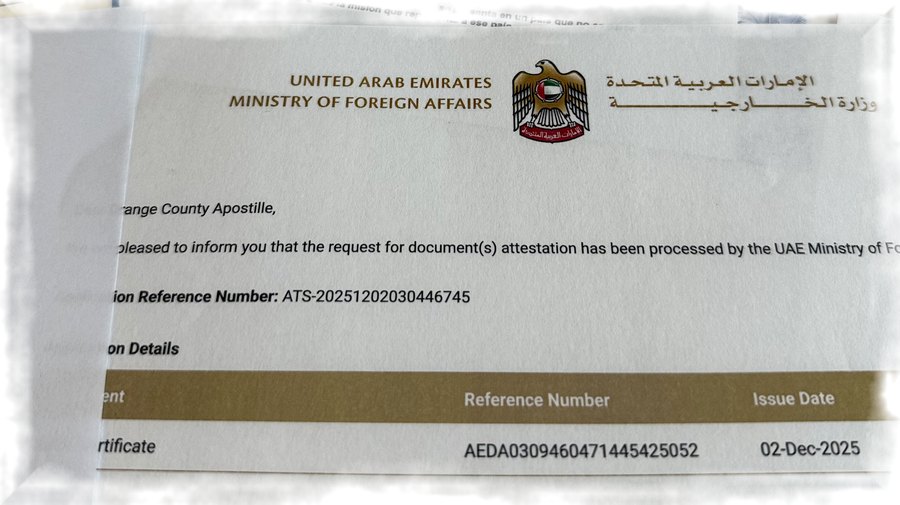
UAE MoFAIC — Final Destination Attestation
Ministry of Foreign Affairs & International Cooperation · UAE
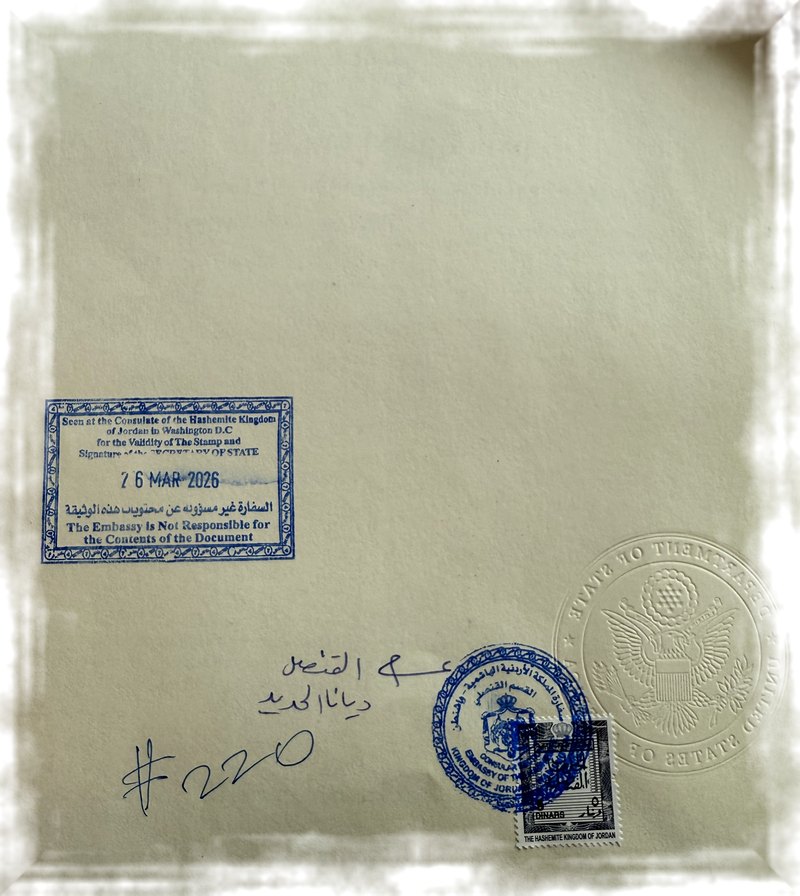
Embassy of Jordan — Consular Legalization Stamp
Washington, D.C. · Final stage for Jordan-bound U.S. documents
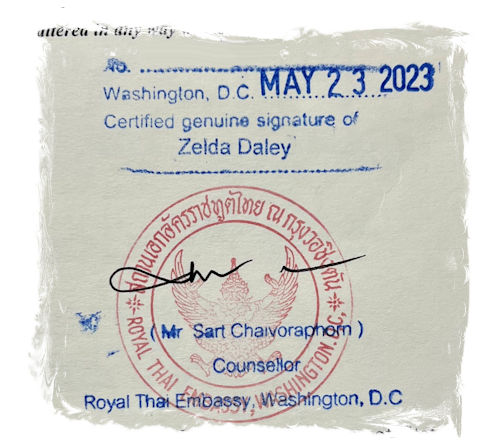
Royal Thai Embassy — Consular Legalization Seal
Washington, D.C. · Final stage for Thailand-bound U.S. documents
Documents We Legalize for Non-Hague Countries
We handle the full legalization chain for virtually every category of U.S. public and private document destined for non-Hague countries. The table below shows the most frequently legalized document types, with notes on their common international uses.
| Document Type | Description | Common International Uses |
|---|---|---|
| Birth Certificates | State-issued vital records of birth from any U.S. state, D.C., or territory | Family residency, dual-nationality registration, school enrollment, inheritance |
| Marriage Certificates | State or county-issued marriage records | Spousal visas, family sponsorship, civil registration abroad, inheritance |
| Divorce Decrees & Court Judgments | Final decrees, custody orders, and certified court records | Foreign remarriage, custody recognition, asset division, family law proceedings |
| Single-Status Affidavits | Sworn statements of marital eligibility | Marriage abroad in the UAE, Vietnam, Thailand, and most non-Hague countries |
| Death Certificates | State-issued vital records of death | Inheritance, probate, repatriation, foreign benefits claims |
| Powers of Attorney | Notarized POAs for property, banking, litigation, or family matters | Real estate transactions, bank account management, court representation abroad |
| FBI Background Checks | FBI Identity History Summary, apostilled at the federal level | Work visas, residency permits, employment licensing in non-Hague countries |
| Educational Diplomas & Transcripts | University, college, and high school records | Employment licensing, academic recognition, professional credentialing |
| Corporate Documents | Articles of incorporation, certificates of good standing, board resolutions | Company formation, branch registration, commercial agency agreements |
| Commercial Invoices & Certificates of Origin | Trade documents for international goods movement | Customs clearance, free-trade-zone import/export |
| Medical Records & Pharmaceutical Documents | Patient records, FDA documents, GMP certificates | Treatment abroad, pharmaceutical registration, medical licensing |
| Affidavits & Sworn Declarations | Notarized statements of fact for foreign use | Court proceedings, inheritance, identity verification, family matters |
Not sure if your document qualifies? Contact us at (760) 469-2997 or email submissions@federalapostille.org — we confirm eligibility and route at no charge.
Understanding Embassy Legalization
Embassy legalization is not a single transaction. It is a sequence of authentications, each issued by a different authority, where each stage validates the one before it. If any stage is skipped or performed out of order, the embassy will reject the document. The comparison table below shows the difference between the apostille pathway (Hague countries) and the embassy legalization pathway (non-Hague countries).
Apostille vs. Embassy Legalization
| Feature | Hague Country (Apostille) | Non-Hague Country (Embassy Legalization) |
|---|---|---|
| Step 1 | Notarization (if required) | Notarization (if required) |
| Step 2 | State or federal apostille | State Secretary of State certification |
| Step 3 | Done — apostille is the final step | U.S. Department of State authentication |
| Step 4 | N/A | Embassy or consulate legalization |
| Step 5 | N/A | In-country ministry attestation (typical) |
| Processing Time | 2 business days + shipping | 2–6 weeks total |
| Example Countries | Spain, Italy, Germany, France, Japan, South Korea, Australia, UK, Brazil, Mexico | UAE, Egypt, Kuwait, Qatar, Lebanon, Iraq, Iran, Taiwan, Vietnam, Thailand, Cuba |
Why the Chain Is Strict
Each stage of the chain authenticates the signature and seal of the previous stage — not the underlying content of the document. The state Secretary of State authenticates the notary's commission. The U.S. Department of State authenticates the state Secretary of State's seal. The destination embassy authenticates the U.S. Department of State's seal. This chain of authentication is how foreign governments trust U.S. documents.
Step 1: Notarization or Document Issuance
The first step in the legalization chain depends on the type of document. Private documents (affidavits, powers of attorney, signed declarations, corporate resolutions) must be executed before a licensed notary public. Public documents (vital records, court records, FBI background checks) are issued directly by the government office of record and skip this step.
What the Notary Does
- Acknowledgment: Notary verifies the signer's identity and willingness to sign the document.
- Jurat: Document holder signs an oath before the notary swearing the document's truthfulness.
- Certified True Copy: Notary compares original to photocopy and certifies it as a true and unaltered reproduction (where state law allows).
Notarial Format Matters for Non-Hague Destinations
Many non-Hague countries require specific notarial formats — for example, Arab Gulf countries often require jurats with bilingual acknowledgment language, while Latin American countries may require Spanish-language jurats. We match the notarial format to the destination country's expectations during intake.
We Handle Notarization for You
You do not need to find your own notary. When you submit your documents through our service, we coordinate notarization in-house using formats matched to your destination. Simply mail your original documents to our Washington, D.C. office.
Step 2: State Secretary of State Certification
After notarization (or directly, for state-issued public documents), the document is submitted to the Secretary of State in the state where the notary is commissioned or the document was issued. The Secretary of State certifies the notary's commission or the issuing official's signature.
State Certification: 2 Business Days
State certification is the fastest stage of the chain. We coordinate with all 50 state Secretary of State offices and arrange the most efficient routing for your state of issue. For documents from multiple states, we handle each state in parallel.
County Clerk Pre-Certification
Some states require an intermediate county clerk certification before the document reaches the Secretary of State — particularly for documents from New York (county clerk certification required before NYS Secretary of State) and certain other jurisdictions. We handle the intermediate step as part of state routing.
Ready to Start Your Embassy Legalization?
Submit your documents through our secure online portal. We handle notarization, state certification, U.S. Department of State authentication, embassy legalization, and return shipping — start to finish.
Step 3: U.S. Department of State Authentication
For documents bound for non-Hague countries, the U.S. Department of State Office of Authentications in Washington, D.C. applies the federal-level authentication that the destination embassy will require. This stage is mandatory and cannot be skipped — the destination embassy will not accept a document that has not been authenticated by the U.S. Department of State.
Hand-Delivery from Our Washington, D.C. Office
Our office is located at 1050 Connecticut Ave NW, Ste 500 — a short distance from the U.S. Department of State Office of Authentications. We hand-deliver and retrieve documents directly, which avoids mail-handling delays and gives us the fastest possible turnaround at this stage.
Standard Processing: 10–12 Business Days
Standard processing through the U.S. Department of State takes approximately 10–12 business days from the date of submission. Documents are accepted at the public counter, processed, and returned to us once authentication is complete.
Step 4: Embassy or Consulate Legalization
Once the U.S. Department of State authentication is complete, the document is submitted to the destination country's embassy or consulate in the United States. The embassy reviews the chain of certifications and applies its own legalization stamp, sticker, or sealed certificate. Each embassy sets its own intake rules, format requirements, fee structure, and turnaround time — and many embassies maintain regional consulates with defined consular jurisdictions.
Common Non-Hague Destinations
Below are several of the highest-volume non-Hague destinations we process. The full directory of country-specific pages appears at the bottom of this page.
🇦🇪 United Arab Emirates
UAE MoFAIC requires full authentication chain for employment visas, family residency, real-estate transactions, and free-zone company formation. Arabic translation required for most uses.
Embassy processing: 2–5 business days
🇪🇬 Egypt
Egyptian consulates maintain strict regional jurisdictions — D.C., New York, Los Angeles, Houston, Chicago. Routing depends on the state of issue.
Embassy processing: 3–7 business days
🇰🇼 Kuwait
Kuwaiti Embassy in Washington, D.C. serves the entire United States. Required for employment licensing, family residency, and business operations.
Embassy processing: 4–8 business days
🇶🇦 Qatar
Qatari consular jurisdiction is split between the Embassy in Washington, D.C. and the Consulate General in Houston. Required for work visas and QFC/QFZ business filings.
Embassy processing: 5–10 business days
🇹🇼 Taiwan (TECRO/TECO)
Authentication handled by TECRO in D.C. and 12 regional TECO offices, as the U.S. and Taiwan do not maintain official diplomatic relations.
Embassy processing: 3–7 business days
🇻🇳 Vietnam — transitional
Vietnam joined the Hague Convention with EIF on 11 September 2026. Until then, embassy legalization is required through Washington, D.C., San Francisco, Houston, or New York consulates.
Embassy processing: 5–10 business days
Step 5: In-Country Ministry Attestation
A number of non-Hague countries — notably in the Gulf, Levant, and parts of Africa and Asia — require the legalized document to be presented to the Ministry of Foreign Affairs (MoFA) in the destination country before it can be used domestically. This stage is handled in-country, not in the United States, but it should be planned for in your overall timeline.
Common In-Country Attestation Authorities
- UAE: Ministry of Foreign Affairs and International Cooperation (MoFAIC)
- Egypt: Ministry of Foreign Affairs, then receiving ministry (Health, Education, etc.)
- Kuwait, Qatar, Saudi Arabia, Bahrain: Ministry of Foreign Affairs
- Lebanon: Ministry of Foreign Affairs and Emigrants
- Iraq, Jordan: Ministry of Foreign Affairs
- Vietnam, Thailand, Cambodia: Ministry of Foreign Affairs
Processing Timeline
Embassy legalization timelines vary significantly by destination country. Below is a representative timeline for the most common scenarios.
Path A: Standard Non-Hague (e.g., UAE, Egypt, Kuwait, Qatar)
Notarize + State
2 business days
Federal Auth
10–12 biz days
Embassy
2–10 days
Shipping
1–5 days
Total: Approximately 3–4 weeks from receipt of documents to delivery.
Path B: Complex Destinations (e.g., Iran, Syria, Yemen, Afghanistan)
Notarize + State
2 business days
Federal Auth
10–12 biz days
Embassy / Alt
2–4 weeks
Shipping
1–5 days
Total: Approximately 5–8 weeks for countries with suspended embassies, restricted relations, or alternate routing (e.g., USACC for Syria).
Common Reasons for Embassy Legalization
🏢
International Employment
Work visas and employment licensing in non-Hague countries (UAE, Saudi Arabia, Qatar, China, Vietnam) require legalized educational, identity, and background check records.
💍
Marriage Abroad
Single-status affidavits, prior divorce decrees, and birth certificates must be legalized for marriage in Vietnam, the UAE, Egypt, Lebanon, and other non-Hague destinations.
🏠
Family Residency & Sponsorship
Sponsorship of spouses, children, and parents in Gulf countries and elsewhere requires legalized marriage and birth records.
🎓
Academic Recognition & Licensing
U.S. degrees, transcripts, and professional credentials must be legalized for licensing in foreign jurisdictions — medicine, engineering, law, teaching.
⚖
Foreign Court Proceedings
Court orders, judgments, powers of attorney, and affidavits used in non-Hague country litigation, custody, divorce, and inheritance proceedings.
🏦
Corporate & Commercial
Foreign company formation, commercial agency appointments, branch registration, free-zone licensing, and international trade documentation.
How to Submit Your Embassy Legalization Request
Submit your order through our secure online portal. The process is the same for every destination country.
-
Visit Our Online Order Portal
Go to www.federalapostille.org/submit-order. The form is available 24/7 and takes approximately 5–10 minutes. No account required.
-
Complete the Order Form
Fill out all required fields:
- Full legal name as it appears on your documents
- Email and phone for confirmations and status updates
- Mailing address for return delivery
- Destination country — determines the exact legalization chain
- Document type(s) — birth certificate, POA, diploma, etc.
- Number of documents and copies needed
- Special instructions — translation needs, deadlines, in-country end use
-
Receive Your Confirmation Email
You will receive a confirmation email with detailed mailing instructions, our office address, accepted payment methods, and a unique order reference number.
-
Prepare and Mail Your Documents
Your package should include:
- Original documents or official certified copies from the issuing office
- Printed copy of your confirmation email
- Payment — money order, cashier's check, or note of online payment
- Prepaid return shipping label (USPS Priority, FedEx, UPS, or DHL with tracking)
Mail to: Federal Apostille & Notary Processing, 1050 Connecticut Ave NW, Ste 500, Washington, DC 20036 -
We Process Your Documents Through the Full Chain
We handle notarization in-house (if needed), submit to the Secretary of State, hand-deliver to the U.S. Department of State, submit to the destination embassy or consulate, and monitor through each stage. You receive email updates at every milestone.
-
Authenticated Documents Returned to You
Your fully legalized documents are securely returned via your prepaid shipping label with tracking information emailed to you.
Document Requirements & Preparation
Original or Certified Copy Required
Submit the original or an official certified copy from the issuing authority. Photocopies, unofficial transcripts, and digital printouts are not accepted by most embassies.
Good Physical Condition
No tears, stains, water damage, whiteout, or unauthorized alterations. Laminated diplomas may need special handling — contact us first.
Official Seal or Signature Present
The document must bear the official seal and/or signature of the issuing authority, registrar, or court clerk.
Specify Destination Country
Tell us the exact destination country and the document's intended use. This determines the legalization chain, consular jurisdiction, and translation requirements.
Translation Requirements
Most non-Hague countries require certified translations. We arrange ATA-certified translations through Visa Translators LLC (ATA Member M-193212) — the translation must also be notarized and legalized.
Number of Copies Needed
Each copy requires its own separate legalization chain. Let us know the total so we prepare them simultaneously to save time and fees.
Pricing
| Service | Price | Processing Time | Includes |
|---|---|---|---|
| Embassy Legalization (Standard Non-Hague) | Contact for quote | 3–4 weeks | Notarization + state + federal + embassy + return shipping |
| Embassy Legalization (Complex Destination) | Contact for quote | 5–8 weeks | Same chain with extended embassy stage (Iran, Syria, Yemen) |
| Certified Translation | Contact for quote | 2–5 business days | ATA-certified translation + notarization + apostille/legalization |
| Multi-Document Discount | Contact for quote | Same as above | Discounted rate for 3+ documents to same destination |
Embassy fees vary widely by destination country and document type. Shipping fees are separate. Return shipping within the U.S. via USPS Priority Mail is typically $8–12. International shipping available worldwide.
Why Choose Federal Apostille for Embassy Legalization?
🏛
Washington, D.C. Office
Walking distance to the U.S. Department of State and most foreign embassies. Hand-delivery means no mailroom delays at the federal stage.
📝
In-House Notarization
No need to find your own notary. We handle notarization with formats matched to your destination country's expectations.
🌐
25+ Non-Hague Countries
Established routing for the UAE, Egypt, Kuwait, Qatar, Lebanon, Iraq, Iran, Syria, Taiwan, Vietnam, Thailand, and more.
🔤
Translation Coordination
Certified and sworn translation through Visa Translators LLC (ATA Member M-193212) in Arabic, Spanish, German, Vietnamese, Farsi, and more.
🔒
Secure Handling
Tracked custody from intake to return shipping. Your originals are protected through every stage of the chain.
📞
Dedicated Support
Phone (760) 469-2997 and email support with personalized guidance for your destination.
Get Your Documents Legalized Today
Whether you need legalization for the UAE, Egypt, Vietnam, Taiwan, or any other non-Hague destination — we handle every stage of the chain.
Frequently Asked Questions
What is embassy legalization and when is it required?
Embassy legalization is the final certification a U.S. document receives from the destination country's embassy or consulate before it can be used abroad. It is required when the destination country has not joined the Hague Apostille Convention. The process involves notarization, state Secretary of State certification, U.S. Department of State authentication, and finally embassy or consulate legalization.
How is embassy legalization different from an apostille?
An apostille is a single certificate accepted by all 129 Contracting Parties to the 1961 Hague Apostille Convention. Embassy legalization is the traditional multi-step process used when the destination country is not part of the Convention. Embassy legalization typically requires four to five stages stacked in a specific order, where each stage authenticates the previous stage's signature and seal.
Which countries require embassy legalization in 2026?
Non-Hague countries that require embassy legalization include the United Arab Emirates, Egypt, Kuwait, Qatar, Lebanon, Jordan, Iraq, Iran, Syria, Yemen, Afghanistan, Taiwan, Cambodia, Laos, Myanmar, Nepal, Sri Lanka, Nigeria, Kenya, Ghana, Ethiopia, Cuba, Haiti, and several others. Vietnam (Hague EIF 11 Sept 2026) and Thailand (accession pending) remain in the legalization workflow as of mid-2026.
How long does embassy legalization take?
Timelines vary by destination. State certification typically takes 2 business days, U.S. Department of State authentication 10–12 business days, and embassy or consulate legalization 2–21 business days depending on the country. Total processing time is approximately 3–4 weeks for standard destinations and 5–8 weeks for complex destinations.
Do I need a certified translation?
In many cases, yes. The destination embassy or in-country ministry may require a certified translation into the country's official language. Whether translation must be performed before or after legalization depends on the destination country's rules. We coordinate certified and sworn translation through Visa Translators LLC (ATA Member M-193212).
Can I send my document directly to the embassy?
Some embassies accept direct mail-in submissions; others require in-person appointments or accept submissions only through approved processing agents. We confirm the current submission method for each destination country before routing your document.
Why was my document rejected by the embassy?
The most common causes are missing prerequisite certifications, incorrect notarization format, missing or non-conforming translation, expired underlying documents, submission to the wrong consular jurisdiction, or document types the embassy will not accept. Pre-submission review eliminates most of these issues.
Do I need to be in Washington, D.C. to use this service?
No. We process embassy legalization for clients in all 50 states. Documents are mailed to our Washington, D.C. office where we coordinate the entire chain — notarization, state certification, U.S. Department of State authentication, and embassy legalization — before returning the documents via your prepaid return shipping label.
What is consular jurisdiction and why does it matter?
Many embassies divide the United States into consular districts handled by regional consulates. The state where your document is issued or notarized determines which embassy or consulate has authority over it. Sending a document to the wrong office is a common cause of rejection. We confirm the correct consular jurisdiction at intake.
What is the difference between an embassy and a consulate?
An embassy is the principal diplomatic mission of a country, typically located in Washington, D.C. A consulate is a regional office that handles consular services (including legalization) for a defined geographic district within the U.S. Many countries operate consulates in Los Angeles, New York, Houston, Chicago, San Francisco, and Miami.
Does my document need attestation in the destination country too?
For many non-Hague countries — especially in the Gulf, Levant, and parts of Africa — yes. The destination country's Ministry of Foreign Affairs typically applies a final attestation upon arrival before the document is accepted by the receiving authority. This stage is handled in-country and is separate from the U.S.-side legalization chain.
How much does embassy legalization cost?
Pricing varies by destination, document type, and complexity. Embassy fees themselves vary widely — some embassies charge a flat fee, others charge per page, and a few base fees on document value. Contact us for a destination-specific quote that includes all stages: notarization, state, federal, embassy, and return shipping.
Non-Hague Country Directory
Each destination country imposes its own format requirements, jurisdictional rules, fee structure, and acceptable document categories. Select the destination below for country-specific process guidance, common document categories, and consular routing notes.
Middle East & North Africa
🇦🇪United Arab Emirates
🇪🇬Egypt
🇰🇼Kuwait
🇶🇦Qatar
🇱🇧Lebanon
🇯🇴Jordan
🇮🇶Iraq
🇮🇷Iran
🇸🇾Syria
🇾🇪Yemen
🇦🇫Afghanistan
Asia & Pacific
🇹🇼Taiwan (TECRO)
🇻🇳Vietnam · transitional
🇹🇭Thailand · transitional
🇰🇭Cambodia
🇱🇦Laos
🇲🇲Myanmar
🇳🇵Nepal
🇱🇰Sri Lanka
Sub-Saharan Africa
Americas
Official Resources & Government Links
- U.S. Department of State — Office of Authentications
- HCCH — Hague Apostille Convention Status Table (Official)
- Hague Convention of 1961 — Full Text (HCCH)
- U.S. Department of State — Apostille Requirements
- U.S. State Department — Foreign Embassies in the United States
Related Authentication Services
All Services
- Academic Record Authentication
- Certified/Sworn Translation
- Consular Report of Birth Abroad (CRBA) Replacement Request
- DD-214 Request
- Embassy Legalization
- Federal Apostille
- ID Card/Passport Authentication
- National Archives Copies & Certified Records Request
- Naturalization Certificate Replacement & Name Change Request
- Online Notary Public
- Retirement & Benefit Verification Letters Request
- State-Level Apostille