

Merchant Mariner Service Record Apostille
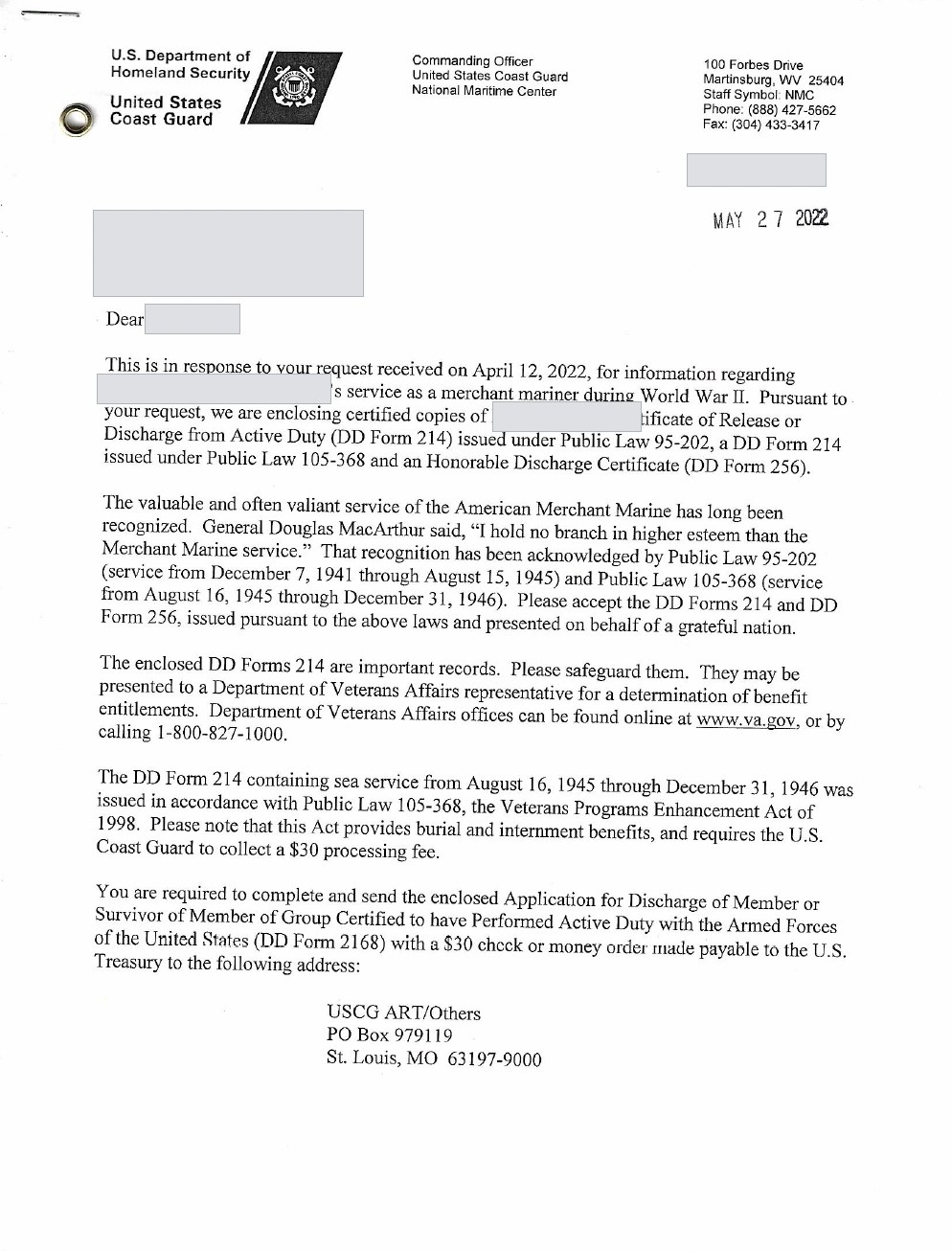
U.S. Coast Guard National Maritime Center Letter, DD Form 214 & DD Form 256 Authentication
Federal authentication of merchant mariner service records issued by the U.S. Coast Guard through the U.S. Department of State — for foreign benefit claims, citizenship-by-descent files, and estate matters abroad. Hand-delivered submission in Washington, D.C. Pre-submission review by federal-document specialists. Embassy legalization handled in-house for non-Hague countries.
What This Document Is
The U.S. Coast Guard National Maritime Center (NMC) in Martinsburg, West Virginia is the Coast Guard's credentialing authority for American merchant mariners and the custodian of merchant mariner service records, including World War II-era personnel files. When a mariner or a surviving family member establishes qualifying wartime sea service, the NMC issues federal discharge documents under a transmittal letter on U.S. Coast Guard letterhead.
A typical NMC issuance includes:
- A transmittal letter from the Commanding Officer, National Maritime Center, bearing a case reference number and the date of issue
- DD Form 214 — Certificate of Release or Discharge from Active Duty, issued for the qualifying service period
- DD Form 256 — Honorable Discharge Certificate, where issued
- DD Form 1300 — Report of Casualty, in the case of a deceased mariner
Veteran status for WWII merchant mariners rests on two statutes. Public Law 95-202 covers oceangoing service from December 7, 1941 through August 15, 1945 and treats that service as active duty for veterans' benefit purposes. Public Law 105-368, the Veterans Programs Enhancement Act of 1998, extends recognition to service from August 16, 1945 through December 31, 1946 — but for that later period the entitlement is limited to burial benefits and interment in a national cemetery.
What It Is Used For Internationally
Merchant mariner discharge documents are increasingly filed abroad, most often by descendants assembling a family record rather than by the mariner. Common uses include:
- Citizenship-by-descent and dual-nationality files — establishing an ancestor's identity, wartime service and U.S. presence for a foreign consulate.
- Foreign survivor and veterans' benefit claims — supporting applications to allied-nation veterans' authorities that credit qualifying wartime service.
- Estate, probate and inheritance proceedings abroad — proving the decedent's identity and service history to a foreign court or notary.
- Foreign pension and social-security filings — where wartime service periods are relevant to entitlement.
- Foreign burial, interment and repatriation paperwork, and genealogical proof filed with foreign archives and lineage societies.
Foreign authorities require federal authentication of these records because they have no means of verifying a U.S. Coast Guard official's signature and agency seal on their own.
How to Obtain It
Requests go to the National Maritime Center rather than to the Department of Veterans Affairs or the National Personnel Records Center:
- Veteran-status and discharge documents: file DD Form 2168, Application for Discharge of Member or Survivor of Member of Group Certified to have Performed Active Duty, with supporting evidence of oceangoing service.
- Deceased mariners: a certified copy of the death certificate is required before the NMC will release a DD Form 214 or DD Form 1300.
- The $30 processing fee applies to service certified under Public Law 105-368, payable to the U.S. Treasury at USCG ART/Others, PO Box 979119, St. Louis, MO 63197-9000.
- Records requests — the Coast Guard now directs Freedom of Information Act and Privacy Act requests through the DHS online portal. Confirm the current channel with the NMC before mailing.
- Older WWII personnel files are progressively transferring to the National Archives in St. Louis; once transferred, a NARA-certified copy is the appropriate source.
Why Federal Authentication Is Required
The U.S. Coast Guard is a component of the Department of Homeland Security. Documents it issues carry a federal agency seal and a federal official's signature, which places them entirely outside a state Secretary of State's authority.
| Issuing Authority | Examples | Where Authenticated |
|---|---|---|
| State or local government | State birth certificates, marriage licenses, notarized affidavits | Secretary of State of the issuing state |
| Federal government | USCG merchant mariner records, DD Form 214, DD Form 256, National Archives certified copies, federal court documents | U.S. Department of State, Office of Authentications — Washington, D.C. |
Because the Coast Guard is a federal agency, an NMC-issued discharge document cannot be apostilled at the state level. Federal authentication by the U.S. Department of State confirms that the certifying official's signature and the agency seal are genuine. Note that the Department of State authenticates the seal and signature — not the underlying service determination.
travel.state.gov — Authenticate Your Document
Document Preparation Requirements
Acceptable Format
- An original or a certified copy issued by the National Maritime Center or the National Archives
- A document showing a legible certifying signature, the official's printed name and title, the agency seal, the date of issue, and agency letterhead
- The complete issuance — the transmittal letter together with the enclosed DD Form 214 and DD Form 256, kept intact
Strict Preparation Rules
- Submit the document exactly as issued — no edits, additions or redactions, including redaction of the Social Security number.
- Do not notarize a federal document — notarizing it can invalidate the federal record for authentication purposes.
- Do not laminate. This is the single most common problem with family-held wartime discharge certificates; lamination obstructs the seal and blocks apostille attachment.
- Do not staple over, hole-punch, or fold across the signature or seal.
- Do not write on, highlight, or annotate any part of the document.
Step-by-Step Apostille Process
Obtain the Certified Record
File DD Form 2168 with the National Maritime Center, with a certified death certificate for a deceased mariner and the $30 fee where Public Law 105-368 applies.
Order & Document Review
Submit your order online. We verify the certifying signature, title, agency seal and issue date before anything reaches the Department of State.
Department of State Submission
Hand-delivery to the U.S. Department of State, Office of Authentications in Washington, D.C., with the DS-4194 form and the federal fee.
Apostille or Authentication Issued
The Department of State issues an Apostille for Hague Convention countries or an Authentication Certificate for non-Hague countries, affixed to the document.
Embassy Legalization (If Required)
For non-Hague destinations, we forward the authenticated record to that country's embassy or consulate in Washington, D.C. for final legalization.
Certified Translation (Optional)
Certified translations in Italian, Spanish, Portuguese, Polish, German, Greek and other languages where the destination authority requires one.
Common Reasons These Documents Are Rejected
1. Laminated Discharge Certificate
Families laminated these documents for decades, and lamination defeats verification of an impressed seal. Fix: request a newly issued certified copy rather than authenticating the laminated original.
2. Self-Made Photocopy
A copy with no original certifying signature or seal has nothing for the Department of State to verify. Fix: obtain a certified copy from the NMC or the National Archives.
3. Notarized Federal Document
A notary attesting to a federal official's signature breaks the chain of certification. Fix: submit the federal document unaltered, with no notarial act added.
4. State-Level Apostille Attempt
A state Secretary of State will return a Coast Guard document unprocessed. Fix: route it to the U.S. Department of State.
5. Redacted or Annotated Copy
Blacking out a Social Security number or writing on the record alters a certified document and contradicts the certification. Fix: submit it exactly as issued.
Hague Convention vs. Non-Hague Countries
| Destination Type | What You Receive | Additional Steps | Examples |
|---|---|---|---|
| Hague Convention country | Apostille issued by the U.S. Department of State | None — ready for use abroad | Italy, Ireland, Poland, Germany, Greece, Portugal, Spain, France, Mexico, Brazil, Australia |
| Non-Hague country | Authentication Certificate from the U.S. Department of State | Embassy or consulate legalization required after authentication | Saudi Arabia, Qatar, Kuwait, UAE, Egypt, Vietnam, Cambodia, Iraq |
Convention membership changes periodically, and we verify status for each order before submission. See our Country Guide for the current list.
Processing Times & Validity
- National Maritime Center issuance: the NMC aims to respond to record requests within 30 days, though WWII-era files held in external storage routinely take longer.
- U.S. Department of State authentication: currently 10–12 business days for routine service, with expedited handling available.
- Embassy legalization: varies by country — typically 3 business days to 4 weeks.
- Validity: an apostille carries no expiration date, and a discharge document records a historical fact. Any recency requirement comes from the receiving foreign authority, not from the United States.
Use our Processing Time Estimator for a country-specific projection. For post-war and modern military discharges, see our DD-214 and Other Military Documents page.
Why Choose Federal Apostille and Notary Processing
We are a Washington, D.C.-based document processing service specializing in federal authentications, including Coast Guard and military service records for families building citizenship, benefit and estate files abroad.
- Hand-delivery to the U.S. Department of State, Office of Authentications — no mail delays
- $120 flat-rate pricing with all government authentication fees included
- Pre-submission review that catches the most common rejection issues before they cost you time
- Embassy legalization for non-Hague countries handled in-house in Washington, D.C.
- Certified translations in Italian, Spanish, Portuguese, Polish, German and other languages
- Worldwide tracked shipping via FedEx, UPS and DHL, with real-time order tracking
- Over 10 years of experience processing federal authentications
Frequently Asked Questions
What is a merchant mariner service record?
It is the U.S. Coast Guard's record of a mariner's sea service. For qualifying World War II service, the National Maritime Center issues federal discharge documents — DD Form 214, DD Form 256 and, for deceased mariners, DD Form 1300 — under a transmittal letter on Coast Guard letterhead.
Can it be apostilled?
Yes. The Coast Guard is a federal agency within the Department of Homeland Security, so its records are authenticated by the U.S. Department of State, not by a state.
My grandfather's certificate is laminated. Can you still use it?
Usually not. Lamination prevents verification of the impressed seal. The reliable path is a newly issued certified copy from the National Maritime Center or the National Archives, which we can then authenticate.
Do I need the original or is a certified copy acceptable?
Either works, provided the document carries an original certifying signature, printed name and title, agency seal, issue date and agency letterhead. A plain photocopy does not.
What is the difference between Public Law 95-202 and Public Law 105-368?
Public Law 95-202 covers oceangoing service from December 7, 1941 through August 15, 1945 and treats it as active duty. Public Law 105-368 extends recognition to service from August 16, 1945 through December 31, 1946, with entitlement limited to burial and national-cemetery interment benefits.
Will the destination require embassy legalization?
Only for non-Hague countries. Most citizenship-by-descent destinations — Italy, Ireland, Poland, Germany, Greece, Portugal — are Hague members, so an apostille is sufficient.
Summary
A merchant mariner service record issued by the U.S. Coast Guard National Maritime Center proves qualifying wartime sea service and the discharge status that follows from it. Because the Coast Guard is a federal agency, only the U.S. Department of State can authenticate that record for use in another country.
Federal Apostille and Notary Processing handles every step after issuance, including embassy legalization for non-Hague destinations and certified translation, and flags the lamination and photocopy problems that stop most family-held wartime documents before they reach the Department of State.
Ready to Get Your Merchant Mariner Record Apostilled?
$120 flat rate. Hand-delivered to the U.S. Department of State. 10–12 business day turnaround. Available nationwide via our secure online portal or mail-in submission.
