

USCIS Genealogy Program Record Apostille
C-Files, A-Files & Index Search Results (Forms G-1041 and G-1041A) | Citizenship-by-Descent Authentication
Federal authentication of USCIS immigration and naturalization records through the U.S. Department of State — for Italian, Irish, Polish and German citizenship-by-descent files and foreign probate matters. Hand-delivered submission in Washington, D.C. Pre-submission review by federal-document specialists. Embassy legalization handled in-house for non-Hague countries.
What This Document Is
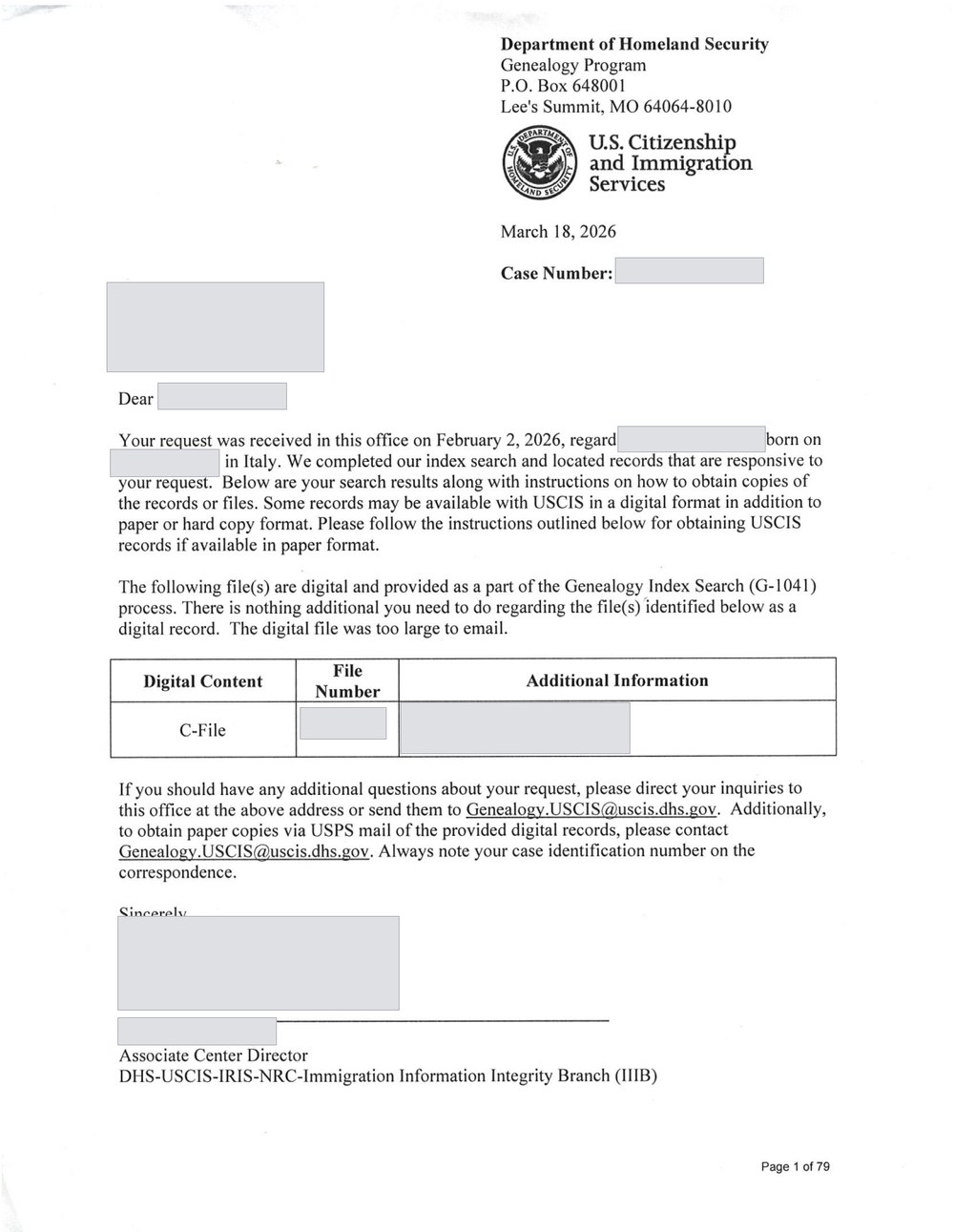
The USCIS Genealogy Program is a fee-for-service program of the Department of Homeland Security that provides access to historical immigration and naturalization records of deceased immigrants. It is administered from the USCIS National Records Center in Lee's Summit, Missouri and governed by 8 CFR 103.38 through 103.41.
A request produces one of two outputs:
- An index search result letter (Form G-1041) — a DHS letter identifying which record series hold material on your ancestor, with the file number for each, so that the record itself can then be ordered
- The record itself (Form G-1041A) — a copy of the file identified by that number, delivered digitally or on paper
The record series covered are:
- Naturalization Certificate Files (C-Files) — September 27, 1906 to March 31, 1956
- Alien Registration Forms (AR-2) — August 1940 to March 1944
- Visa Files — July 1, 1924 to March 31, 1944
- Registry Files — March 2, 1929 to March 31, 1944
- A-Files — numbered below eight million, with older files progressively transferring to the National Archives
What It Is Used For Internationally
Almost every international use of a USCIS genealogy record turns on a single question: when did the ancestor naturalize — or did they naturalize at all?
- Italian citizenship jure sanguinis — the dominant use case. Under pre-1992 Italian law, an ancestor who became a U.S. citizen before the next descendant in line was born broke the chain of transmission. The applicant must prove either that naturalization came after that birth, or that it never happened.
- Other citizenship-by-descent claims — Irish, Polish, German, Greek and Portuguese files frequently turn on the same naturalization date, though each consulate's document list differs.
- Foreign probate and inheritance — establishing an ancestor's nationality and identity for a foreign court or notary.
- Dual-citizenship registration and consular filings, and genealogical proof submitted to foreign records offices.
Where the receiving authority is a foreign court or a municipal office in the destination country — rather than that country's consulate in the United States — an apostille is usually required, and often a translation as well.
How to Obtain It
- Form G-1041, Genealogy Index Search Request — searches the historical indices and returns file numbers. Filing online is substantially cheaper than filing on paper.
- Form G-1041A, Genealogy Records Request — retrieves the actual file, one fee per file, and requires a valid file number from the index search or from a naturalization certificate.
- Confirm current fees on uscis.gov before filing. Fees changed under a recent USCIS fee rule and some legacy pages still display superseded amounts.
- Plan for a long queue. USCIS publishes processing times for both forms in the range of roughly 175 to 180 business days each, and the two steps run sequentially.
- Keep the USCIS mailing envelope. Several Italian consulates accept the uncertified USCIS photocopy specifically when it arrives in the USCIS envelope, which serves as evidence of provenance.
Why Federal Authentication Is Required
USCIS is a component of the Department of Homeland Security. A certified record bearing a USCIS seal and a federal official's signature is a federal document, and federal documents are authenticated only in Washington, D.C.
| Issuing Authority | Examples | Where Authenticated |
|---|---|---|
| State or local government | State birth, marriage and death certificates, county court records, notarized affidavits | Secretary of State of the issuing state |
| Federal government | USCIS Certificate of Non-Existence of Record, Certificates of Naturalization, National Archives certified copies, federal court documents | U.S. Department of State, Office of Authentications — Washington, D.C. |
Because USCIS is a federal agency, its records cannot be apostilled at the state level. Note also what an apostille does and does not do: it acknowledges the seal and signature of the issuing official, not the contents of the document. That is precisely why an uncertified genealogy photocopy cannot be apostilled — there is no official seal or signature on it to acknowledge.
travel.state.gov — Authenticate Your Document
Document Preparation Requirements
What Can Be Apostilled
- The USCIS Certificate of Non-Existence of Record (CONE) — requested on Form G-1566. This is a certified, sealed USCIS statement that no record of naturalization exists for a named person, and it is the instrument jure sanguinis applicants need when an ancestor never naturalized. See our Certificate of Nonexistence of Record page.
- National Archives certified copies — NARA issues certified copies of federal court declarations of intention, petitions for naturalization and oaths, with a red ribbon and gold seal, which the Department of State will apostille. See our National Archives page.
- A Certificate of Naturalization held by the document holder. See our Certificate of Naturalization page.
What Cannot Be Apostilled
- An uncertified USCIS Genealogy Program photocopy or PDF — no seal, no certifying signature
- A self-printed copy of a digital record delivered by email
- A NARA negative search letter, which is electronically signed and not a certified document
Strict Preparation Rules
- Do not notarize a federal record — notarizing it can invalidate the federal document for authentication purposes. This is the most damaging self-inflicted error on this document type.
- Do not laminate — lamination obstructs the seal and blocks apostille attachment.
- Do not staple over, hole-punch, or fold across the signature or seal.
- Do not write on, highlight, or annotate any part of the document.
- Check name spellings early. Mismatches between the U.S. record and the foreign civil records are a frequent cause of consular rejection and are far cheaper to resolve before authentication than after.
Step-by-Step Apostille Process
Identify the Record
File Form G-1041 online to obtain the file number, then Form G-1041A for the record itself. Retain the USCIS envelope the copies arrive in.
Obtain a Certified Instrument
Where the destination requires an apostille, secure a certified document — a USCIS Certificate of Non-Existence on Form G-1566, or a NARA certified copy of the court naturalization record.
Order & Document Review
Submit your order online. We confirm the document is certified, sealed and signed, and that it will survive Department of State review before it is submitted.
Department of State Submission
Hand-delivery to the U.S. Department of State, Office of Authentications in Washington, D.C., with the DS-4194 form and the federal fee.
Apostille or Authentication Issued
The Department of State issues an Apostille for Hague Convention countries or an Authentication Certificate for non-Hague countries, affixed to the document.
Certified Translation (Optional)
Certified translations in Italian, Polish, German, Greek, Portuguese and other languages where a foreign municipality or court requires one.
Common Reasons These Documents Are Rejected
1. Uncertified Genealogy Copy Submitted for Apostille
The most common error on this document type. A Genealogy Program photocopy has no seal or certifying signature. Fix: obtain a certified instrument — a USCIS CONE or a NARA certified copy — and apostille that instead.
2. Notarized Federal Record
A notary attesting to a federal official's signature breaks the chain of certification. Fix: submit the certified federal document unaltered.
3. Photocopy Where the Consulate Demands an Original
Several consulates require no-record letters to be originals bearing the office seal, not copies. Fix: submit the original issuance and keep a scan for your own file.
4. State-Level Apostille Attempt
A state Secretary of State has no authority over a DHS seal and will return the document. Fix: route it to the U.S. Department of State.
5. Name or Date Mismatch Across Records
Spelling variants and inconsistent dates between the U.S. record and the foreign civil records stall consular review. Fix: reconcile the discrepancy — usually by affidavit or record correction — before the file is submitted abroad.
Hague Convention vs. Non-Hague Countries
| Destination Type | What You Receive | Additional Steps | Examples |
|---|---|---|---|
| Hague Convention country | Apostille issued by the U.S. Department of State | None — ready for use abroad | Italy, Ireland, Poland, Germany, Greece, Portugal, Spain, France, Mexico, Brazil, Argentina |
| Non-Hague country | Authentication Certificate from the U.S. Department of State | Embassy or consulate legalization required after authentication | Saudi Arabia, Qatar, Kuwait, UAE, Egypt, Vietnam, Cambodia, Iraq |
Convention membership changes periodically, and we verify status for each order before submission. See our Country Guide for the current list.
Processing Times & Validity
- USCIS Genealogy Program: index search and records request each run in the range of roughly 175 to 180 business days, and they are sequential — budget 12 to 18 months for the pair.
- USCIS Certificate of Non-Existence: requested separately on Form G-1566; confirm current processing time and fee on uscis.gov.
- U.S. Department of State authentication: currently 10–12 business days for routine service, with expedited handling available.
- Validity: an apostille carries no expiration date, and a naturalization record documents a historical fact. Consulates set their own document-age rules for supporting civil records.
Because the USCIS queue is measured in months, start the record search well before booking a consular appointment. Use our Processing Time Estimator for a country-specific projection.
Why Choose Federal Apostille and Notary Processing
We are a Washington, D.C.-based document processing service specializing in federal authentications, including immigration and naturalization records for citizenship-by-descent applicants.
- Hand-delivery to the U.S. Department of State, Office of Authentications — no mail delays
- $120 flat-rate pricing with all government authentication fees included
- Pre-submission review that catches the most common rejection issues before they cost you time — including the uncertified-copy problem that stops most genealogy files
- Embassy legalization for non-Hague countries handled in-house in Washington, D.C.
- Certified translations in Italian, Polish, German, Greek, Portuguese and other languages
- Worldwide tracked shipping via FedEx, UPS and DHL, with real-time order tracking
- Over 10 years of experience processing federal authentications
Frequently Asked Questions
What is a USCIS Genealogy Program record?
It is a copy of a historical USCIS immigration or naturalization file for a deceased immigrant — most often a C-File, A-File, Visa File, Registry File or AR-2 alien registration form — obtained on Form G-1041 and Form G-1041A.
Can a genealogy record be apostilled?
Not as issued. USCIS states that the Genealogy Program cannot provide certified copies, and an apostille certifies an official's seal and signature. Where a destination requires an apostille, the certified instrument is a USCIS Certificate of Non-Existence of Record or a National Archives certified copy of the court naturalization record.
Do Italian consulates require a certified copy?
Generally no. USCIS notes that applicants for dual Italian citizenship are not required to provide certified copies of naturalization certificates obtained from USCIS, and several consulates accept the uncertified copy in its original USCIS envelope. Filings made inside Italy — with a comune or a court — are a different matter and usually require an apostille and translation.
My ancestor never naturalized. What do I file?
A Certificate of Non-Existence of Record from USCIS on Form G-1566, which is certified and sealed. Several consulates also require a separate no-record letter from the National Archives.
How long does the USCIS side take?
USCIS publishes processing times of roughly 175 to 180 business days each for the index search and the records request, and they run one after the other. Start early and file online, which is meaningfully cheaper than paper.
Do I need a certified translation?
It depends where the file is going. U.S. consulates of Italy generally accept English-language U.S. documents without translation; filings with an Italian municipality or the courts generally require both an apostille and an Italian translation. We provide certified translations alongside the authentication.
Summary
A USCIS Genealogy Program record establishes when — or whether — an immigrant ancestor became a U.S. citizen, the fact on which most citizenship-by-descent claims turn. Because USCIS is a federal agency, only the U.S. Department of State can authenticate its records for foreign use, and a state Secretary of State cannot.
The point that costs applicants the most time is that the Genealogy Program issues photocopies, not certified copies. Federal Apostille and Notary Processing identifies the certified instrument your destination actually needs — a USCIS Certificate of Non-Existence, a National Archives certified copy, or a Certificate of Naturalization — and handles authentication, legalization and translation from there.
Ready to Get Your USCIS Record Apostilled?
$120 flat rate. Hand-delivered to the U.S. Department of State. 10–12 business day turnaround. Available nationwide via our secure online portal or mail-in submission.
