DEA Certificate of Registration Apostille
Federal authentication of your DEA Certificate of Registration through the U.S. Department of State — for pharmaceutical export and foreign regulatory requirements worldwide.
Hand-delivered submission in Washington, D.C. Pre-submission review by federal-document specialists. Embassy legalization handled in-house for non-Hague countries.
What This Document Is
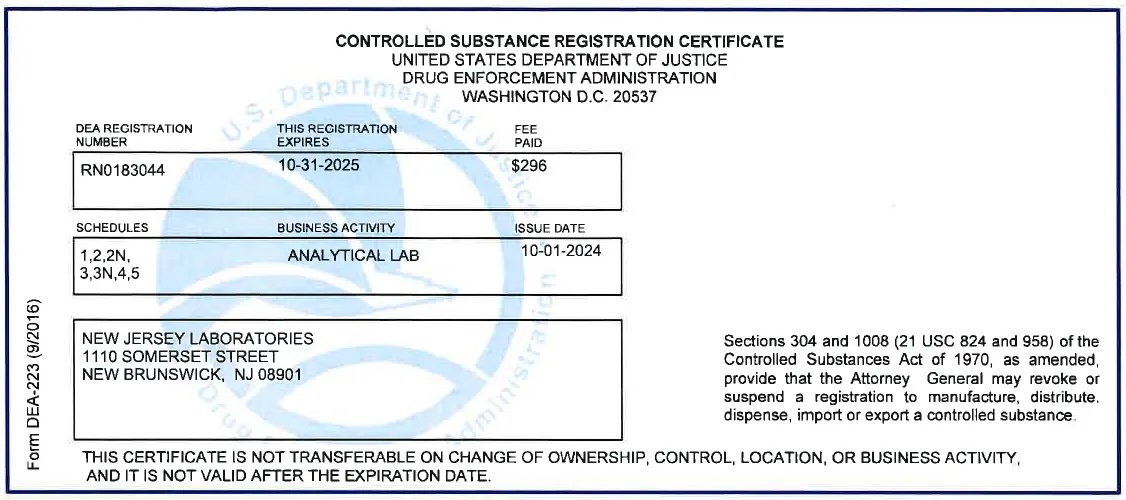
A DEA Certificate of Registration, issued on DEA Form 223, is the official document from the U.S. Drug Enforcement Administration (DEA), part of the U.S. Department of Justice, authorizing a registrant to manufacture, distribute, dispense, research, or handle controlled substances under the Controlled Substances Act.
A typical certificate shows:
- The registrant name and address
- The DEA registration number
- The schedules of controlled substances authorized
- The business activity and expiration date
Foreign regulators and trading partners often require an authenticated copy to confirm a U.S. entity’s authority to handle controlled substances.
What It Is Used For Internationally
A DEA registration certificate is required abroad to prove authority over controlled substances. Common uses include:
- Pharmaceutical and controlled-substance exports — proving U.S. authorization to foreign regulators.
- Foreign import and manufacturing licenses — supporting applications with overseas authorities.
- International research and clinical supply — documenting registration for cross-border programs.
- Distributor and partner due diligence — verifying registration for agreements.
Foreign authorities require federal authentication because they cannot independently verify that this document is genuine.
How to Obtain It
The DEA issues and renews registrations through its Diversion Control Division:
- Your active DEA Certificate of Registration (Form 223) is your document — a certified copy may be requested where required.
- Confirm the registration is current and the schedules match your need before authentication.
Why Federal Authentication Is Required
Apostille authority in the United States is split between state Secretaries of State and the U.S. Department of State, based on which authority issued the document.
| Issuing Authority | Examples | Where Authenticated |
|---|---|---|
| State or local government | State birth certificates, marriage licenses, notarized affidavits | Secretary of State of the issuing state |
| Federal government | DEA Certificate of Registration, FDA export certificates, cGMP certificates, federal court documents | U.S. Department of State, Office of Authentications — Washington, D.C. |
Because the DEA is a federal agency, its Certificate of Registration cannot be apostilled at the state level. Federal authentication by the U.S. Department of State confirms the certificate is genuine.
travel.state.gov — Authenticate Your Document
Document Preparation Requirements
Acceptable Format
- A current DEA Certificate of Registration (Form 223), unaltered.
- A certificate showing the correct registrant, number, schedules, and unexpired date.
Strict Preparation Rules
- Submit the document exactly as issued — no edits, additions, or redactions.
- Do not notarize a federal document — notarizing it can invalidate the federal record.
- Do not laminate — lamination obstructs the seal and blocks apostille attachment.
- Do not staple over, hole-punch, or fold across the signature or seal.
- Do not write on, highlight, or annotate any part of the document.
Step-by-Step Apostille Process
Confirm Your DEA Registration
Ensure your DEA Certificate of Registration (Form 223) is current and shows the correct schedules. Submit it as issued; a certified copy may be requested where required.
Order & Document Review
Submit your order online and send us the document. We verify the format, signature, and seal before anything goes to the Department of State.
Department of State Submission
We hand-deliver the document to the U.S. Department of State, Office of Authentications in Washington, D.C., with the DS-4194 request form and federal fee.
Apostille or Authentication Issued
The Department of State issues an Apostille (Hague countries) or an Authentication Certificate (non-Hague countries), affixed to your document.
Embassy Legalization (If Required)
For non-Hague countries, we forward the authenticated document to the destination country’s embassy or consulate in Washington, D.C. for final legalization.
Certified Translation (Optional)
If your destination requires another language, we provide certified translations — commonly Spanish, Portuguese, Arabic, French, Chinese.
Common Reasons These Documents Are Rejected
1. Expired Registration
An expired certificate is not accepted. Fix: renew and submit a current registration.
2. Altered Certificate
Any modification invalidates it. Fix: submit the DEA-issued certificate unchanged.
3. Self-Made Copy Without Required Certification
Some authorities require a certified copy. Fix: confirm whether a certified copy is needed for your destination.
4. State-Level Apostille Attempt
Federal certificates are returned by a state Secretary of State. Fix: route to the U.S. Department of State.
5. Schedule Mismatch
The schedules must match the intended activity abroad. Fix: confirm the certificate covers the required schedules.
Hague Convention vs. Non-Hague Countries
| Destination Type | What You Receive | Additional Steps | Examples |
|---|---|---|---|
| Hague Convention country | Apostille issued by U.S. Department of State | None — ready for use abroad. | Mexico, Spain, Italy, Portugal, France, Germany, Brazil, Japan, South Korea, India, Australia. |
| Non-Hague country | Authentication Certificate from U.S. Department of State | Embassy or consulate legalization required after authentication. | Saudi Arabia, Qatar, Kuwait, UAE, Egypt, Vietnam, Cambodia, Iraq. |
Hague Convention membership changes periodically. We verify the destination country’s current status as part of every order. See our Country Guide for the latest list.
Processing Times & Validity
- DEA issuance/renewal: handled directly with the DEA; ensure the registration is current before authentication.
- U.S. Department of State authentication: currently 10–12 business days for routine processing (expedited available through our office).
- Embassy legalization: varies by country — typically 3 business days to 4 weeks; common for pharmaceutical markets.
- Validity: tied to the registration’s expiration date — authenticate while current and confirm the destination’s recency rule.
Use our Processing Time Estimator for a country-specific projection.
Why Choose Federal Apostille and Notary Processing
We are a Washington, D.C.-based document processing service specializing in federal authentications, including DEA registration certificates for pharmaceutical exporters and researchers.
- Hand-delivery to the U.S. Department of State, Office of Authentications — no mail delays.
- $120 flat-rate pricing with all government authentication fees included.
- Pre-submission review that catches the most common rejection issues before they cost you time.
- Embassy legalization for non-Hague countries handled in-house in Washington, D.C.
- Certified translations in Spanish, Portuguese, Arabic, French, Chinese, and other languages.
- Worldwide tracked shipping via FedEx, UPS, and DHL, with real-time order tracking.
- Over 10 years of experience processing federal authentications.
Frequently Asked Questions
What is a DEA Certificate of Registration?
It is the DEA-issued certificate (Form 223) authorizing a registrant to handle controlled substances under the Controlled Substances Act. It shows the registrant, DEA number, schedules, and expiration date.
Can it be apostilled?
Yes. The DEA is a federal agency, so its Certificate of Registration is authenticated by the U.S. Department of State, not by a state.
Does my registration need to be current?
Yes. Authenticate while the registration is current — an expired certificate will be rejected. Confirm the schedules match the intended activity abroad.
Will the destination require embassy legalization?
Often, for non-Hague pharmaceutical markets. We handle embassy legalization in-house after Department of State authentication.
Do I need a certified copy or the original?
It depends on the destination. Some authorities accept the issued certificate; others require a certified copy. We confirm what your destination needs.
Do I need a certified translation?
Frequently, for foreign regulatory use. We provide certified translations alongside the authentication.
Summary
A DEA Certificate of Registration proves a U.S. entity’s authority to handle controlled substances. Because the DEA is a federal agency, only the U.S. Department of State can authenticate it for international use.
Federal Apostille and Notary Processing handles every step, including embassy legalization for non-Hague markets, so your DEA registration is delivered abroad in accepted form — while your registration is current.
Ready to Get Your DEA Registration Apostilled?
$120 flat rate. Hand-delivered to the U.S. Department of State. 10–12 business day turnaround. Available nationwide via our secure online portal or mail-in submission.
