

USCIS Form G-24: The Certification That Makes a Federal Apostille Possible
Form G-24 is the cover certification U.S. Citizenship and Immigration Services attaches to a certified true copy of an immigration record. It is also the only version of most USCIS documents the U.S. Department of State will authenticate.
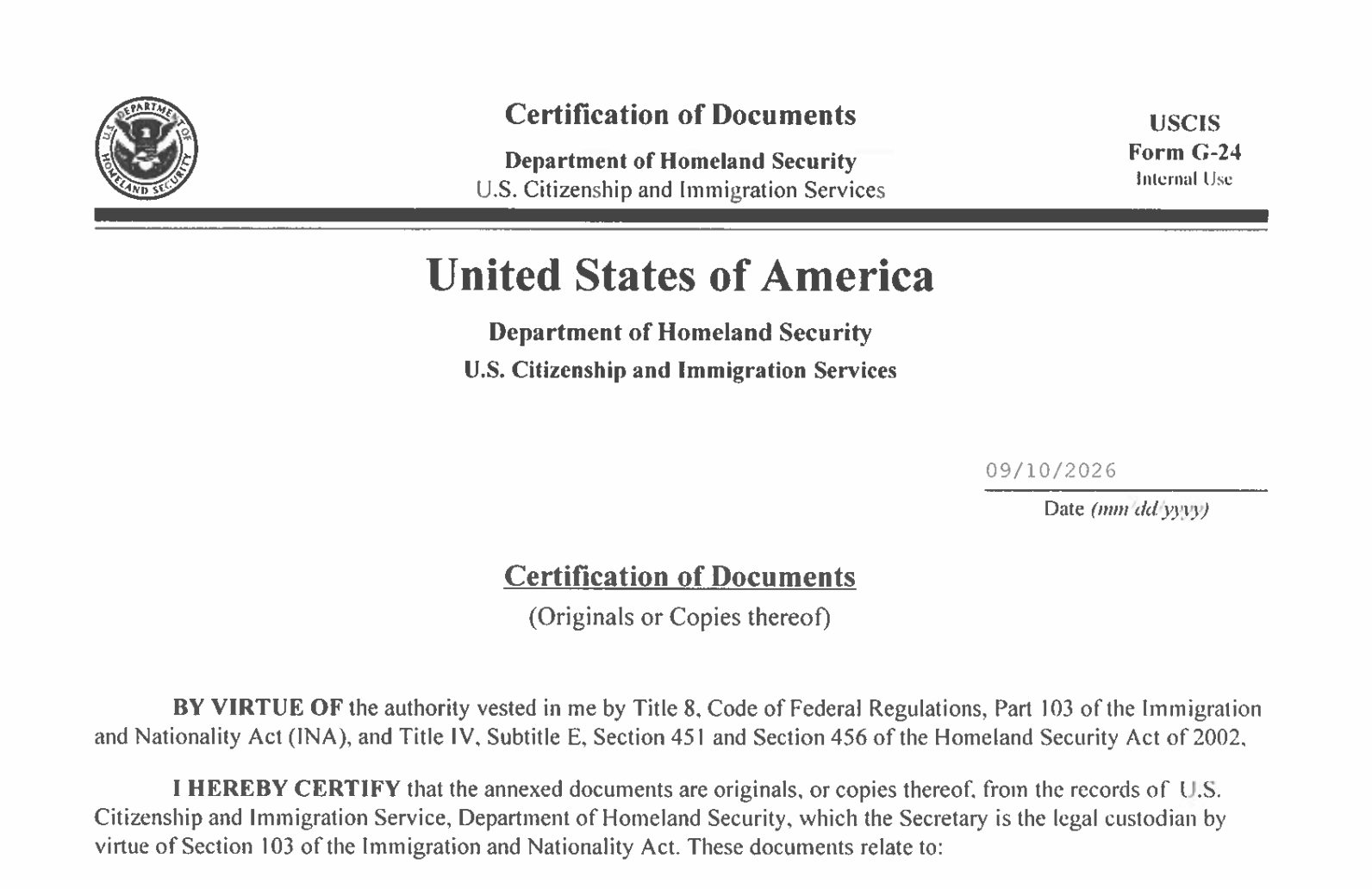
If a foreign government has asked you for an apostilled copy of your Certificate of Naturalization, your Certificate of Citizenship, or another immigration record, you will almost certainly end up holding a document most people have never heard of: USCIS Form G-24, Certification of Documents.
It is not a form you fill out. It is not something you download and submit. It is a certification page that a USCIS officer prints, signs, and attaches to a photocopy of your record — converting an ordinary copy into an official federal document. And once it exists, it unlocks a process that the original certificate itself cannot: authentication by the U.S. Department of State.
What Form G-24 Actually Is
Form G-24 is an internal-use certification issued by the Department of Homeland Security through U.S. Citizenship and Immigration Services. Its job is narrow and specific: to attest that the pages stapled behind it are genuine originals, or genuine copies, drawn from USCIS records.
The result is a two-part document. The front page is the G-24 certification itself, bearing the DHS seal, a certification date, and the signature of the certifying USCIS official. Behind it sits the annexed material — typically a photocopy of your naturalization or citizenship certificate. The two are issued together and function as a single instrument.
The vocabulary matters. USCIS calls this a Certified True Copy. The Department of State and most foreign governments call the same thing an authenticated copy. If you walk into a USCIS field office asking for an "apostille" or an "authentication," you may be told the agency does not provide one — which is technically correct, because the apostille is issued by a different agency entirely. Ask for a Certified True Copy and you will get the G-24.
Reading the Certification Language
The body of the G-24 is short, and worth understanding, because it explains exactly what the certification does and does not claim.
Three things follow from that language. First, the certifying authority is federal, which determines where the apostille must be obtained. Second, the certification speaks only to the records custody question — it confirms the documents came from USCIS files, not that any underlying immigration benefit remains valid. Third, the certification is tied to the specific pages annexed to it. Separate them and you have destroyed the document.
Never unstaple a G-24. The certification page and the annexed copy are one document. Removing the staple, rebinding the pages, or submitting the certification page by itself will cause rejection at the Department of State, and USCIS will not re-certify by mail. You would need a second in-person appointment.
Which Documents Get a G-24
In practice, the overwhelming majority of G-24 certifications issued for international use cover two documents:
- Certificate of Naturalization — required for dual citizenship applications, foreign property transactions, marriage abroad, inheritance matters, and consular registration.
- Certificate of Citizenship — most often for children who acquired or derived citizenship, where a foreign government needs proof of status.
USCIS can also certify other material held in its files, including Permanent Resident Card records, Declarations of Intention, and select A-file contents. Availability varies by field office and by what the officer can verify at the counter, so it is worth stating precisely what you need when you book the appointment.
How to Obtain a G-24 From USCIS
There is one route, and it is an in-person route. USCIS does not certify copies by mail, by email, or through any online portal.
Book the Appointment
Call the USCIS Contact Center at 800-375-5283 and request an in-person appointment at your local field office for a Certified True Copy. Availability varies considerably by city; allow several weeks in busy districts.
Prepare Your Packet
Bring the original certificate, a clean photocopy of it, and government-issued photo identification such as a driver's license, state ID, or U.S. passport. Bring one photocopy for each certified copy you need.
Attend and Request
A designated USCIS employee reviews the documents and may certify the copy once your identity and citizenship status are confirmed. Use the phrase "Certified True Copy" to avoid confusion at the window.
Leave With Everything
USCIS returns your original certificate along with the new G-24 certified copy. The agency will not forward the certified copy to the Department of State or any other agency on your behalf — that step is yours.
Request more than one. Certified copies are issued per photocopy presented. If you anticipate needing an apostilled record for two different countries, two different institutions, or a future filing, bring extra photocopies to the same appointment. A second trip means a second wait for a second slot.
Why Only the State Department Can Apostille It
Apostille authority in the United States is split. Secretaries of State authenticate documents signed by officials of their own state — county clerks, state registrars, notaries public. The U.S. Department of State authenticates documents signed by federal officials.
A G-24 is signed by a USCIS officer, so it belongs entirely to the federal track. It is processed through the U.S. Department of State, Office of Authentications, at 518 23rd Street NW in Washington, D.C. No state Secretary of State can apostille it. No notary public can certify it, re-certify it, or add any layer of authority to it — a notarized photocopy of a federal record is not an acceptable substitute and will be returned.
Do not send your original certificate anywhere. Original Certificates of Naturalization and Citizenship are federal identity documents. The entire purpose of the G-24 is to let you keep the original safely at home while a certified copy travels through the authentication chain.
The Apostille Process, Step by Step
Once the G-24 is in hand, the remaining path is straightforward — provided the paperwork is assembled correctly the first time.
| Stage | What Happens | Handled By |
|---|---|---|
| Certification | USCIS issues Form G-24 with the annexed certified copy | You, in person at a USCIS field office |
| Pre-submission review | Document integrity, signature legibility, destination country and cover-sheet accuracy are verified | Federal Apostille & Notary Processing |
| Federal authentication | Apostille or certificate of authentication affixed to the G-24 packet | U.S. Department of State, Office of Authentications |
| Embassy legalization (non-Hague only) | Consular stamp applied after federal authentication | Destination country's embassy in Washington, D.C. |
| Return | Completed packet shipped with tracking | Federal Apostille & Notary Processing |
Our Washington, D.C. office submits by hand rather than by mail, which removes the two slowest and least predictable legs of the journey. Current turnaround is 7 business days, excluding Fridays and federal holidays. You can check estimates against other document types on our processing time page.
G-24 vs. N-565 vs. Genealogy Records
Three different USCIS pathways produce three different pieces of paper, and only some of them are apostillable. Choosing the wrong one costs months.
| Pathway | What You Receive | Can It Be Apostilled? | Best For |
|---|---|---|---|
| Form G-24 certification (in-person appointment) |
Certified true copy with DHS certification cover page | Yes — U.S. Department of State | You hold the original and need an authenticated copy for foreign use |
| Form N-565 (replacement application) |
Replacement certificate, or a special certificate of naturalization for foreign recognition | Yes, once issued — but processing is lengthy | Original lost, stolen, damaged, or containing outdated information |
| Genealogy Program (Form G-1041) |
Uncertified photocopies of historical records, with a program response letter | No — the program does not issue certified copies | Ancestral research; some dual-citizenship filings that accept the response letter |
A note for Italian and German dual-citizenship applicants. USCIS has published guidance indicating that the Italian and German consulates in Washington, D.C. advised the agency that dual-citizenship applicants are not required to submit certified copies of naturalization certificates — the photocopy, together with the Genealogy Program response letter and the mailing envelope, has been accepted. Consular requirements change, and individual consulates set their own practice. Confirm with your consulate before choosing this route, and see our country requirements guide.
Why G-24 Submissions Get Rejected
The Department of State authenticates a signature, not a story. Nearly every rejection we see traces back to something structural rather than substantive:
- The packet was separated. The certification page arrived without the annexed copy, or the pages were rebound out of order.
- A notary was involved. Someone added a notarial certificate to a federal document, which the Department of State will not authenticate.
- The original was submitted instead. Original certificates are returned rather than authenticated.
- The destination country was omitted or wrong. The apostille and legalization paths diverge entirely depending on whether the country is a Hague Convention member; the cover sheet must name the correct destination.
- The signature could not be verified. The Office of Authentications matches the certifying official's signature against its records. Illegible, smudged, or photocopied signatures create problems — always submit the G-24 USCIS handed you, never a copy of it.
- The copy is unreadable. If the annexed photocopy is dark, skewed, or cropped, a foreign authority may reject it even after a valid apostille is attached.
Every packet we handle is reviewed against this list before it reaches the counter, which is the single biggest reason clients who have already been rejected once come to us for the second attempt.
Non-Hague Countries and Embassy Legalization
If your destination country is a party to the 1961 Hague Apostille Convention, the Department of State apostille is the final step. The document is ready for use abroad.
If it is not — the UAE, Qatar, Kuwait, Egypt, Jordan, Lebanon, Vietnam, Thailand, Taiwan, Cuba and others fall outside the Convention — the G-24 needs a longer chain. After federal authentication, the packet goes to that country's embassy or consulate in Washington, D.C. for legalization, and in several cases onward to a Ministry of Foreign Affairs after arrival. We handle these chains in-house, which matters here: embassy requirements change without notice, and each has its own fee structure, appointment system, and formatting preferences.
Frequently Asked Questions
Is Form G-24 something I fill out and submit?
No. G-24 is issued by USCIS, not by the applicant. It is an internal certification form that a USCIS officer completes, signs, and attaches to a photocopy of your record during an in-person appointment. There is no version of it you download or file.
Can I get a G-24 certified copy by mail or online?
No. USCIS does not certify copies as true through the mail or electronically. An in-person appointment at a local field office is required, scheduled through the USCIS Contact Center at 800-375-5283. Bring your original document, a photocopy, and photo identification.
Can a notary public certify a copy of my naturalization certificate instead?
No. A notary public has no authority over federal records. The U.S. Department of State will not authenticate a notarized photocopy of a Certificate of Naturalization or Certificate of Citizenship. Only USCIS can issue an acceptable certified copy, and it does so through Form G-24.
Can my state's Secretary of State apostille a G-24?
No. Form G-24 carries the signature of a federal officer, so it falls exclusively under the jurisdiction of the U.S. Department of State, Office of Authentications, in Washington, D.C. State offices authenticate only documents signed by state and local officials.
Does a G-24 expire?
The certification itself carries a date but no stated expiration. Foreign authorities, however, frequently impose their own recency rules — three months and six months from issuance are both common. Check your destination country's requirement before scheduling your USCIS appointment, so the certification is not stale by the time it arrives abroad.
What does the apostille cost and how long does it take?
Our flat rate is $120 per document, with all federal fees included, and current turnaround is 7 business days excluding Fridays and federal holidays. Embassy legalization for non-Hague countries adds consular fees and time that vary by country; we quote those before submission.
Should I request more than one certified copy?
Usually yes. USCIS issues one certified copy per photocopy you present, so bringing extra photocopies to a single appointment is far cheaper in time than booking a second appointment later. Each certified copy can then receive its own apostille for a different country or institution.
Have Your G-24 in Hand? We'll Handle the Rest.
Our Washington, D.C. office hand-delivers to the Department of State's Office of Authentications, reviews every packet before submission, and manages embassy legalization for non-Hague countries in-house. Flat $120 per document, ready in 7 business days.
