
USCIS Certification of Documents Apostille
Federal authentication of your USCIS Certification of Documents through the U.S. Department of State — for use in any country worldwide.
Hand-delivered submission in Washington, D.C. Pre-submission review by federal-document specialists. Embassy legalization handled in-house for non-Hague countries.
What This Document Is
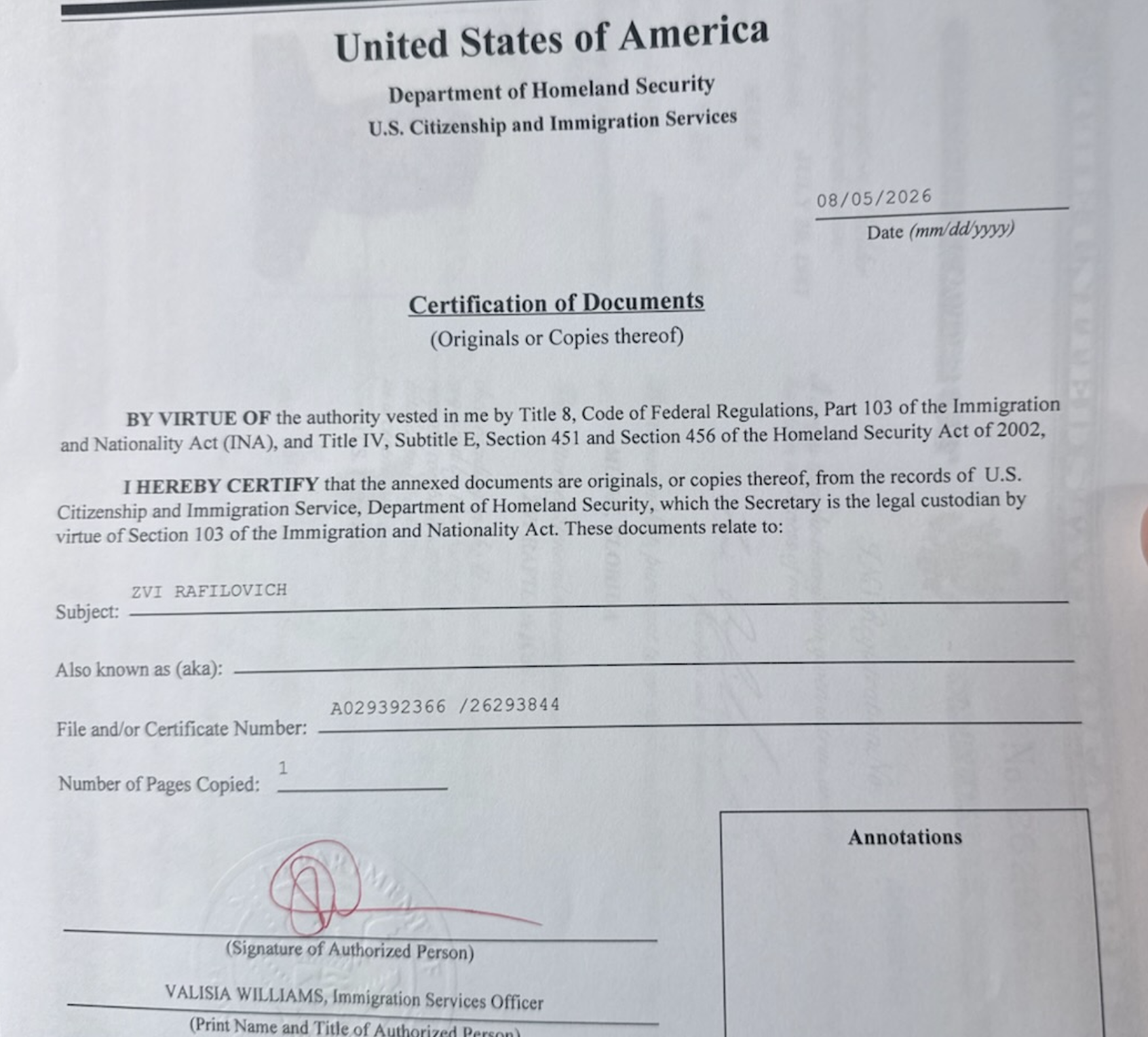
A USCIS Certification of Documents is an official cover certification issued by U.S. Citizenship and Immigration Services (USCIS), a federal agency under the U.S. Department of Homeland Security. It states that the annexed documents are originals, or true copies thereof, drawn from the records of USCIS — records for which the Secretary of Homeland Security is the legal custodian under Section 103 of the Immigration and Nationality Act (INA).
The certification is issued under the authority of Title 8, Code of Federal Regulations, Part 103, and Sections 451 and 456 of the Homeland Security Act of 2002. A standard Certification of Documents contains:
- The formal certification statement (“I hereby certify that the annexed documents are originals, or copies thereof…”)
- Subject — the full name of the individual the records relate to
- Also known as (aka) — any alternate name spellings
- File and/or Certificate Number (e.g., the A-number and certificate number)
- Number of pages copied
- Date of certification
- Signature, printed name, and title of the authorized Immigration Services Officer
- The official USCIS / Department of Homeland Security seal
The certification page accompanies certified copies of underlying records — commonly immigration file (A-file) documents, genealogy records, visa records, or historical naturalization-related materials. It is the federal instrument that makes those copies officially certified.
What It Is Used For Internationally
USCIS-certified records are frequently authenticated because they serve as official federal proof of a person’s immigration history, identity, or ancestry — information foreign governments rely on for citizenship, inheritance, and legal matters.
- Dual citizenship and ancestry claims — establishing an ancestor’s immigration or naturalization history for citizenship-by-descent applications (e.g., Italian, Irish, German, Polish, and other jure sanguinis programs).
- Genealogical and family-history proof abroad — verifying arrival, residence, or immigration records for foreign registries.
- Foreign estate, inheritance, and probate proceedings — proving identity or lineage for succession matters.
- Legal proceedings in a foreign court — where certified U.S. immigration records are entered as evidence.
- Correcting or reconciling identity records — where name spellings or dates of birth differ between countries.
- Immigration and residency applications abroad — supporting documentation for foreign visa or residency filings.
Because a foreign authority cannot independently confirm that a USCIS certification is genuine, the document must be federally authenticated before it will be accepted overseas.
Keep the Certification and Records Together
Unlike an original identity certificate, a USCIS Certification of Documents is designed to travel with the certified copies it describes. The certification statement, the “Number of Pages Copied” field, and the officer’s signature all refer to that specific bundle of records. If the pages are separated or altered:
- The certification no longer matches the records, and the U.S. Department of State will reject the submission.
- Foreign authorities may refuse the document as incomplete or tampered.
- A replacement request to USCIS — and additional processing time — becomes necessary.
Submit the packet exactly as USCIS returned it. Our pre-submission review confirms the certification page and annexed records are intact before anything goes to the Department of State.
How to Obtain a USCIS Certification of Documents
USCIS is the only authority that can issue certified copies of its records. There are two common pathways:
Method 1 — USCIS Genealogy Program (Forms G-1041 / G-1041A)
The Genealogy Program provides historical immigration and naturalization records for deceased individuals (and living individuals with proof of identity/consent where applicable).
- Form G-1041 (Index Search Request): locates which record series exist for a named individual.
- Form G-1041A (Records Request): orders certified copies of the identified records.
- Result: USCIS returns the records with a signed Certification of Documents cover page suitable for federal apostille.
- Fees & timing: vary by request type — check uscis.gov/g-1041a for current fees and current processing estimates.
Method 2 — USCIS FOIA / Privacy Act Records Request
For a living person’s own immigration file (A-file), a FOIA/Privacy Act request can produce certified copies of records. When a certified set is requested, USCIS attaches the Certification of Documents cover page.
Why Federal Authentication Is Required
Apostille authority in the United States is split between state Secretaries of State and the U.S. Department of State, based on which authority issued the document.
| Issuing Authority | Examples | Where Authenticated |
|---|---|---|
| State or local government | State birth certificates, marriage licenses, notarized affidavits, state-licensed professional records | Secretary of State of the issuing state |
| Federal government | USCIS Certification of Documents, Certificate of Naturalization, Certificate of Citizenship, FBI Identity History Summary, IRS letters, SSA verifications, federal court documents | U.S. Department of State, Office of Authentications — Washington, D.C. |
Because USCIS is a federal agency, its Certification of Documents cannot be apostilled at the state level. A state apostille placed on a federal document is invalid and will be rejected by the receiving foreign government. Federal authentication verifies that the document came from a legitimate U.S. federal agency and that the USCIS officer’s signature and seal are genuine.
travel.state.gov — Authenticate Your Document
Document Preparation Requirements
Acceptable Format
- USCIS-issued certification page with the official certification statement, seal, and the signature and title of an Immigration Services Officer.
- The annexed certified records, kept attached in the exact order issued.
- A legible date and complete file / certificate number and page count.
Strict Preparation Rules
- Submit the packet exactly as issued by USCIS — no edits, additions, or reordering.
- Do not notarize the certification — notarizing a federal record invalidates it.
- Do not laminate any page — lamination obstructs the seal and blocks apostille attachment.
- Do not remove staples, re-staple, hole-punch, or separate the certification from its records.
- Do not write on, highlight, or annotate any page.
- Independently made photocopies or scans of the certified set are not acceptable.
Step-by-Step Apostille Process
Obtain Certified Records From USCIS
Request certified copies through the USCIS Genealogy Program (G-1041 / G-1041A) or a FOIA/Privacy Act request. USCIS returns the records with a signed Certification of Documents page.
Order & Document Review
Submit your order online and send us the USCIS-certified packet. We confirm the certification page and annexed records are intact and in proper form.
Department of State Submission
We hand-deliver the document to the U.S. Department of State, Office of Authentications in Washington, D.C., with the authentication request form (DS-4194) and federal fee.
Apostille or Authentication Issued
The Department of State issues an Apostille (Hague countries) or an Authentication Certificate (non-Hague countries), affixed to your document.
Embassy Legalization (If Required)
For non-Hague countries, we forward the authenticated document to the destination country’s embassy or consulate in Washington, D.C. for final legalization.
Certified Translation (Optional)
If your destination requires another language, we provide certified translations — commonly Italian, Spanish, Portuguese, French, German, and others.
How to Visually Confirm the Document Is Ready
Before submitting, verify all of the following are present and intact. (Refer to the sample image at the top of this page.)
- The complete USCIS certification statement
- Subject name (and any aka spellings) filled in
- File and/or certificate number and number of pages copied
- A legible certification date
- The signature, printed name, and title of an Immigration Services Officer
- The official USCIS / Department of Homeland Security seal, unobstructed
- All annexed records attached in the original order
- No lamination, no added notarization, no highlighting or handwriting
- Clean, uncropped margins and professional reproduction quality
Common Reasons These Documents Are Rejected
1. Certification Separated From Its Records
The most common issue. The certification page must stay attached to the exact records it certifies. Fix: submit the packet intact, as issued.
2. Notarized or Re-Certified by a Notary
A notary has no authority over federal records; notarization invalidates the document. Fix: submit the USCIS-certified original only.
3. Self-Made Photocopy or Scan
Independently made copies lack federal certification. Fix: use only the set certified and signed by USCIS.
4. Laminated Pages
Lamination obstructs the seal and blocks apostille attachment. Fix: never laminate; request a replacement if needed.
5. State-Level Apostille Attempt
Federal documents routed to a state Secretary of State are returned unprocessed. Fix: route to the U.S. Department of State, Office of Authentications.
6. Markings, Highlighting, or Annotations
Any handwritten marking invalidates the document. Fix: keep the packet clean and store it flat until submission.
Hague Convention vs. Non-Hague Countries
| Destination Type | What You Receive | Additional Steps | Examples |
|---|---|---|---|
| Hague Convention country | Apostille issued by U.S. Department of State | None — ready for use abroad. | Italy, Ireland, Germany, Poland, Spain, Portugal, France, Mexico, Brazil, Argentina, Japan, South Korea, India, Australia. |
| Non-Hague country | Authentication Certificate from U.S. Department of State | Embassy or consulate legalization required after authentication. | Saudi Arabia, Qatar, Kuwait, Egypt, Vietnam, Cambodia, Iraq. |
Hague Convention membership changes periodically. We verify the destination country’s current status as part of every order. See our Country Guide for the latest list.
Processing Times & Validity
- USCIS record issuance: varies by request type — genealogy and FOIA timelines fluctuate; plan ahead and confirm current estimates with USCIS.
- U.S. Department of State authentication: currently 10–12 business days for routine processing (subject to government workload; expedited service available through our office).
- Embassy legalization: varies by country — typically 3 business days to 4 weeks.
- Validity: a USCIS certification does not expire, but some foreign authorities require recently issued authentications (often within the last 6–12 months). Confirm the destination country’s requirement before ordering.
Use our Processing Time Estimator for a country-specific projection.
Why Choose Federal Apostille and Notary Processing
We are a Washington, D.C.-based document processing service specializing exclusively in federal authentications. USCIS-certified records are a frequent request among clients pursuing dual citizenship and ancestry claims abroad.
- Hand-delivery to the U.S. Department of State, Office of Authentications — no mail delays.
- $120 flat-rate pricing with all government authentication fees included.
- Pre-submission review that catches the most common issues (separated pages, notarized copies, lamination) before they cost you time.
- Embassy legalization for non-Hague countries handled in-house in Washington, D.C.
- Certified translations in Italian, Spanish, Portuguese, French, German, and other languages.
- Worldwide tracked shipping via FedEx, UPS, and DHL, with real-time order tracking.
- Over 10 years of experience processing federal authentications.
Frequently Asked Questions
What is a USCIS Certification of Documents?
It is a cover certification issued by U.S. Citizenship and Immigration Services stating that the annexed documents are originals, or true copies thereof, drawn from USCIS records for which the Secretary of Homeland Security is the legal custodian. It is signed by an authorized Immigration Services Officer and accompanies certified copies of immigration or genealogy records.
Can a USCIS Certification of Documents be apostilled directly?
Yes. Because the certification is itself a federally certified copy issued and signed by a USCIS officer, it is authenticated by the U.S. Department of State, Office of Authentications. It should not be re-notarized, laminated, or separated from the records it certifies.
How do I obtain a USCIS Certification of Documents?
Request certified copies through the USCIS Genealogy Program (Form G-1041 index search and Form G-1041A record request) or through a USCIS FOIA/Privacy Act request. USCIS returns the requested records with a signed Certification of Documents cover page.
Do the certified records need to stay attached to the certification page?
Yes. The certification page and the annexed records must remain together exactly as issued by USCIS. Removing, reordering, re-stapling, or altering the pages invalidates the certification and will cause rejection by the Department of State.
Is this the same as a Certificate of Naturalization?
No. A Certificate of Naturalization is an original identity certificate proving U.S. citizenship, and an original cannot be apostilled — you need a USCIS-certified copy via Form N-565. A Certification of Documents is a cover certification USCIS places on certified copies of records it holds, and that certified set can be authenticated directly.
Can I get certified copies of a living relative’s immigration file?
Generally, records for living individuals require their consent or proof of identity through the FOIA/Privacy Act process. The USCIS Genealogy Program primarily serves records of deceased individuals or historical records. Check current USCIS eligibility rules for your specific situation.
Why do foreign governments require this document to be apostilled?
Foreign authorities cannot independently verify a USCIS certification. The apostille or authentication certificate issued by the U.S. Department of State confirms that the USCIS signature and seal are genuine, allowing the certified records to be legally recognized abroad.
Will I need a certified translation?
Many countries require a certified translation into their official language — especially for citizenship-by-descent and civil registry use. We provide certified translations alongside the apostille so the document is delivered ready to file.
Do I need to visit your office in person?
No. We work with clients nationwide and internationally. Send your USCIS-certified packet by mail or courier and we handle the in-person Department of State submission on your behalf.
Summary
A USCIS Certification of Documents is a federal instrument certifying that annexed records are true copies from USCIS holdings. Because it is issued under federal authority, only the U.S. Department of State — never a state Secretary of State — can authenticate it for international use. The certification and its records must stay together exactly as issued.
Federal Apostille and Notary Processing handles every step — from document review through final embassy legalization — so your USCIS-certified records are delivered abroad in legally recognized form for dual citizenship, ancestry claims, estate matters, and foreign legal proceedings.
Ready to Get Your USCIS Certification of Documents Apostilled?
$120 flat rate. Hand-delivered to the U.S. Department of State. 10–12 business day turnaround. Available nationwide via our secure online portal or mail-in submission.
