Consular Affidavit Apostille
U.S. Embassy Notarized Affidavit Apostille | Single Status & Eligibility to Marry Affidavits (22 U.S.C. 4215)
Federal authentication of affidavits sworn before a U.S. consular officer abroad — for marriage registration, powers of attorney, and property matters worldwide. Hand-delivered submission in Washington, D.C. Pre-submission review by federal-document specialists. Embassy legalization handled in-house for non-Hague countries.
What This Document Is
A consular affidavit is a sworn statement executed before a U.S. consular officer at a U.S. Embassy or Consulate abroad. Under 22 U.S.C. 4215 and 22 U.S.C. 4221, consular officers are authorized to administer oaths and perform any notarial act a notary public may perform in the United States, and the resulting act has the same force and effect within the United States as one performed by a domestic notary. The procedure is governed by 22 CFR Part 92.
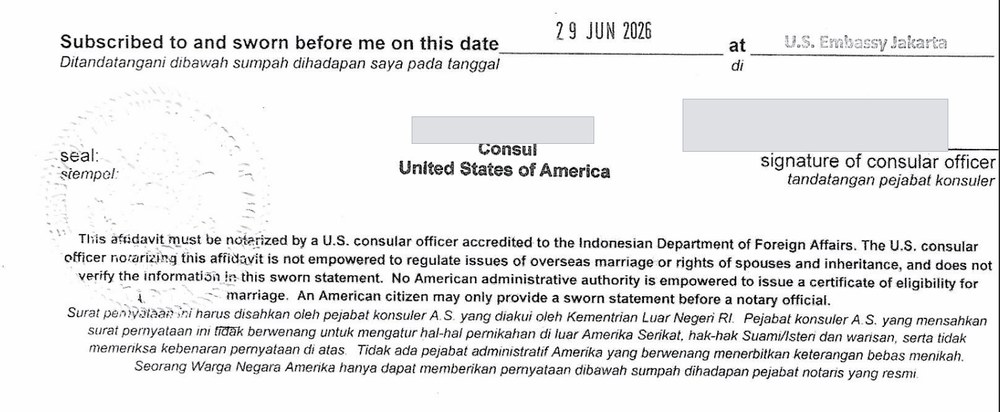
The consular officer completes a notarial certificate — the jurat — on the face of the affidavit. A typical jurat shows:
- The wording "Subscribed to and sworn before me on this date," often printed bilingually
- The date and place of the notarial act, naming the U.S. Embassy or Consulate
- The consular officer's printed name, title and signature
- The impressed consular seal of the United States of America
What the officer certifies is narrow and worth understanding before you file anything abroad: the identity of the person who appeared, the fact that the person appeared in person, and the administration of the oath. Under 22 CFR 92.27(b), notarizing officers are not required to examine the truth of an affiant's allegations, and 22 CFR 92.11(b) bars them from drafting the document. The consular officer verifies the oath — not the facts sworn to.
What It Is Used For Internationally
A consular affidavit is the instrument Americans abroad use when a foreign authority demands a sworn statement that no U.S. office can issue as a certificate. The most common applications are:
- Marriage abroad — affidavit of eligibility to marry. Many civil registrars require proof of legal capacity to marry. The U.S. government has no national marital-status registry and cannot attest to marital status, so a sworn affidavit before a consular officer substitutes for the "certificate of no impediment" that other countries issue.
- Powers of attorney — executed abroad for property sales, banking, vehicle transfers, or litigation back in the United States or in the host country.
- Property and inheritance matters — heirship affidavits, renunciations, deeds and acknowledgments under 22 CFR 92.30–92.35.
- Affidavits of support and financial capacity — sponsorship statements filed with foreign immigration authorities.
- Education and employment declarations — degree and experience affidavits, and parental consent for minors.
Foreign registrars and ministries require federal authentication of these affidavits because they have no way to independently verify a U.S. consular officer's seal and signature. The apostille or authentication certificate supplies that verification.
How to Obtain It
Notarial appointments are booked directly with the U.S. Embassy or Consulate in the country where you are located. The key procedural points:
- You must appear in person. The Department of State does not offer remote or virtual consular notarization.
- Do not sign the document before your appointment. The signature must be made in the officer's presence.
- Bring valid photo identification and the unsigned document, already drafted — consular officers cannot prepare legal documents for you.
- The fee is $50 per consular seal (Item 41, Schedule of Fees, 22 CFR 22.1), including each additional seal provided in the same transaction.
Why Federal Authentication Is Required
Authentication follows the officer who signed the document, not the place where it was signed. Because a consular officer is a federal officer of the United States, the affidavit is a federally signed instrument regardless of the country it was executed in.
| Issuing Authority | Examples | Where Authenticated |
|---|---|---|
| State or local government | State birth certificates, marriage licenses, affidavits notarized by a state-commissioned notary | Secretary of State of the issuing state |
| Federal government | Consular affidavits, Consular Reports of Birth Abroad, FBI background checks, federal court documents | U.S. Department of State, Office of Authentications — Washington, D.C. |
A state Secretary of State cannot authenticate a consular affidavit. State offices maintain registries of the notaries they commission; they hold no specimen of a U.S. consular officer's signature or seal and have no jurisdiction over federal officials. The Department of State's published requirements list documents signed by a "U.S. consular officer" among those it authenticates directly.
travel.state.gov — Authenticate Your Document
Document Preparation Requirements
Acceptable Format
- The original affidavit bearing the consular officer's original signature and impressed consular seal
- A complete document — every page of the affidavit that the jurat refers to, kept together
- A legible consular officer name, title, date and place of the notarial act
Strict Preparation Rules
- Do not notarize the document again. The Department of State is explicit that a document is no longer valid for authentication once it has been notarized on top of the federal certification. A state notary stamp added over a consular jurat destroys eligibility.
- Do not laminate — lamination obstructs the impressed seal and blocks apostille attachment.
- Do not staple over, hole-punch, or fold across the consular seal or signature.
- Do not write on, highlight, or annotate any part of the document after notarization.
- If a translation is required, the translation is what gets notarized — never the consular original.
Step-by-Step Apostille Process
Execute the Affidavit at the Embassy
Book a notarial appointment, appear in person with photo ID and the unsigned affidavit, and sign before the consular officer. Keep the original with its seal intact.
Order & Document Review
Submit your order online. We verify the jurat, the consular officer's signature and the seal impression before anything reaches the Department of State.
Department of State Submission
Hand-delivery to the U.S. Department of State, Office of Authentications in Washington, D.C., with the DS-4194 form and the federal fee.
Apostille or Authentication Issued
The Department of State issues an Apostille for Hague Convention countries or an Authentication Certificate for non-Hague countries, affixed to the document.
Embassy Legalization (If Required)
For non-Hague destinations, we forward the authenticated affidavit to that country's embassy or consulate in Washington, D.C. for final legalization.
Certified Translation (Optional)
Certified translations in Spanish, Portuguese, Arabic, French, Chinese, Indonesian and other languages where the destination registrar requires one.
Common Reasons These Documents Are Rejected
1. Sent to a State Secretary of State
The most common error. State offices return consular documents unprocessed. Fix: route the affidavit to the U.S. Department of State, Office of Authentications.
2. Notarized a Second Time
A state notary stamp added over the consular jurat invalidates the document for authentication. Fix: submit the consular original exactly as the officer issued it.
3. Photocopy or Scan Submitted
Copies carry no original seal or signature for the Department of State to verify. Fix: submit the original, or return to the post for a fresh notarial act.
4. Missing or Illegible Consular Seal
A faint seal impression, a cut-off signature block, or a missing officer title stops verification. Fix: confirm the jurat is complete and legible before submission.
5. Stale-Dated for the Destination
Many foreign civil registrars will only accept a single-status or eligibility affidavit executed within the last three or six months. Fix: confirm the registrar's freshness rule and sequence the consular appointment and the authentication so the window does not expire in transit.
Hague Convention vs. Non-Hague Countries
| Destination Type | What You Receive | Additional Steps | Examples |
|---|---|---|---|
| Hague Convention country | Apostille issued by the U.S. Department of State | None — ready for use abroad | Mexico, Spain, Italy, Portugal, France, Germany, Brazil, Japan, South Korea, India, Australia |
| Non-Hague country | Authentication Certificate from the U.S. Department of State | Embassy or consulate legalization required after authentication | Saudi Arabia, Qatar, Kuwait, UAE, Egypt, Vietnam, Cambodia, Iraq |
Convention membership changes periodically, and we verify status for each order before submission. See our Country Guide for the current list.
Processing Times & Validity
- Consular appointment: handled directly with the embassy or consulate; availability varies by post and can require several weeks' lead time.
- U.S. Department of State authentication: currently 10–12 business days for routine service, with expedited handling available.
- Embassy legalization: varies by country — typically 3 business days to 4 weeks.
- Validity: an apostille itself carries no expiration date. The practical clock is the destination registrar's recency rule, which is usually measured from the date of the affidavit rather than the date of the apostille.
Use our Processing Time Estimator for a country-specific projection.
Why Choose Federal Apostille and Notary Processing
We are a Washington, D.C.-based document processing service specializing in federal authentications, including consular affidavits for Americans marrying, buying property, and managing family matters abroad.
- Hand-delivery to the U.S. Department of State, Office of Authentications — no mail delays
- $120 flat-rate pricing with all government authentication fees included
- Pre-submission review that catches the most common rejection issues before they cost you time
- Embassy legalization for non-Hague countries handled in-house in Washington, D.C.
- Certified translations in Spanish, Portuguese, Arabic, French, Chinese and other languages
- Worldwide tracked shipping via FedEx, UPS and DHL, with real-time order tracking
- Over 10 years of experience processing federal authentications
Frequently Asked Questions
What is a consular affidavit?
It is a sworn statement executed before a U.S. consular officer at a U.S. Embassy or Consulate abroad, under 22 U.S.C. 4215 and 22 CFR Part 92. The officer administers the oath, verifies your identity, and affixes the consular seal and signature.
Can it be apostilled?
Yes. A consular officer is a federal officer, so the affidavit is authenticated by the U.S. Department of State — not by a state Secretary of State.
Why can't I get a U.S. certificate of no impediment to marry?
The United States has no national marital-status registry, and marriage and divorce records are held at state and county level. No federal or state office can issue a negative attestation of marital status. A sworn affidavit before a consular officer is the accepted substitute in most countries that ask for one.
Does the consular officer confirm that my statements are true?
No. Under 22 CFR 92.27(b), the notarizing officer certifies the oath and your identity, not the truth of the contents. The affidavit stands or falls on your own sworn statement.
Will the destination require embassy legalization?
Only for non-Hague countries. We handle embassy legalization in-house after Department of State authentication.
Do I need a certified translation?
Frequently, when the affidavit is filed with a foreign civil registrar. We provide certified translations alongside the authentication. The translation is notarized — never the consular original.
Summary
A consular affidavit is a sworn statement taken by a U.S. consular officer abroad under federal authority. Because that officer is a federal official, only the U.S. Department of State can authenticate the document for use in another country — a state Secretary of State cannot.
Federal Apostille and Notary Processing handles every step after the embassy appointment, including embassy legalization for non-Hague destinations and certified translation, so your affidavit reaches the foreign registrar in accepted form and inside its recency window.
Ready to Get Your Consular Affidavit Apostilled?
$120 flat rate. Hand-delivered to the U.S. Department of State. 10–12 business day turnaround. Available nationwide via our secure online portal or mail-in submission.
