
Federal Authentication of State-Apostilled Documents
When a state-issued document is destined for a non-Hague country, the state apostille alone is not enough. The document must also be authenticated by the U.S. Department of State and then legalized at the destination country's embassy or consulate.
We coordinate the full chain in Washington, D.C. — state apostille submission, federal authentication of the state signature, and embassy legalization — so your document is delivered ready to use abroad.
What This Process Is
When a U.S. state-issued document is going to a foreign country that is not a member of the 1961 Hague Apostille Convention, a single state apostille is not enough to make the document legally recognized abroad. Non-Hague countries do not accept state apostilles directly; they require an additional federal authentication step by the U.S. Department of State, followed by legalization at the destination country's embassy or consulate.
This three-step process is sometimes called chain authentication, double authentication, or consular legalization. Whatever the terminology, the principle is the same: each link in the chain certifies the link before it, so by the time the document reaches the foreign authority, every signature has been verified by an authority the foreign government recognizes.
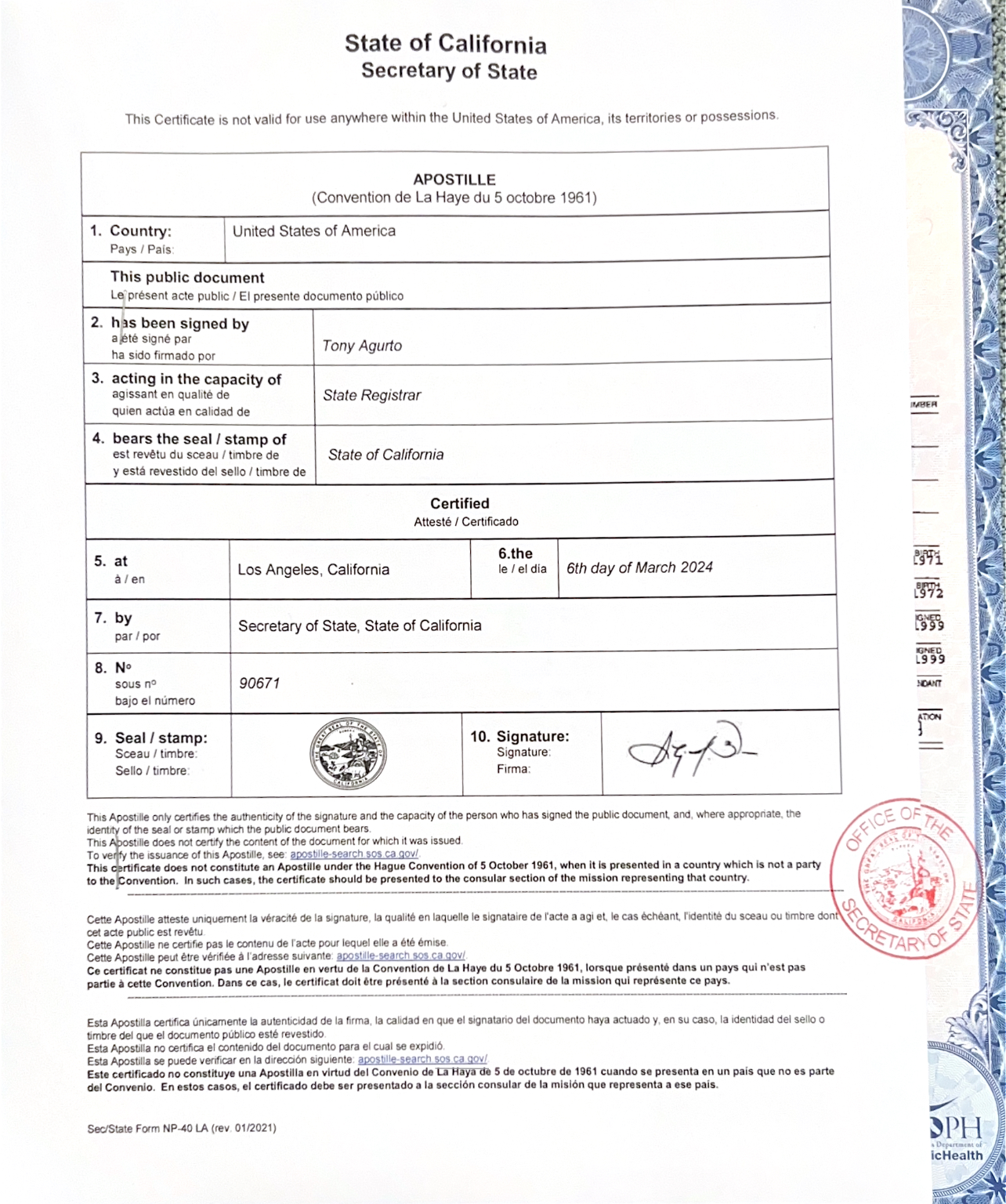
The sample image at the top of this page — a State of California Secretary of State Apostille — is the first link in this chain when the destination is a non-Hague country. From there, the document moves to the U.S. Department of State for federal authentication of the state signature, and finally to the embassy or consulate of the destination country for final legalization.
When Federal Authentication of a State Apostille Is Required
The single determining factor is whether the destination country is a member of the 1961 Hague Apostille Convention. For state-issued documents, the rule is:
| Destination Country | What's Required | Examples of Destinations |
|---|---|---|
| Hague Convention member | State apostille only. Document is ready for use abroad. No federal authentication, no embassy legalization. | Mexico, Spain, Italy, Portugal, France, Germany, Netherlands, UK, Brazil, Argentina, Colombia, Chile, Japan, South Korea, India, Australia, Philippines, China, UAE. |
| Non-Hague country | State apostille (or state authentication) → U.S. Department of State authentication → embassy/consulate legalization. The full chain. | Saudi Arabia, Qatar, Kuwait, Egypt, Vietnam, Cambodia, Iran, Iraq, Pakistan, Bangladesh, and others. |
Hague Convention membership changes periodically. China joined in November 2023 and the UAE joined in 2024, so documents going to those countries no longer require the chain — a state apostille alone is now sufficient. By contrast, several Gulf and Middle East countries (Saudi Arabia, Qatar, Kuwait, Egypt), parts of Southeast Asia (Vietnam, Cambodia), and certain South Asian and African countries still require the chain. We confirm the current Hague status of every destination as part of order intake.
Non-Hague Countries That Currently Trigger This Chain
The following countries currently require the federal authentication chain for U.S. state-issued documents. This list changes periodically as countries join the Hague Convention; verify current status with your destination's consulate before submission.
| Region | Countries | Common Document Types Sent |
|---|---|---|
| Middle East & Gulf | Saudi Arabia, Qatar, Kuwait, Egypt, Iran, Iraq, Lebanon (verify), Jordan (verify) | Birth certificates, marriage certificates, single status affidavits, corporate documents, notarized powers of attorney, educational diplomas. |
| Southeast Asia | Vietnam, Cambodia, Laos, Myanmar, Thailand (verify current status) | Birth certificates, marriage certificates, corporate documents, business registration documents, notarized property transfers. |
| South Asia | Pakistan, Bangladesh, Sri Lanka (verify), Afghanistan | Birth and marriage certificates, educational documents, corporate filings, notarized affidavits for family matters. |
| Africa | Many sub-Saharan African countries are non-Hague — confirm individually before submission (e.g., Algeria, Sudan, Libya, Ethiopia) | Educational and licensing documents, business registration, family law documents. |
| Recently changed status | China (joined Nov 2023), UAE (joined 2024), Canada (joined 2024) | These countries no longer require the chain — state apostille alone is now sufficient. |
For the official current list of Hague Convention member states, see the Hague Conference on Private International Law status table. Our team verifies Hague status as part of every order.
The Three-Step Authentication Chain
For a state-issued document destined for a non-Hague country, the chain has three sequential stages of authentication. Each stage must be complete before the next can begin.
(state apostille / state authentication)
(federal authentication of the state signature)
(final legalization for destination country)
Step 1 — State Apostille or State Authentication
The state Secretary of State (or equivalent authority) certifies the signature, capacity, and seal of the issuing state official or the notary public. For Hague-bound documents, this would be the end of the process — the state-issued certificate would be called an "apostille." For non-Hague-bound documents, the state issues either an apostille or an authentication certificate depending on the state's practice; either format is acceptable as the input to Step 2.
Step 2 — U.S. Department of State Authentication
The U.S. Department of State, Office of Authentications in Washington, D.C., authenticates the state Secretary of State's signature on the Step 1 certificate. This is a separate federal certificate issued on Department of State letterhead, affixed to the document. The Department of State maintains a registry of state officials' signatures and can verify them. This step is what foreign embassies require before they will legalize the document.
For non-Hague countries, the U.S. Department of State issues an Authentication Certificate (not an Apostille) at this step. The visual format and language are similar to a federal apostille, but the Authentication Certificate is the legally correct form for non-Hague destinations.
Step 3 — Embassy or Consulate Legalization
The document, now bearing both the state apostille (Step 1) and the U.S. Department of State authentication (Step 2), is submitted to the destination country's embassy or consulate in Washington, D.C. The embassy's consular section reviews the U.S. Department of State authentication and adds its own legalization stamp or certificate — confirming that the document is now recognized for use within the destination country.
Each embassy has its own legalization process, fees, language requirements, and supporting documentation. Some embassies require translation into the destination country's language before legalization; others require additional forms or in-person submission. We coordinate with all major embassies in Washington, D.C.
Why the Federal Step Is Required for Non-Hague Countries
To understand why the federal authentication step is necessary, it helps to understand what the Hague Convention does — and what it doesn't do for non-member countries.
What the Hague Convention Does
The 1961 Hague Apostille Convention is a multilateral treaty that simplified international document authentication among member states. Under the Convention, a single apostille issued by the document's country of origin (in the U.S., by a state Secretary of State or the federal Department of State, depending on who signed the document) is sufficient for the document to be recognized in any other Hague member country. No further steps are required.
What Happens for Non-Hague Countries
Non-Hague countries are not parties to this simplified system. For these countries, the older traditional system of consular legalization still applies. Under consular legalization:
- The destination country does not recognize the state Secretary of State as an authority whose signature it can verify directly.
- The destination country does recognize the U.S. Department of State as the federal authority whose signature carries the imprimatur of the U.S. government.
- The destination country's embassy is the only authority that can certify a document for use in that country — and it will only do so after the U.S. Department of State has authenticated the state-level signature first.
The chain effectively says to the foreign embassy: "The U.S. federal government confirms that this state signature is genuine." The embassy then confirms: "The destination country accepts this U.S. federal confirmation, and the document is now legalized for use here."
State Documents That Commonly Go Through This Chain
Any state-issued public document or state-notarized document can go through the federal authentication chain when destined for a non-Hague country. The following document types are the most commonly chain-authenticated:
| Document Type | Common Use Case in Non-Hague Countries |
|---|---|
| State birth certificate | Foreign marriage in Saudi Arabia, Egypt, Qatar; foreign immigration applications in Vietnam, Pakistan; family reunification in Iran, Iraq. |
| State marriage certificate | Spousal residency applications in Gulf states; foreign property and inheritance proceedings; family-based immigration in non-Hague countries. |
| State death certificate | Foreign inheritance and estate proceedings; foreign insurance and pension claims. |
| Single status / no-impediment affidavit | One of the most common chain-authenticated documents — required for marriage in Saudi Arabia, Egypt, Qatar, Vietnam, and other non-Hague jurisdictions. |
| Power of attorney | Foreign property transactions, foreign banking authorizations, foreign legal representation in non-Hague jurisdictions. |
| Corporate documents (Articles of Incorporation, Certificate of Good Standing, Bylaws) | Foreign business registration in Saudi Arabia, Qatar, Egypt, Vietnam; foreign subsidiary formation; international contracts. |
| State-licensed professional documents (notarized diplomas, transcripts, professional licenses) | Foreign professional licensing in non-Hague jurisdictions, academic admission, employment credentialing. |
| State court documents (divorce decrees, custody orders, adoption decrees) | Foreign legal recognition of U.S. court judgments in non-Hague jurisdictions. |
| Notarized contracts and commercial agreements | International business transactions, foreign tenders, cross-border contractual matters. |
Any state-issued or state-notarized document can go through this chain. The choice of chain processing depends entirely on the destination country, not on the document type.
How to Prepare Your Document for the Chain
Document preparation depends on whether the underlying document is a state-issued public record (like a birth certificate) or a privately prepared document that requires notarization first.
State-Issued Public Records
These documents are typically chain-ready as issued by the state. Requirements:
- Original or state-certified copy — issued by the state or county vital records office, state court, or state Secretary of State (for corporate records).
- Recently issued — many non-Hague country embassies require certificates issued within the last 3 to 6 months.
- Bears the official state or county seal and the signature of the issuing officer.
- Unaltered and unmarked — no additional stamps, no annotations.
Privately Prepared Documents
These documents must be notarized before they can enter the chain. Requirements:
- Signed in front of a notary public commissioned in the state whose Secretary of State will issue the first-stage apostille or authentication.
- Notary stamp/seal must be valid and current, with all state-required elements (name, commission number, expiration date, jurisdiction).
- Notary acknowledgment language must match the state's requirements.
- Some states require county clerk certification of the notary's commission before the Secretary of State will apostille or authenticate (e.g., New York for documents notarized in certain counties).
Embassy-Specific Requirements
Different destination embassies have different requirements at the Step 3 legalization stage. Common additional requirements include:
- Certified translation into the destination country's official language (Arabic for Gulf states; Vietnamese for Vietnam; Farsi for Iran; etc.)
- Embassy-specific cover forms or applications
- Power of attorney authorizing our office to submit on the applicant's behalf (for certain embassies)
- Photocopies of supporting identification
Our team confirms embassy-specific requirements at order intake so the document is prepared correctly before submission.
Step-by-Step Process
Confirm Destination Is Non-Hague
Verify that the destination country requires the chain authentication. Our team confirms current Hague status as part of order intake — countries shift status periodically (e.g., China joined the Convention in 2023, the UAE in 2024).
Document Review
Submit your order online and send us the state-issued or state-notarized document. Our team verifies the document is in proper form before submission to the issuing state.
State Secretary of State Submission
We submit your document to the Secretary of State of the issuing state for the first-stage state apostille or state authentication.
U.S. Department of State Authentication
Once the state-stage certification is in hand, we hand-deliver the document to the U.S. Department of State, Office of Authentications in Washington, D.C., for federal authentication of the state Secretary of State's signature.
Embassy / Consulate Legalization
We submit the document to the destination country's embassy or consulate in Washington, D.C., for final legalization. This step's requirements vary by embassy — we handle the embassy-specific paperwork.
Certified Translation & Return Shipping
If your destination requires the document in another language, we provide certified translations alongside the chain authentication. Final delivery is via tracked, insured shipping worldwide.
How to Visually Confirm Each Stage
A fully chain-authenticated document will display three separate certifications affixed to or attached to the original document, in this order:
- Stage 1 — State apostille or state authentication. Issued by the state Secretary of State. Follows the standard 10-point Hague Convention format (for apostilles) or a similar state authentication certificate (for state authentications). Bears the state seal and apostille certificate number. The sample image at the top of this page is a California state apostille.
- Stage 2 — U.S. Department of State Authentication Certificate. Issued by the Office of Authentications in Washington, D.C. Bears the U.S. Department of State seal and signature of the Office of Authentications official. Confirms the genuineness of the state Secretary of State's signature.
- Stage 3 — Embassy / consulate legalization. Issued by the destination country's embassy or consulate in Washington, D.C. Format varies widely by country — typically a stamp, sticker, or attached certificate in the destination country's language (Arabic, Vietnamese, Farsi, etc.). Often bears the embassy seal and consular officer signature.
- All three certifications attached together, in the correct sequence, to or with the underlying state-issued document.
- For destination countries requiring translation, a certified translation in the destination language attached alongside the authentication chain.
Common Reasons Chain Authentication Submissions Are Rejected
Submissions are most commonly rejected for predictable reasons at each stage of the chain. All are preventable.
1. Routing to U.S. Department of State Without First Obtaining State Apostille
Skipping Stage 1 and submitting an unsealed state document directly to the U.S. Department of State results in rejection — the federal authority cannot authenticate a document that has not yet been state-apostilled. Fix: always obtain the state apostille first.
2. Submitting Federal Documents for State Apostille
Federal documents (FBI background checks, USCIS certificates, SSA letters, VA letters, etc.) cannot enter the chain through Stage 1 — they bypass it entirely and go directly to the U.S. Department of State for federal apostille processing. Fix: route federal documents through federal apostille, not chain authentication.
3. Submitting to the Wrong Embassy
Some destinations have multiple consulates in the U.S. with different jurisdictions. Submitting to the wrong consulate causes rejection. Fix: identify the correct embassy/consulate based on the document's destination region within the foreign country.
4. Embassy Translation Requirement Missed
Many non-Hague country embassies require a certified translation into the destination language (Arabic, Vietnamese, Farsi, etc.) attached before they will legalize. Fix: coordinate certified translation alongside the chain authentication.
5. Document Older Than Embassy's Freshness Window
Many embassies require state-issued vital records (birth, marriage, death) within the last 3 to 6 months. Fix: request a fresh state-certified record before initiating the chain.
6. Notary Issues at Stage 1
For notarized documents, an expired notary commission or missing county clerk pre-certification (where required, e.g., New York) causes rejection at Stage 1 — and the rest of the chain cannot proceed. Fix: verify notary credentials and obtain county clerk certification when required.
7. Trying to Combine Chain Authentication with a Federal Apostille
The chain authentication process and federal apostille processing are mutually exclusive — a document gets one route or the other, not both. Fix: understand which route applies based on the issuing authority of the underlying document.
Processing Times & Validity
Total turnaround for the full chain depends on each stage. Plan for several weeks of total processing time.
- Stage 1 — State Secretary of State: typically 1 to 6 weeks depending on the issuing state; expedited service is available in many states; walk-in same-day service is available in select states (California regional offices, NYC office).
- Stage 2 — U.S. Department of State authentication: currently 10–12 business days for routine processing (subject to government workload — expedited service available through our office).
- Stage 3 — Embassy / consulate legalization: varies widely by country — typically 3 business days to 4 weeks. Some Gulf-state embassies are faster; some Southeast Asian and African embassies are slower.
- Pre-apostille county clerk certification (where required, e.g., New York): adds 1 to 3 business days at Stage 1.
- Total realistic timeline: 4 to 10 weeks for the full chain, sometimes longer for complex cases. Plan well in advance of foreign filing deadlines.
- Validity for foreign use: chain-authenticated documents do not formally expire, but the underlying state record may have freshness rules imposed by the destination country (often 3 to 6 months for vital records).
Use our Processing Time Estimator for a country-specific and state-specific projection.
Why Choose Federal Apostille and Notary Processing
Chain authentication for non-Hague countries is one of the most complex services in the apostille industry. It requires coordination across three separate government authorities — the state Secretary of State, the U.S. Department of State, and the destination country's embassy or consulate — each with its own forms, fees, processing times, and rules. We handle the full chain in-house in Washington, D.C.
- Full-chain coordination — state apostille submission, federal authentication of the state signature, and embassy legalization handled in one workflow.
- 50-state coverage at Stage 1 — apostille processing in any U.S. state, plus D.C. and U.S. territories.
- Embassy relationships in Washington, D.C. — established processes with major non-Hague country embassies (Saudi Arabia, Qatar, Kuwait, Egypt, Vietnam, Iran, Iraq, Pakistan, and others).
- Pre-submission review by chain authentication specialists — catching rejection issues at each stage before they cascade through the rest of the chain.
- Certified translations in Arabic, Vietnamese, Farsi, Chinese, Urdu, Bengali, and other languages required by non-Hague embassies.
- Walk-in service at major Stage 1 state offices (California, New York) for faster turnaround when needed.
- Hague-status verification as part of every order — preventing wasted effort when a destination country has recently joined the Convention (e.g., UAE 2024).
- Worldwide tracked shipping via FedEx, UPS, and DHL — direct to your foreign destination.
- Real-time order tracking from intake through delivery — particularly important for chain authentication where multiple stages compound timing uncertainty.
- Over 10 years of experience processing chain authentications for non-Hague destinations.
Frequently Asked Questions
Why does a state-apostilled document need federal authentication?
Federal authentication of a state apostille is required only when the destination country is not a member of the 1961 Hague Apostille Convention. Non-Hague countries do not recognize a state apostille directly; they require the additional step of having the U.S. Department of State authenticate the state Secretary of State's signature on the apostille, followed by legalization at the destination country's embassy or consulate. This is sometimes called chain authentication, double authentication, or consular legalization.
Do all state-apostilled documents need federal authentication?
No. State-apostilled documents going to Hague Convention countries (Mexico, Spain, Italy, Germany, UK, Japan, Brazil, and most major economies, plus China and the UAE which joined recently) are ready for use abroad once the state apostille is affixed — no federal authentication needed. Only documents destined for non-Hague countries require the federal authentication and embassy legalization chain.
Which countries currently require this chain authentication?
Non-Hague countries that currently require chain authentication include Saudi Arabia, Qatar, Kuwait, Egypt, Vietnam, Cambodia, Iran, Iraq, Pakistan, Bangladesh, and certain African and South Asian countries. The list changes as countries join the Hague Convention — for example, the UAE joined in 2024, China joined in 2023, and Canada joined in 2024, so they no longer require chain authentication. Always confirm the current status of your destination country before submission.
What is the order of steps for a state document going to a non-Hague country?
The chain has three sequential steps: (1) Submit the state-issued or state-notarized document to the state Secretary of State for state apostille or state authentication; (2) Submit the state-apostilled document to the U.S. Department of State, Office of Authentications in Washington, D.C., for federal authentication of the state signature; (3) Submit to the destination country's embassy or consulate in Washington, D.C., for final legalization. Each step must be completed before the next begins.
How long does the full chain take?
Total turnaround typically ranges from 4 to 10 weeks depending on the state, the U.S. Department of State workload, and the destination country's embassy processing time. State apostille processing typically takes 1 to 6 weeks; U.S. Department of State authentication typically takes 10 to 12 business days; embassy legalization varies widely from 3 business days to 4 weeks. Expedited service is available at multiple stages.
Can I skip the state apostille step and go directly to the U.S. Department of State?
No. The U.S. Department of State at Stage 2 authenticates the state Secretary of State's signature on the Stage 1 certificate. Without that state signature first, there is nothing for the U.S. Department of State to authenticate. The chain must proceed in order.
What is the difference between an apostille and an authentication certificate?
Both are formal certifications of a signature on a public document. The difference is which destination they're issued for. An apostille is issued under the Hague Convention and is recognized by all Hague member countries without further steps. An authentication certificate is issued for non-Hague destinations and is the precursor to embassy legalization. The visual format and language are similar, but the legal effect differs based on the destination country's Hague status.
Did the UAE / China / Canada really join the Hague Convention recently?
Yes. China joined effective November 2023, the UAE joined in 2024, and Canada joined in 2024. Documents destined for these countries no longer require chain authentication — a state apostille alone is now sufficient for state-issued documents, and a federal apostille is sufficient for federally-signed documents. This represents a significant simplification for U.S. exporters and applicants to these countries.
Do I need to be in the issuing state to start the chain?
No. Our service covers chain authentication for documents from all 50 U.S. states regardless of where you live. You can submit your document to us by mail or courier, and we handle the in-person or mail-in submissions to the state Secretary of State, the U.S. Department of State, and the destination country's embassy on your behalf.
Will my document need a certified translation?
Many non-Hague country embassies require certified translation into the destination country's official language — Arabic for Gulf states, Vietnamese for Vietnam, Farsi for Iran, Urdu for Pakistan, and others. We provide certified translations alongside the chain authentication so the document is delivered ready for embassy submission and final foreign use.
Can a federally-signed document go through this same chain?
No. Federal documents (FBI background checks, USCIS certificates, SSA letters, VA letters, etc.) follow a different process. For non-Hague destinations, federally-signed documents go: (1) directly to the U.S. Department of State for federal authentication (skipping the state stage entirely), and (2) then to the destination country's embassy for legalization. The state apostille stage doesn't apply because the document doesn't bear a state signature.
Do I need to be in Washington, D.C. or visit your office in person?
No. We work with clients nationwide and internationally. You can submit your document to us by mail or courier, and we coordinate all three stages of the chain — state apostille submission, U.S. Department of State authentication, and embassy legalization in Washington, D.C. — on your behalf.
Summary
When a U.S. state-issued document is destined for a non-Hague Convention country, a single state apostille is not enough — the document must also be federally authenticated by the U.S. Department of State and then legalized at the destination country's embassy or consulate. This three-stage chain (state apostille → federal authentication → embassy legalization) is the recognized pathway for non-Hague destinations such as Saudi Arabia, Qatar, Kuwait, Egypt, Vietnam, Cambodia, Iran, Iraq, Pakistan, and others.
The Hague status of destination countries shifts periodically — China joined the Convention in 2023, the UAE and Canada joined in 2024, eliminating the chain requirement for those destinations. Always confirm the current status of your destination before initiating the chain. Federal Apostille and Notary Processing handles every stage of the chain in Washington, D.C., so your state-issued document is delivered abroad in legally recognized form.
Ready to Get Your State Document Chain-Authenticated?
State apostille submission in all 50 U.S. states. U.S. Department of State authentication in Washington, D.C. Embassy legalization for non-Hague destinations handled in-house. Certified translation in Arabic, Vietnamese, Farsi, and other languages.
