
Document Filter
Military Notary Acknowledgment Apostille
A notarization performed by a U.S. military legal assistance officer or judge advocate under 10 U.S.C. § 1044a is a federal notarial act — not a state one. Because of that, the document cannot be apostilled through any state Secretary of State. The only path to a recognized international authentication is through the U.S. Department of State Office of Authentications in Washington, D.C.
We coordinate the federal apostille chain in Washington, D.C. — hand-delivery to the U.S. Department of State, embassy legalization for non-Hague destinations, and certified translation — so your military-notarized document is delivered ready for foreign use.
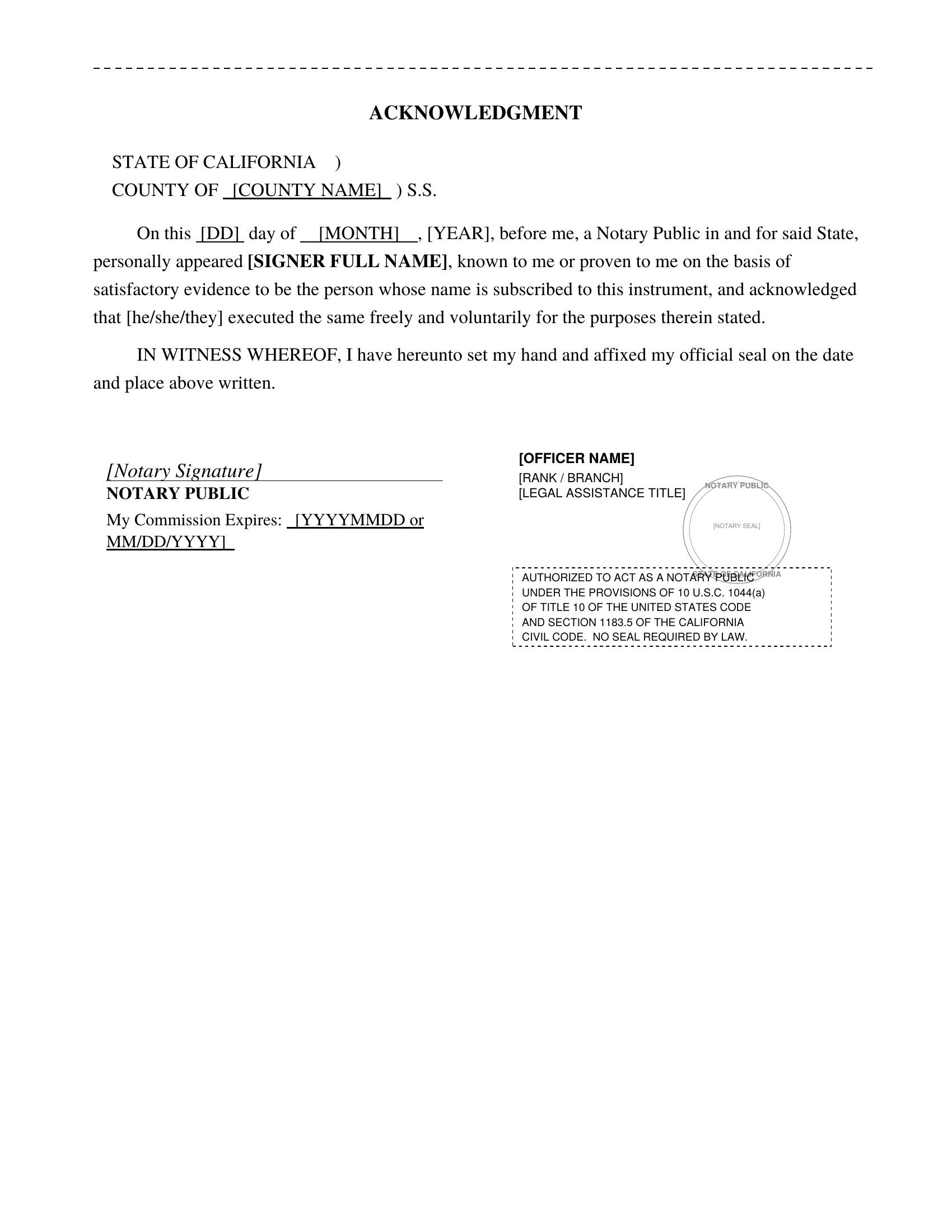
Sample military notary acknowledgment. The dashed-border stamp citing 10 U.S.C. § 1044(a) identifies this as a federal notarial act — performed under federal statutory authority by a military legal assistance officer or judge advocate, not a state-commissioned notary public.
10+ Years
Federal Experience
D.C. Based
Hand-Delivered Submissions
Full Coverage
All Federal Documents
Worldwide
Destination Coverage
On This Page
- What This Document Is
- Federal Authority of Military Notaries (10 U.S.C. § 1044a)
- Why the Federal Apostille Route Applies
- The Federal Authentication Chain
- Officers Authorized Under 10 U.S.C. § 1044a
- Required Format of the Acknowledgment
- How to Prepare Your Document
- Step-by-Step Process
- How to Visually Confirm the Apostille
- Common Rejection Reasons
- Non-Hague Destinations: Embassy Legalization
- Processing Times & Validity
- Why Choose Us
- Frequently Asked Questions
What This Document Is
A military notary acknowledgment is a notarization performed by a U.S. military officer acting under the federal authority of 10 U.S.C. § 1044a. The statute grants certain military personnel the same notarial powers as a state-commissioned notary public, valid anywhere in the world regardless of where the officer is stationed and regardless of whether the officer holds any state notary commission.
Military notary acknowledgments are commonly used when a service member — active duty, reservist, dependent, or eligible civilian — needs a notarized document but does not have practical access to a civilian notary. The notarization is typically performed at a military installation‘s legal assistance office, JAG office, or by an authorized officer in the field.
Common documents that bear a military notary acknowledgment:
- Powers of attorney (general, special, durable, healthcare)
- Real estate transaction documents (deeds, sale contracts, lender forms)
- Family law documents (single status affidavits, parental consents, custody affidavits)
- Estate planning documents (wills, codicils, trust documents, beneficiary forms)
- Business and corporate documents (entity formation, contract execution)
- Identity and citizenship affidavits
- Sworn statements and declarations for foreign use
Federal Authority of Military Notaries Under 10 U.S.C. § 1044a
10 U.S.C. § 1044a is the federal statute that creates the military notary system. The statute provides that certain military personnel "shall have the general powers of a notary public and of a consul of the United States" in the performance of all notarial acts. Three features of the statute are critical for apostille purposes:
- Federal authority, not state. The notarial power comes directly from federal statute. The officer is not commissioned by any state Secretary of State.
- Worldwide jurisdiction. The authority is valid wherever the officer is located — on a U.S. base in the continental United States, aboard a Navy vessel, at a forward operating base overseas, or anywhere else the officer is performing official duties.
- No seal required. The statute expressly waives the requirement of a seal. The acknowledgment typically includes a printed notice such as "No seal required by law" on the authority stamp. Some officers nonetheless affix a personal or command seal; either way is acceptable.
Why the Federal Apostille Route Applies
Apostille and authentication systems work by chain of signature verification: the certifying authority confirms that the signature on the document is genuine because that signature is on file with the certifying authority. The choice of certifying authority depends on whose signature is being verified.
For a state notary public, the state Secretary of State holds the notary‘s commission on file and can verify the signature. That is why state-notarized documents go to the state Secretary of State for the apostille.
For a military notary acting under 10 U.S.C. § 1044a, no state Secretary of State holds the officer‘s commission on file — because no state commissioned the officer. The U.S. Department of State Office of Authentications is the federal authority that recognizes military notary signatures, and it is the only authority that can issue an apostille on a 10 U.S.C. § 1044a notarization.
Common mistake: Submitting a military-notarized document
to a state Secretary of State for apostille. The state will reject the
submission because the officer‘s signature is not on the state‘s notary
signature file. The document must go directly to the U.S. Department of
State Office of Authentications.
The Federal Authentication Chain
For a military-notarized document, the apostille chain is shorter than for state-notarized documents. There is no state stage:
STEP 1
Military Notary
Document notarized under 10 U.S.C. § 1044a
→
STEP 2
U.S. Department of State
Office of Authentications, Washington, D.C.
→
STEP 3
Embassy or Consulate
Only if destination is non-Hague
For destinations that are members of the 1961 Hague Apostille Convention, the chain ends at Step 2 — the U.S. Department of State apostille is sufficient. For non-Hague destinations, Step 3 (embassy legalization in Washington, D.C.) is required as the final step.
Officers Authorized to Notarize Under 10 U.S.C. § 1044a
The statute and its implementing regulations identify the following categories of personnel as authorized to perform notarial acts under 10 U.S.C. § 1044a:
| Category | Details |
|---|---|
| Judge advocates | Active-duty and reserve judge advocates of all armed services (Army, Navy, Air Force, Marine Corps, Space Force, Coast Guard) and the Public Health Service Commissioned Corps. |
| Civilian attorneys serving as legal assistance officers | Civilian DoD attorneys assigned to provide legal assistance under 10 U.S.C. § 1044. |
| Adjutants and assistant adjutants | Of any component of the armed forces (active duty or reserve). |
| Personnel adjutants | Of any component of the armed forces. |
| Other persons designated by service regulations | Each armed service may designate additional categories of personnel in its own regulations. |
The Department of State Office of Authentications recognizes notarizations performed by any officer in these categories. The acknowledgment must identify the officer‘s name, rank or grade, branch of service, and title legibly.
Required Format of the Military Acknowledgment
For the U.S. Department of State Office of Authentications to authenticate a military notarization, the acknowledgment must contain the following elements:
- Express citation of 10 U.S.C. § 1044a in the authority statement. Standard wording: "Authorized to act as a notary public under the provisions of 10 U.S.C. § 1044(a)."
- Officer‘s typed (printed) full name — first, middle (or initial), and last name as it appears in service records.
- Officer‘s rank or grade and branch of service — e.g., "Captain, USMC" or "Lieutenant Commander, JAGC, USN."
- Officer‘s title in the legal assistance office — e.g., "Legal Assistance Attorney," "Trial Counsel," "Defense Counsel."
- Officer‘s legible original signature.
- Date of notarization.
- Acknowledgment language — properly worded for the type of notarial act being performed (acknowledgment, jurat, or oath).
About the seal: 10 U.S.C. § 1044a expressly waives the
seal requirement. The U.S. Department of State does not require a seal on
the notarial act. If an officer affixes a personal or command seal anyway,
that is acceptable but not necessary.
How to Prepare Your Document for Federal Apostille
Preparation depends on whether the document is already notarized or still needs notarization. In either case, the document must reach the U.S. Department of State in its final, complete form.
If the Document Is Already Notarized
- Confirm that the acknowledgment cites 10 U.S.C. § 1044a.
- Confirm that the officer‘s name, rank, branch, and title are legible.
- Confirm that the date of notarization is present.
- The document and acknowledgment must be on the same page, or the acknowledgment must be securely attached as a separate page citing the underlying document.
- Do not separate, modify, or annotate the document after notarization.
If the Document Still Needs Notarization
- Sign the document in front of the military officer — never beforehand. The officer must witness the signature.
- Bring valid photo identification (military ID, passport, or government-issued ID).
- If the document requires a jurat or oath rather than a plain acknowledgment, alert the officer in advance so the correct notarial wording is used.
- Request that the officer print clearly all required identifying information (name, rank, branch, title).
Step-by-Step Process
1
Confirm Eligibility for Federal Apostille
Verify that the notarization was performed under 10 U.S.C. § 1044a (military notary) — not by a state-commissioned notary public, even if that notary happens to be a service member. The authority cited on the acknowledgment determines the route.
2
Document Review
Submit your order and send us the original military-notarized document. Our team verifies the acknowledgment language, officer identification, and supporting requirements before submission to the U.S. Department of State.
3
U.S. Department of State Submission
We hand-deliver the document to the U.S. Department of State Office of Authentications in Washington, D.C. The Office authenticates the officer‘s signature against its records of military notaries.
4
Federal Apostille Issued
The U.S. Department of State issues either an Apostille (for destinations that are Hague Convention members) or an Authentication Certificate (for non-Hague destinations). The federal certificate is affixed to the document.
5
Embassy Legalization (Non-Hague Destinations Only)
If your destination country is not a Hague Convention member, we submit the document to the destination country‘s embassy or consulate in Washington, D.C. for final legalization.
6
Certified Translation & Return Shipping
If your destination requires the document in another language, we provide certified translations alongside the federal apostille. Final delivery is via tracked, insured shipping worldwide.
How to Visually Confirm the Apostille
A properly apostilled military-notarized document will display the following, attached in this order to the underlying document:
- The underlying document bearing the military notary acknowledgment, signed and dated by the officer, citing 10 U.S.C. § 1044a.
- The U.S. Department of State Apostille — issued by the Office of Authentications on Department of State letterhead, bearing the Department of State seal and signature of an Authentication Officer. For Hague destinations, this is formatted under the standard ten-point Hague Convention apostille format.
- For non-Hague destinations only — an embassy or consular legalization stamp, sticker, or certificate added by the destination country‘s embassy or consulate in Washington, D.C.
- For destination countries requiring translation — a certified translation in the destination language attached alongside the federal apostille.
Common Reasons Submissions Are Rejected
1. Acknowledgment Does Not Cite 10 U.S.C. § 1044a
If the acknowledgment lacks the statutory citation — or cites only a state notary statute — the U.S. Department of State cannot confirm that the notarization was performed under federal military authority. Fix: have the officer re-notarize with the correct authority block, or attach a supplemental certification.
2. Officer‘s Name, Rank, or Branch Illegible
The Department of State must identify the officer to verify the signature against its records. If the name, rank, or branch is illegible or omitted, the document is rejected. Fix: request a replacement notarization with all identifying information typed or printed clearly.
3. Submitted to the Wrong Authority (State Apostille Attempted)
A military-notarized document submitted to a state Secretary of State will be rejected — the state has no record of the officer‘s commission because there is none. Fix: route to the U.S. Department of State Office of Authentications, the only authority that can authenticate a 10 U.S.C. § 1044a notarization.
4. Photocopy Submitted Instead of Original
The Department of State authenticates original signatures only. Photocopies of the notarized document are not eligible. Fix: submit the original signed and notarized document.
5. Document Altered After Notarization
Any modification to the document after the officer‘s signature voids the notarization. This includes adding pages, changing wording, or annotating the document. Fix: have the document re-notarized in its corrected final form.
6. Embassy Translation Requirement Missed (Non-Hague Destinations)
Many non-Hague country embassies require certified translation into the destination language before they will legalize. Fix: coordinate certified translation alongside the federal apostille.
Non-Hague Destinations: Adding Embassy Legalization
If your destination country is not a member of the 1961 Hague Apostille Convention, the U.S. Department of State authentication alone is not enough — the document must also be legalized by the destination country‘s embassy or consulate in Washington, D.C. before it is recognized in the destination country.
Non-Hague destinations that commonly require this additional step include Saudi Arabia, Qatar, Kuwait, Egypt, Vietnam, Cambodia, Iran, Iraq, Pakistan, Bangladesh, and certain African countries. Hague Convention membership shifts periodically — China joined in 2023, and the UAE and Canada joined in 2024, so documents bound for those countries no longer require embassy legalization. We confirm current Hague status as part of every order.
Processing Times & Validity
- U.S. Department of State Office of Authentications: currently 10 to 12 business days for routine processing (subject to government workload). Expedited service is available through our office.
- Embassy / consulate legalization (non-Hague destinations): typically 3 business days to 4 weeks, depending on the destination country.
- Total realistic timeline for Hague destinations: 2 to 3 weeks.
- Total realistic timeline for non-Hague destinations: 4 to 8 weeks, sometimes longer for complex destinations.
- Validity for foreign use: federally-apostilled documents do not formally expire, but some destination embassies impose freshness rules — typically 3 to 6 months from the date of notarization.
Why Choose Federal Apostille and Notary Processing
- Federal-document focus. Our entire workflow is built around the U.S. Department of State Office of Authentications and the Washington, D.C. embassy chain — exactly the route a military-notarized document must follow.
- Walking-distance proximity. Our office is at 1050 Connecticut Ave NW, Ste 500 in Washington, D.C., near the Department of State and the major embassies. We hand-deliver, not mail.
- Pre-submission review by federal apostille specialists — catching format and language issues with the military acknowledgment before the document is submitted.
- Certified translations in Arabic, Vietnamese, Farsi, Spanish, and other languages required by non-Hague country embassies.
- Worldwide tracked shipping via FedEx, UPS, and DHL — direct to your foreign destination or to wherever you are stationed.
- Real-time order tracking from intake through delivery.
- Service member friendly. We work with active duty service members and their families stationed CONUS and OCONUS — submission by mail or courier, no in-person visit required.
Frequently Asked Questions
What does 10 U.S.C. § 1044a mean on the acknowledgment?
It is the federal statute granting military legal assistance officers and judge advocates the same notarial powers as a state notary public, valid anywhere in the world. When this citation appears on the acknowledgment, the document is a federal notarial act and must be apostilled by the U.S. Department of State, not by any state Secretary of State.
Can I take a military-notarized document to my state‘s Secretary of State instead?
No. State Secretaries of State only maintain commission records for notaries they themselves commissioned. A 10 U.S.C. § 1044a notary is commissioned under federal statute and is not on any state‘s signature file. The state will reject the submission. The only correct route is the U.S. Department of State Office of Authentications.
Do I need to be in Washington, D.C. to use your service?
No. We work with clients nationwide and internationally. You can mail or courier your document to our D.C. office, and we handle hand-delivery to the U.S. Department of State and any required embassy on your behalf.
My document doesn‘t have a seal — is that a problem?
No. 10 U.S.C. § 1044a expressly waives the seal requirement for military notarizations. The U.S. Department of State will authenticate the document based on the officer‘s signature alone, provided the statutory citation and identifying information are present.
The officer is deployed and I‘m stateside. Will it work?
Yes — the officer‘s location at the time of notarization has no effect on the validity. 10 U.S.C. § 1044a grants worldwide jurisdiction. The notarization is just as valid whether performed at Fort Liberty, aboard the USS Gerald R. Ford, or at a forward operating location.
Does Hague Convention membership matter for this document?
Yes — for the embassy stage only. The federal apostille from the U.S. Department of State is required for every destination. Whether embassy legalization is also required depends on whether the destination country is a Hague Convention member. Hague members (Mexico, Spain, Italy, Germany, Japan, Brazil, China since 2023, the UAE since 2024, and others) require only the federal apostille. Non-Hague countries (Saudi Arabia, Qatar, Kuwait, Egypt, Vietnam, Iran, and others) require both federal apostille and embassy legalization.
How long does it take?
Routine federal apostille processing is currently 10 to 12 business days at the U.S. Department of State. For non-Hague destinations, additional embassy time (3 days to 4 weeks) applies. Expedited federal processing is available through our office.
I had a state notary witness my signature but the notary happens to be in the military. Which route?
The route is determined by the authority cited on the acknowledgment — not by the notary‘s military status. If the acknowledgment cites a state notary commission, it is a state notarization and must go to that state‘s Secretary of State. If the acknowledgment cites 10 U.S.C. § 1044a, it is a federal notarization and must go to the U.S. Department of State. The wording of the acknowledgment controls.
Can the document be notarized abroad and apostilled here?
Yes. A 10 U.S.C. § 1044a notarization performed at an overseas military installation is fully valid and is apostilled by the U.S. Department of State in Washington, D.C. The originating location has no effect on the federal apostille process. You or your representative ship the original notarized document to the U.S. for federal apostille processing.
What about powers of attorney that are time-sensitive?
Powers of attorney are among the most common military-notarized documents. If your power of attorney has a hard foreign deadline (a real estate closing, a foreign business filing, etc.), let us know at intake so we can prioritize the order and use expedited federal processing where available.
Ready to Apostille Your Military-Notarized Document?
Federal apostille of 10 U.S.C. § 1044a notarizations at the U.S. Department of State Office of Authentications. Embassy legalization for non-Hague destinations handled in-house. Certified translation in Arabic, Vietnamese, Farsi, and other languages.
Start My Order Call (760) 469-2997