FAA Aircraft Bill of Sale Apostille (AC Form 8050-2)
Federal authentication of your FAA Aircraft Bill of Sale through the U.S. Department of State — for international aircraft sales, foreign registration, deregistration, and export.
Hand-delivered submission in Washington, D.C. Pre-submission review by federal-document specialists. Embassy legalization handled in-house for non-Hague countries.
What Is an FAA Aircraft Bill of Sale?
An FAA Aircraft Bill of Sale — issued on AC Form 8050-2 — is the official federal instrument used to transfer legal ownership of any aircraft on the United States civil aircraft registry (any aircraft bearing an "N-number"). The form is filed with the Federal Aviation Administration's Aircraft Registration Branch (AFS-750) at the Mike Monroney Aeronautical Center in Oklahoma City, Oklahoma, where it is recorded as part of the aircraft's permanent federal title chain.
A properly executed and recorded Bill of Sale documents the conveyance of "all rights, title, and interests" in a specific aircraft from the seller to the purchaser. Once filed and accepted by the FAA, it becomes a federal record of the transaction — distinct from any state title document, contract of sale, or foreign aircraft registry filing.
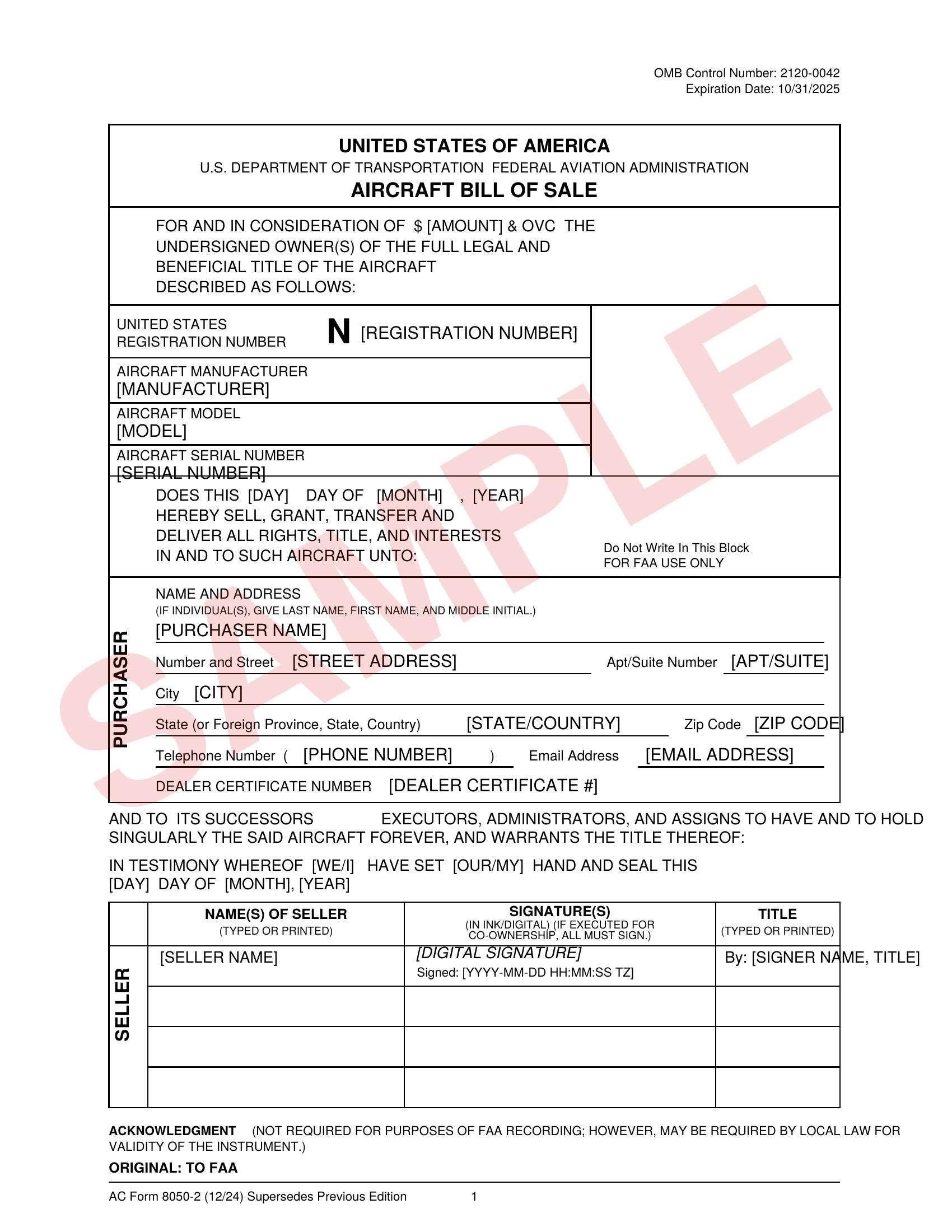
A standard AC Form 8050-2 contains:
- Document title: "United States of America — U.S. Department of Transportation — Federal Aviation Administration — Aircraft Bill of Sale"
- Form number and revision: AC Form 8050-2 (current revision 12/24)
- Consideration stated by the parties (e.g., "$1.00 & OVC")
- U.S. registration number (N-number) of the aircraft
- Aircraft manufacturer, model, and serial number
- Date of execution
- Purchaser name and address (including foreign address where applicable)
- Seller name(s), signature(s), and title(s) — ink or qualifying digital signature
- Dealer Certificate number, where applicable
- FAA recordation block — populated by the FAA upon acceptance
The Bill of Sale is generally executed simultaneously with — or shortly before — the buyer's Application for Aircraft Registration (AC Form 8050-1), and the two are typically submitted to the FAA together.
What It Is Used For Internationally
Because the Bill of Sale establishes the chain of title for the aircraft under federal law, foreign governments and aviation authorities treat it as the controlling document for cross-border aircraft transactions. A federally authenticated AC Form 8050-2 is commonly required for:
- Re-registration of the aircraft in a foreign country — most foreign civil aviation authorities require an apostilled Bill of Sale to issue a new registration certificate (e.g., Mexican XB-/XA- registry, Brazilian PP-/PT- registry, Canadian C- registry, EASA member-state registries).
- Deregistration from the U.S. N-number registry — when an aircraft is exported and the new state of registry requires proof of the FAA-recorded transfer.
- Export customs clearance — customs authorities in the destination country routinely require an apostilled Bill of Sale to release the aircraft from bond.
- Foreign airworthiness and import certification — civil aviation authorities issuing a new Certificate of Airworthiness or import permit may require the authenticated transfer of ownership document.
- Cross-border aircraft financing and leasing — international lenders, lessors, and security trustees use the apostilled Bill of Sale to perfect their interest in the aircraft under the laws of the new country.
- Cape Town Convention filings — for aircraft objects registered with the International Registry, an authenticated Bill of Sale supports priority filings.
- Foreign tax, VAT, and import-duty proceedings — tax authorities frequently require federally authenticated transfer documentation to assess or exempt import duties.
- Foreign court proceedings — disputes involving aircraft title, repossession, or estate matters in foreign jurisdictions.
- Aircraft auction and bankruptcy sales — international buyers require the apostilled Bill of Sale to perfect ownership under their domestic law.
Foreign authorities require federal authentication because they cannot independently verify the legitimacy of the FAA's certification or the U.S. recordation seal.
Bill of Sale vs. Title vs. Foreign Registration Documents — Don't Confuse Them
Aircraft transactions often involve several documents that look similar but serve different legal purposes and are authenticated through different channels.
| Document | Issued / Filed With | What It Proves | How It's Authenticated |
|---|---|---|---|
| FAA Aircraft Bill of Sale — AC Form 8050-2 | Executed by seller; recorded with the FAA Aircraft Registration Branch (AFS-750), Oklahoma City | Transfer of ownership in a U.S.-registered aircraft | Federal apostille / authentication by the U.S. Department of State, Office of Authentications in Washington, D.C., based on a FAA-Certified True Copy. |
| Certificate of Aircraft Registration — AC Form 8050-3 | Issued by the FAA Aircraft Registry to the registered owner | That the aircraft is currently registered to a specific owner | Federal apostille based on a FAA-Certified True Copy of the registration record. |
| Foreign Aircraft Registration Certificate | The civil aviation authority of another country (after re-registration) | That the aircraft is registered under the laws of that country | Apostilled or legalized by the foreign government that issued it — not by the U.S. Department of State. |
| Private contract of sale / purchase agreement | Negotiated and signed by the parties | Contractual terms of the transaction (price, warranties, indemnities, escrow, delivery) | If notarized, can be apostilled at the state Secretary of State level. Not a federal document and not equivalent to the FAA Bill of Sale. |
For international aircraft transfers, you may need multiple documents authenticated through different channels. The federal apostille covers the FAA Bill of Sale and related FAA registry documents; state apostilles cover notarized contracts of sale, escrow agreements, and corporate authority documents.
Originals Are Filed with the FAA — You Need a Certified Copy
This is the single most common point of confusion for first-time international aircraft sellers. The transaction works like this:
- You execute the original AC Form 8050-2.
- You submit the original to the FAA Aircraft Registration Branch with the new owner's registration application.
- The FAA records the Bill of Sale, retains the original in the aircraft file at Oklahoma City, and issues the new Certificate of Aircraft Registration.
- To obtain an apostille for international use, you (or the new owner) request a FAA-Certified True Copy of the recorded Bill of Sale from the Aircraft Registry.
- The certified copy — bearing the FAA Aircraft Registry's certification statement, registrar's signature, and official seal — is what the U.S. Department of State authenticates.
Equally important:
- An uncertified photocopy of your unrecorded Bill of Sale is not eligible for federal authentication. Even if notarized, a photocopy carries no federal certification and will be rejected.
- State-level apostilles are invalid on FAA documents. The FAA is a federal agency, and only the U.S. Department of State can authenticate its certifications.
- Lamination, alteration, or annotation of the certified copy will cause rejection.
How to Obtain a FAA-Certified True Copy
The FAA Aircraft Registration Branch (AFS-750) is the only authority that can issue a certified true copy of a recorded Bill of Sale that is acceptable for federal authentication.
Where to Request
Requests are submitted to the FAA Aircraft Registration Branch at the Mike Monroney Aeronautical Center, Oklahoma City, Oklahoma. Requests may be submitted by mail, by fax, or in person at the public counter. We can also handle the request on your behalf as part of an end-to-end order.
What to Submit
- Aircraft identification — U.S. registration number (N-number), aircraft manufacturer, model, and serial number.
- Document identification — date of the Bill of Sale and the names of the parties, when known.
- Requestor information — name, address, and contact details of the person making the request.
- Applicable FAA fee — per-document copy fee (verify current rates on faa.gov).
- Return shipping — pre-paid label or shipping instructions, for fastest return.
Processing Time
Routine requests currently take 5 to 10 business days. Expedited counter service is available in person at the Oklahoma City public counter and through expediter services. For time-sensitive transactions, we can coordinate expedited retrieval as part of the apostille order.
Acceptable Certified Copies Must:
- Be issued directly by the FAA Aircraft Registration Branch (AFS-750)
- Bear the FAA Aircraft Registry's certification statement
- Display the authorized registrar's signature
- Show the official FAA Aircraft Registry seal
- Be printed on official FAA paper or stock
Why Federal Authentication Is Required
Apostille and authentication authority in the United States is divided between state Secretaries of State and the U.S. Department of State based on the issuing authority of the document — not on the subject matter.
| Issuing Authority | Examples | Where Authenticated |
|---|---|---|
| State or local government | State vehicle titles, notarized aircraft purchase contracts, corporate authority documents, notarized affidavits, state-licensed escrow documents | Secretary of State of the issuing state |
| Federal government | FAA Aircraft Bill of Sale (AC Form 8050-2), FAA Certificate of Aircraft Registration (AC Form 8050-3), FAA airworthiness certificates, FAA pilot/mechanic certificates, Consular Report of Birth Abroad, Certificate of Naturalization, FBI Identity History Summary, IRS letters, SSA verifications, DD-214 military records | U.S. Department of State, Office of Authentications — Washington, D.C. |
Because the Bill of Sale is recorded and certified by the Federal Aviation Administration — a federal agency within the U.S. Department of Transportation — it cannot be apostilled at the state level. State authorities have no jurisdiction to authenticate federal documents, and any state apostille placed on a FAA-certified copy is invalid and will be rejected by the receiving foreign government and foreign aviation authority.
Federal authentication serves to:
- Verify that the document was issued by the FAA Aircraft Registration Branch
- Confirm the authenticity of the registrar's signature and the FAA Aircraft Registry seal
- Enable formal recognition by foreign governments under international law and the 1961 Hague Apostille Convention
travel.state.gov — Authenticate Your Document
Document Preparation Requirements
To be eligible for federal authentication, the FAA-Certified True Copy must meet all federal submission standards. Even minor deviations can cause rejection.
Acceptable Formats
- FAA-Certified True Copy of AC Form 8050-2 obtained directly from the FAA Aircraft Registration Branch (AFS-750).
- Must bear the official FAA Aircraft Registry certification statement and the registry seal.
- Must include the authorized signature of the FAA registrar or duly delegated officer.
- Older revisions of AC Form 8050-2 are accepted, provided the FAA certification on the copy is current.
Strict Preparation Rules
- Submit the certified copy exactly as issued by the FAA — no edits, modifications, or additions.
- Do not notarize the certified copy. Notarization does not add validity and may complicate processing.
- Do not laminate the document. Lamination obstructs the federal seal and prevents proper apostille attachment.
- Do not staple through the certification, hole-punch the seal, or fold across signatures.
- Do not write on, highlight, or annotate any portion of the certified copy.
- Photocopies, scans, or reprints of the certified copy are not acceptable.
- If the destination country requires the apostille on the reverse side or in a specific orientation, advise our team at intake so we can request the proper FAA copy format.
Step-by-Step Apostille Process
Confirm Recordation with the FAA
Verify that the Bill of Sale has been filed with and recorded by the FAA Aircraft Registration Branch in Oklahoma City. We can confirm recordation on your behalf if needed.
Request a FAA-Certified True Copy
Submit a request to AFS-750 for a certified true copy of the recorded Bill of Sale. We can handle this step end-to-end as part of an integrated order, or you can supply the certified copy directly.
Order & Document Review
Submit your order online and send us the FAA-Certified True Copy. Our team verifies the certification, seal, and signature meet federal submission standards before any Department of State filing.
Department of State Submission
We hand-deliver your document to the U.S. Department of State, Office of Authentications in Washington, D.C., along with the federal authentication request form (DS-4194) and the appropriate federal fee.
Apostille or Authentication Issued
The Office of Authentications issues either an Apostille (Hague Convention countries) or an Authentication Certificate (non-Hague countries), affixed directly to your FAA-Certified True Copy.
Embassy Legalization (If Required)
For non-Hague countries, we forward the authenticated document to the destination country's embassy or consulate in Washington, D.C., for final legalization.
Certified Translation (Optional)
If your destination country's civil aviation authority requires the document in another language, we provide certified translations — commonly Spanish (Mexico, Argentina, Colombia, Spain), Portuguese (Brazil), French, Italian, Arabic, Chinese, and others.
How to Visually Confirm the Document Is Ready
Before submitting your FAA-Certified True Copy for federal authentication, verify that all of the following are present and intact. (Refer to the sample image at the top of this page for what a properly executed AC Form 8050-2 looks like.)
- Clear document title — "United States of America — U.S. Department of Transportation — Federal Aviation Administration — Aircraft Bill of Sale"
- Form designator visible: AC Form 8050-2 (with revision date)
- Aircraft details fully populated — U.S. registration number (N-number), manufacturer, model, and serial number
- Purchaser name and address fully populated
- Seller name(s), signature(s), and title(s) clearly readable
- FAA recordation block clearly populated by the FAA Aircraft Registry
- FAA Aircraft Registry certification statement on the copy
- Authorized signature of the certifying FAA registrar
- Official FAA Aircraft Registry seal — clear and unobstructed
- No alterations, marks, or handwritten notes
- No lamination, staples, binding, or attachments
- Clean margins with no trimming or cropping
Common Reasons FAA Bill of Sale Submissions Are Rejected
The Department of State and foreign aviation authorities routinely reject FAA Bill of Sale submissions for a small set of recurring issues. All are preventable.
1. Uncertified Photocopy Submitted
The single most common rejection. A photocopy of your file copy of the Bill of Sale — even one that looks perfect — has no federal certification. Fix: request a FAA-Certified True Copy from the FAA Aircraft Registration Branch and submit only the certified version.
2. Notarized Photocopy Submitted
A notary public has no authority to certify federal records. A notarized photocopy of an FAA Bill of Sale is invalid for federal authentication. Fix: obtain certification directly from the FAA Aircraft Registry.
3. Bill of Sale Not Yet Recorded with the FAA
If the Bill of Sale has not been filed with and accepted by the FAA Aircraft Registration Branch, there is no recorded original from which to issue a certified copy. Fix: file the Bill of Sale with the FAA first; once recorded, request the certified copy.
4. State-Level Apostille Attempted
State Secretaries of State have no authority over federal documents. Submissions routed to a state office are returned unprocessed. Fix: ensure submission goes to the U.S. Department of State, Office of Authentications in Washington, D.C.
5. Laminated or Altered Certified Copy
Lamination obstructs the FAA seal and prevents the apostille from being properly affixed. Fix: never laminate any federal document. Request a replacement certified copy from the FAA.
6. Missing or Illegible Certification
Faded seals, unclear registrar signatures, or damaged certification language cause rejection. Fix: ensure the certified copy is clean, intact, and fully legible. Request a fresh copy if quality is compromised.
7. Wrong Country Routing (Hague vs. Non-Hague)
A Hague apostille issued for a non-Hague destination — or a non-Hague authentication for a Hague country — will be rejected by the foreign aviation authority. Fix: confirm the destination country's Hague Convention status before ordering.
8. Apostille Affixed Without Embassy Legalization (for Non-Hague Countries)
Some non-Hague countries require both U.S. Department of State authentication and their embassy's legalization stamp before recognizing the document. Fix: for non-Hague destinations, complete the embassy legalization step in Washington, D.C. before shipping the document abroad.
Hague Convention vs. Non-Hague Countries
The final form of authentication depends on whether the destination country is a member of the 1961 Hague Apostille Convention:
| Destination Type | What You Receive | Additional Steps | Common Aviation Destinations |
|---|---|---|---|
| Hague Convention country | Apostille issued by U.S. Department of State | None — document is ready for use abroad. | Mexico, Brazil, Argentina, Colombia, Chile, Spain, Italy, Portugal, France, Germany, Netherlands, UK, Switzerland, Australia, India, Japan, South Korea. |
| Non-Hague country | Authentication Certificate from U.S. Department of State | Embassy or consulate legalization required after authentication. | UAE, Saudi Arabia, Qatar, Kuwait, Egypt, Vietnam, Cambodia, Iran, Iraq. |
Hague Convention membership changes periodically — and aviation-active countries like the UAE and Saudi Arabia have specific embassy legalization workflows for FAA documents. Federal Apostille and Notary Processing verifies the destination country's current status and embassy requirements as part of every order. View our Country Guide for the latest list.
Processing Times & Validity
Total turnaround depends on three stages: the FAA Aircraft Registry issuing the certified true copy, the U.S. Department of State Office of Authentications processing the apostille, and (when required) embassy legalization.
- FAA-Certified True Copy request (routine): currently 5 to 10 business days.
- FAA Aircraft Registry expedited / counter pickup: available; can reduce turnaround to 1–3 business days for time-sensitive transactions.
- U.S. Department of State authentication: currently 10–12 business days for routine processing (subject to government workload — expedited service available through our office).
- Embassy legalization: varies widely by country and embassy — typically 3 business days to 4 weeks.
- Validity for foreign use: FAA Bills of Sale do not expire. However, some foreign civil aviation authorities require recently issued certified copies (typically within the last 3–6 months) and recently issued apostilles, particularly for re-registration. Confirm the destination country's specific requirement before ordering.
For time-critical international closings, we coordinate FAA certified-copy retrieval, federal authentication, and embassy legalization in parallel wherever possible. Use our Processing Time Estimator for a country-specific projection.
Why Choose Federal Apostille and Notary Processing
We are a Washington, D.C.-based document processing service specializing exclusively in federal authentications. FAA Aircraft Bill of Sale apostilles are one of our most-requested services among aircraft brokers, dealers, exporters, leasing companies, and aviation attorneys handling international aircraft transactions — particularly Mexico, Brazil, Argentina, and Caribbean closings.
- End-to-end FAA coordination — we can request the FAA-Certified True Copy from Oklahoma City on your behalf and have it federally authenticated in a single workflow.
- Hand-delivery to the U.S. Department of State, Office of Authentications — no mail delays.
- $120 flat-rate pricing with all government authentication fees included — no hidden costs.
- Pre-submission review by federal-document specialists who catch the most common rejection issues (uncertified copies, missing recordation, lamination, state-level routing) before they cost you time and money.
- Embassy legalization for non-Hague countries handled in-house in Washington, D.C. — important for UAE, Saudi, and other Gulf destinations.
- Certified translations in Spanish, Portuguese, French, Italian, German, Vietnamese, Arabic, Chinese, and other languages — calibrated to civil aviation authority requirements.
- Worldwide tracked shipping via FedEx, UPS, and DHL.
- Real-time order tracking from FAA retrieval through delivery abroad.
- Over 10 years of experience processing federal authentications, including FAA documents.
Frequently Asked Questions
Can I apostille the original FAA Aircraft Bill of Sale that I signed?
No. The original Bill of Sale (AC Form 8050-2) is recorded with and retained by the FAA Aircraft Registration Branch in Oklahoma City — it is not returned to the seller or buyer after recording. For federal authentication, you must request a FAA-Certified True Copy from the FAA Aircraft Registry. The certified copy is what gets the apostille.
Can a state Secretary of State apostille my FAA Bill of Sale?
No. The FAA Aircraft Bill of Sale is a federal document recorded by the Federal Aviation Administration, which is part of the U.S. Department of Transportation. Only the U.S. Department of State, Office of Authentications in Washington, D.C. can apostille or authenticate it. Any state apostille placed on a FAA document is invalid and will be rejected by foreign governments and foreign aviation authorities.
How do I order a Certified True Copy from the FAA Aircraft Registry?
Submit a request to the FAA Aircraft Registration Branch (AFS-750) at the Mike Monroney Aeronautical Center in Oklahoma City, Oklahoma. You can request by mail, by fax, or in person at the public counter. Identify the aircraft by U.S. registration number (N-number), manufacturer, model, and serial number, and request a certified true copy of the recorded Bill of Sale. A small per-document fee applies. Routine processing currently takes 5 to 10 business days; expedited counter service is also available. We can handle this step on your behalf as part of an integrated order.
Do I need to notarize the Bill of Sale before sending it for apostille?
No. Notarization is not required for FAA recording and does not make the document eligible for federal apostille. What matters for international use is that the document is a FAA-Certified True Copy bearing the FAA Aircraft Registry's certification statement, registrar's signature, and official seal. A notarized photocopy of an unrecorded Bill of Sale is not acceptable for federal authentication. The acknowledgment block on AC Form 8050-2 itself is optional for FAA recording, though it may be required by local law in some jurisdictions for validity of the underlying contractual transfer.
Can the apostille be placed on a Bill of Sale from a private aircraft sale before it has been filed with the FAA?
Not through federal authentication. The U.S. Department of State only authenticates FAA-Certified True Copies of documents already recorded with the Aircraft Registry. If the transaction has not been recorded with the FAA yet, the bill of sale must first be submitted to and accepted by the FAA Aircraft Registration Branch. Once recorded, you can request the certified true copy and proceed with the apostille. (As an alternative for some commercial closings, a separately notarized contract of sale can be apostilled at the state level, but this is a different document and serves a different legal purpose.)
How long does the entire process take from FAA recordation to apostille?
If the Bill of Sale is already recorded with the FAA, the FAA-Certified True Copy request typically takes 5 to 10 business days, and our Department of State authentication takes 10–12 business days. Embassy legalization, if needed, adds an additional 3 business days to 4 weeks. Total timelines typically run 3 to 8 weeks. For time-critical closings — Mexican deregistration, Brazilian import permits, UAE embassy legalization — we coordinate FAA retrieval and federal authentication in parallel where possible.
I'm exporting an aircraft to Mexico. What do I actually need?
Mexican re-registration (XB- or XA- registry) typically requires: (1) an apostilled FAA-Certified True Copy of the AC Form 8050-2 Bill of Sale, (2) an apostilled FAA-Certified True Copy of the AC Form 8050-3 Certificate of Aircraft Registration, (3) Mexican deregistration confirmation that the aircraft has been removed from the U.S. N-number registry, and (4) certified Spanish translations of all apostilled documents. We handle items (1), (2), and (4) in a single workflow; item (3) is coordinated with the FAA Aircraft Registry. Mexico is a Hague Convention country, so embassy legalization is not required.
What about exporting to the UAE, Saudi Arabia, or other Gulf countries?
Gulf countries are typically non-Hague Convention members and require both U.S. Department of State authentication and embassy legalization. Our workflow for UAE-bound aircraft documents includes: FAA-Certified True Copy → U.S. Department of State authentication → UAE Embassy legalization in Washington, D.C. → certified Arabic translation. We handle all steps in-house. Plan for an additional 1–3 weeks beyond standard Hague processing.
Can I get the FAA Certificate of Aircraft Registration (AC 8050-3) apostilled at the same time?
Yes — and most international aircraft transactions require both. The Bill of Sale (AC 8050-2) proves the transfer; the Certificate of Aircraft Registration (AC 8050-3) proves current registered ownership. Foreign civil aviation authorities and customs agencies typically require both apostilled together. We can request both certified true copies from the FAA in a single retrieval and process both apostilles simultaneously.
Will I need a certified translation of the apostilled Bill of Sale?
Most foreign civil aviation authorities require a certified translation into the official language of the destination country — Spanish for Mexican and Latin American registries, Portuguese for Brazil, Arabic for Gulf countries, and so on. We offer certified translations alongside the apostille service so that everything is delivered ready-to-file at the foreign aviation authority.
Do I need to be in Washington, D.C. or visit your office in person?
No. We work with aircraft owners, brokers, dealers, and aviation attorneys nationwide and internationally. You can supply the FAA-Certified True Copy by mail or courier (or have us request it from the FAA on your behalf), and we handle the in-person submission to the U.S. Department of State, Office of Authentications and embassy legalization in Washington, D.C.
The seller of the aircraft used a digital signature on the Bill of Sale. Is that acceptable?
Yes. The current revision of AC Form 8050-2 (12/24) expressly accepts digital signatures: "SIGNATURE(S) (IN INK/DIGITAL) (IF EXECUTED FOR CO-OWNERSHIP, ALL MUST SIGN.)" Once recorded by the FAA, a digitally signed Bill of Sale becomes part of the federal record and can be issued as a FAA-Certified True Copy for apostille purposes. The FAA's certification — not the seller's signature method — is what makes the document eligible for federal authentication.
Summary
The FAA Aircraft Bill of Sale (AC Form 8050-2) is a federal title document recorded by the Federal Aviation Administration's Aircraft Registration Branch in Oklahoma City. Because it is a federal record, only the U.S. Department of State — never a state Secretary of State — can authenticate it for international use. Original Bills of Sale are filed with and retained by the FAA; a FAA-Certified True Copy is required for apostille processing.
Federal Apostille and Notary Processing handles every step — from FAA-Certified True Copy retrieval through Department of State authentication, embassy legalization, and certified translation — so that your aircraft Bill of Sale is delivered abroad in legally recognized form for foreign re-registration, deregistration, export customs clearance, cross-border financing, and international aviation closings.
Ready to Get Your FAA Bill of Sale Apostilled?
$120 flat rate. Hand-delivered to the U.S. Department of State. 10–12 business day federal turnaround. End-to-end FAA Certified True Copy retrieval available. Embassy legalization for non-Hague destinations handled in-house.
