
Certificate of Naturalization Apostille
Federal authentication of your USCIS Certificate of Naturalization through the U.S. Department of State — for use in any country worldwide.
Hand-delivered submission in Washington, D.C. Pre-submission review by federal-document specialists. Embassy legalization handled in-house for non-Hague countries.
What This Document Is
A Certificate of Naturalization is an official federal record issued to individuals who have become United States citizens through the naturalization process. It is issued by U.S. Citizenship and Immigration Services (USCIS), a federal agency under the U.S. Department of Homeland Security, and serves as primary evidence of acquired U.S. citizenship — recognized both domestically and internationally when properly authenticated.
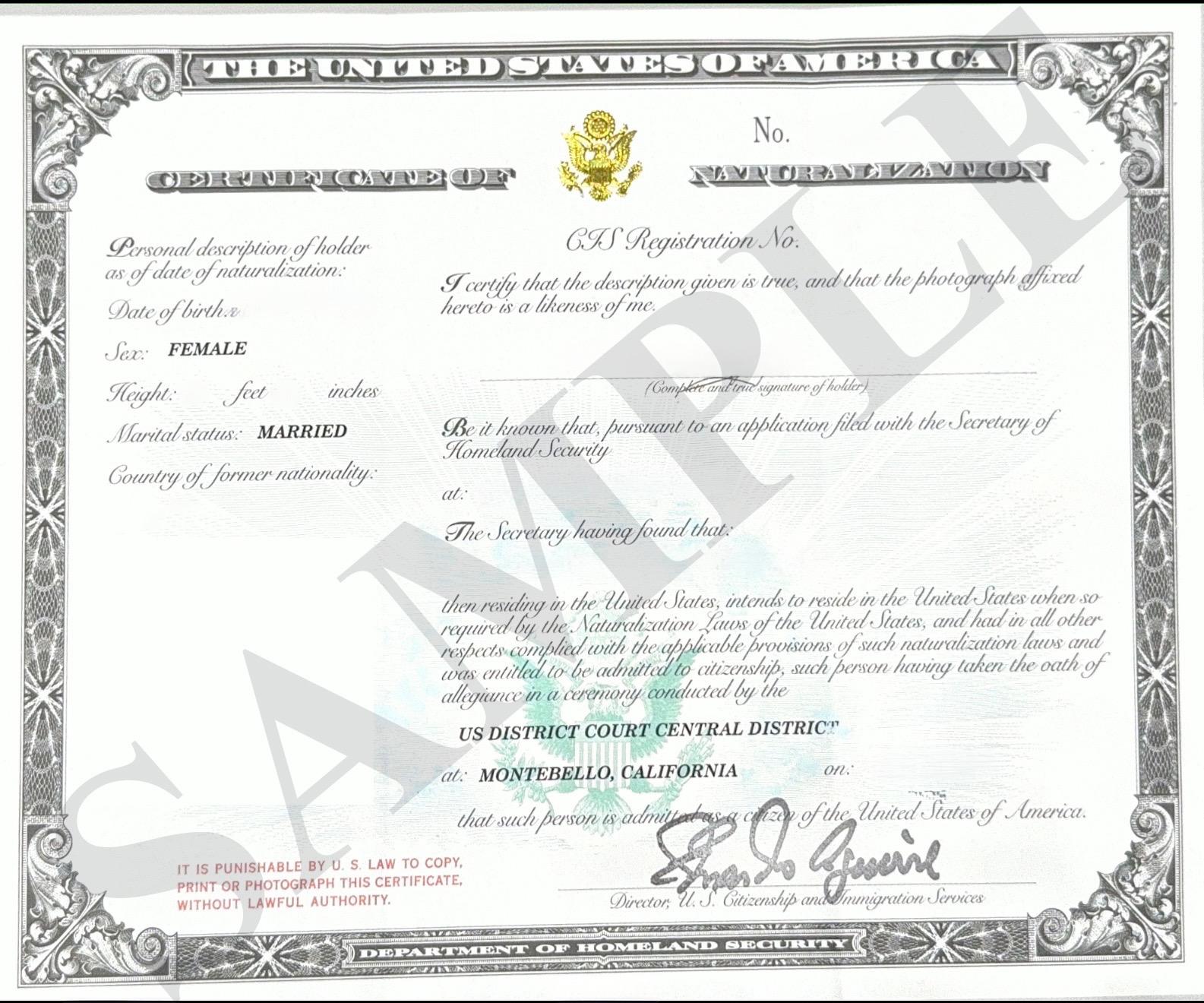
A standard Certificate of Naturalization contains the following information:
- Full legal name of the naturalized citizen at the time of the oath ceremony
- USCIS A-number (Alien Registration Number)
- Certificate number (a unique identifier for the document itself)
- Date and place of naturalization (city, state, and oath ceremony court)
- Photograph of the naturalized citizen
- Date of birth, country of former allegiance, sex, and physical description
- Official Department of Homeland Security seal (embossed or printed)
- Signature of the USCIS Director or authorized issuing officer
This document is distinct from a Certificate of Citizenship, which is issued to individuals who acquired or derived U.S. citizenship through a U.S. citizen parent rather than through the naturalization process.
What It Is Used For Internationally
The Certificate of Naturalization is one of the most frequently authenticated USCIS documents because it is required by foreign governments as definitive proof of U.S. citizenship status — particularly when the citizen seeks to assert dual nationality, register civil status, or conduct legal transactions abroad.
Common international use cases include:
- Dual citizenship and nationality registration — claiming citizenship in a country of origin (e.g., Italy, Ireland, Germany, Mexico, Philippines) where the naturalized citizen retains rights of return.
- Foreign passport issuance — many countries require proof of U.S. naturalization status before issuing or renewing their own passport.
- Marriage registration in a foreign country — civil registries in many countries require federally authenticated proof of citizenship.
- Recognition of civil status abroad — birth registration of children, adoption proceedings, and family law matters.
- International inheritance and estate proceedings — establishing citizenship for purposes of inheritance, taxation, or property succession.
- Property ownership, transfer, or succession overseas — particularly in jurisdictions with citizenship-restricted property rules.
- Immigration sponsorship abroad — petitioning for foreign-national family members under U.S. citizenship.
- Foreign residency or consular registration — registering with U.S. embassies abroad or applying for foreign long-term residency.
- International business, banking, and tax filings — establishing U.S. citizenship for FATCA, CRS, or foreign-banking documentation.
Foreign authorities require the document to be federally authenticated because they cannot independently verify the legitimacy of a USCIS-issued certificate.
Originals Cannot Be Apostilled
This is one of the most common — and most expensive — mistakes applicants make. Federal regulations expressly prohibit attaching apostille certificates to original USCIS identity documents. Submitting an original will result in:
- Automatic rejection by the U.S. Department of State, Office of Authentications
- Return of the document without authentication
- No refund of processing fees in many cases
- Significant delay in obtaining the apostille
The restriction exists because:
- Originals are irreplaceable federal identity records — replacing one requires a USCIS Form N-565 application and 6–12 months of processing.
- Federal regulations prohibit permanent alteration of original USCIS documents, including affixing additional seals or staples.
- Apostille certificates must be affixed to certified copies only — never to the original.
Federal apostille processing requires a USCIS-issued certified copy of the Certificate of Naturalization. The next section explains how to obtain one.
How to Obtain a Certified Copy of Your Certificate of Naturalization
USCIS is the only authority that can issue a certified copy of a Certificate of Naturalization. There are two valid pathways, depending on your situation:
Method 1 — File USCIS Form N-565 (Most Common)
Form N-565 (Application for Replacement Naturalization/Citizenship Document) is filed when the original certificate has been lost, damaged, mutilated, or when the applicant needs an additional certified copy for legal purposes such as foreign use.
- Where to file: Online through the USCIS account portal, or by mail to the appropriate USCIS lockbox.
- Filing fee: $555 (USCIS fee — subject to change; check uscis.gov/n-565 for current rate).
- Processing time: Currently 6 to 12 months for routine cases.
- Result: A replacement Certificate of Naturalization that is acceptable for federal apostille processing.
Method 2 — Request a Certified True Copy via FOIA / Records Request
In some limited circumstances, USCIS will issue a certified true copy of an existing Certificate of Naturalization through a records request. This pathway is less common and typically applies when the original is intact but the applicant requires an additional certified version for apostille-only purposes.
Why Federal Authentication Is Required
Apostille and authentication authority in the United States is divided between state Secretaries of State and the U.S. Department of State based on the issuing authority of the document.
| Issuing Authority | Examples | Where Authenticated |
|---|---|---|
| State or local government | State birth certificates, marriage licenses, notarized affidavits, state-licensed professional records | Secretary of State of the issuing state |
| Federal government | Certificate of Naturalization (USCIS), Certificate of Citizenship, FBI Identity History Summary, IRS letters, Social Security Administration verifications, federal court documents, DD-214 military records | U.S. Department of State, Office of Authentications — Washington, D.C. |
Because USCIS is a federal agency, a Certificate of Naturalization cannot be apostilled at the state level. State authorities have no jurisdiction to authenticate federal documents, and any state apostille placed on a USCIS-issued certificate is invalid and will be rejected by the receiving foreign government.
Federal authentication is required to:
- Verify that the document was issued by a legitimate U.S. federal agency
- Confirm the authenticity of the USCIS signature and Department of Homeland Security seal
- Enable formal recognition by foreign governments under international law
travel.state.gov — Authenticate Your Document
Document Preparation Requirements
To be eligible for federal authentication, the certified copy of the Certificate of Naturalization must meet all federal submission standards. Even minor deviations can cause rejection.
Acceptable Format
- USCIS-issued certified copy obtained through Form N-565 or an authorized USCIS records request.
- Must bear the official USCIS certification statement and an inked or embossed federal seal.
- Must include the authorized signature of a USCIS officer.
Strict Preparation Rules
- Submit the document exactly as issued by USCIS — no edits, modifications, or additions.
- Do not submit the original certificate — it will be rejected and returned unprocessed.
- Do not notarize the document. Notarization automatically invalidates a federal record.
- Do not laminate the document. Lamination obstructs the federal seal and prevents apostille attachment.
- Do not staple, hole-punch, fold across the seal, or otherwise alter the document.
- Do not write on, highlight, or annotate any portion of the certificate.
- Photocopies, scans, or reprints of the certified copy are not acceptable.
Step-by-Step Apostille Process
Obtain Certified Copy from USCIS
File Form N-565 with USCIS to receive a replacement or certified copy of your Certificate of Naturalization. Original certificates cannot be apostilled.
Order & Document Review
Submit your order online and send us the USCIS-certified copy. Our team verifies the document is in proper form before any submission to the Department of State.
Department of State Submission
We hand-deliver your document to the U.S. Department of State, Office of Authentications in Washington, D.C., along with the federal authentication request form (DS-4194) and the appropriate federal fee.
Apostille or Authentication Issued
The Department of State issues either an Apostille (Hague Convention countries) or an Authentication Certificate (non-Hague countries), affixed directly to your document.
Embassy Legalization (If Required)
For non-Hague countries, we forward the authenticated document to the destination country's embassy or consulate in Washington, D.C., for final legalization.
Certified Translation (Optional)
If your destination country requires the document in another language, we provide certified translations — commonly Spanish, Portuguese, French, Arabic, Vietnamese, Chinese, and others.
How to Visually Confirm the Document Is Ready
Before submitting your certified copy of the Certificate of Naturalization for federal authentication, verify that all of the following are present and intact. (Refer to the sample image at the top of this page for what a properly issued certificate looks like.)
- USCIS certification statement clearly indicating the document is a certified true copy
- Official Department of Homeland Security or USCIS seal (embossed or inked, unobstructed)
- Authorized USCIS signature
- Original USCIS certificate number visible
- Photograph of the naturalized citizen (if applicable to the certificate format issued)
- No lamination, staples, binding, or attachments
- No highlighting, handwriting, or annotations
- Clean margins with no trimming or cropping
- Uniform paper size and professional reproduction quality
Common Reasons Certificates of Naturalization Are Rejected
The Department of State and foreign governments routinely reject Certificate of Naturalization submissions for a small set of recurring issues. All are preventable.
1. Original Certificate Submitted
The most common rejection. Originals are absolutely prohibited. Fix: file Form N-565 with USCIS to obtain a certified copy before submitting for apostille.
2. Notarized Photocopy
A notary public has no authority to certify federal records. Notarized photocopies of a Naturalization Certificate are invalid for federal authentication. Fix: obtain certification directly from USCIS.
3. Laminated Certificate
Lamination obstructs the federal seal and prevents the apostille from being properly affixed. Fix: never laminate any USCIS document. If your original is laminated, request a replacement via Form N-565.
4. Damaged or Altered Document
Any visible damage, modification, or repair invalidates federal acceptance. Fix: submit only clean, unaltered documents. If yours is damaged, request a replacement.
5. Missing USCIS Certification Language
Authentication requires verification that the document was issued by USCIS. Photocopies without certification language are rejected. Fix: ensure the copy includes formal USCIS certification language and seal.
6. State-Level Apostille Attempts
Submissions routed to a state Secretary of State are returned unprocessed. Fix: ensure submission is routed to the U.S. Department of State, Office of Authentications.
7. Markings, Highlighting, or Annotations
Any handwritten marking — even a small note or highlighter line — invalidates the document. Fix: handle the certified copy carefully and store it flat in a clean envelope until submission.
Hague Convention vs. Non-Hague Countries
The final form of authentication depends on whether the destination country is a member of the 1961 Hague Apostille Convention:
| Destination Type | What You Receive | Additional Steps | Examples |
|---|---|---|---|
| Hague Convention country | Apostille issued by U.S. Department of State | None — document is ready for use abroad. | Mexico, Spain, Italy, Portugal, France, Germany, Netherlands, UK, Brazil, Argentina, Japan, South Korea, India, Australia. |
| Non-Hague country | Authentication Certificate from U.S. Department of State | Embassy or consulate legalization required after authentication. | Saudi Arabia, Qatar, Kuwait, Egypt, Vietnam, Cambodia, Iran, Iraq. |
Hague Convention membership changes periodically. Federal Apostille and Notary Processing verifies the destination country's current status as part of every order. View our Country Guide for the latest list.
Processing Times & Validity
Total turnaround depends on three stages: USCIS issuance of the certified copy, the U.S. Department of State's authentication processing, and (when required) embassy legalization.
- USCIS Form N-565 processing: currently 6 to 12 months for routine cases — significantly longer than other federal documents. Plan accordingly.
- U.S. Department of State authentication: currently 10–12 business days for routine processing (subject to government workload — expedited service available through our office).
- Embassy legalization: varies widely by country — typically 3 business days to 4 weeks.
- Validity for foreign use: Certificates of Naturalization generally do not expire, though some foreign authorities require recently authenticated copies (typically issued within the last 6–12 months). Confirm the destination country's specific requirement before ordering.
Use our Processing Time Estimator for a country-specific projection.
Why Choose Federal Apostille and Notary Processing
We are a Washington, D.C.-based document processing service specializing exclusively in federal authentications. USCIS Certificate of Naturalization apostilles are one of our most-requested services among naturalized citizens establishing dual nationality or registering civil status abroad.
- Hand-delivery to the U.S. Department of State, Office of Authentications — no mail delays.
- $120 flat-rate pricing with all government authentication fees included — no hidden costs.
- Pre-submission review by federal-document specialists who catch the most common rejection issues (original certificate submission, notarized copies, lamination) before they cost you time and money.
- Embassy legalization for non-Hague countries handled in-house in Washington, D.C.
- Certified translations in Spanish, Vietnamese, Arabic, Chinese, Portuguese, French, Italian, German, and other languages.
- Worldwide tracked shipping via FedEx, UPS, and DHL.
- Real-time order tracking from intake through delivery.
- Over 10 years of experience processing federal authentications.
Frequently Asked Questions
Can I apostille my original Certificate of Naturalization?
No. Original Certificates of Naturalization cannot be apostilled or authenticated. Federal regulations prohibit attaching apostille certificates to original federal identity records. You must obtain a USCIS-certified true copy through Form N-565 before federal authentication.
Can a notary public certify a copy of my Naturalization Certificate?
No. Notary publics have no authority to certify federal records. The U.S. Department of State will reject any notarized photocopy of a Certificate of Naturalization. Only USCIS-issued certified copies are accepted for federal apostille.
How do I get a certified copy of my Certificate of Naturalization from USCIS?
File USCIS Form N-565 (Application for Replacement Naturalization/Citizenship Document). USCIS will issue a replacement or certified copy that is acceptable for federal authentication. Processing time is currently 6 to 12 months for routine cases. Expedited service may be requested in qualifying circumstances such as urgent foreign-government deadlines.
How long does the entire process take from N-565 filing to apostille?
USCIS Form N-565 processing currently takes 6 to 12 months. Once the certified copy is received, our Department of State authentication takes 10–12 business days. Embassy legalization, if needed, adds an additional 3 business days to 4 weeks. Plan ahead — total timelines can run from 7 months to over a year.
What is the difference between a Certificate of Naturalization and a Certificate of Citizenship?
A Certificate of Naturalization is issued to people who became U.S. citizens through the naturalization process (passing a citizenship test, attending an oath ceremony). A Certificate of Citizenship is issued to people who acquired or derived U.S. citizenship through a U.S. citizen parent — typically children of U.S. citizens born abroad, or children whose parents naturalized while the child was under 18. Both are USCIS documents and both can be apostilled, but they originate from different processes.
Why do foreign governments require my Certificate of Naturalization to be apostilled?
Foreign authorities cannot independently verify that a USCIS document is authentic. The apostille (or authentication certificate) issued by the U.S. Department of State confirms that the USCIS signature and seal are genuine, allowing the document to be legally recognized in the destination country.
Can my Certificate of Naturalization be used for dual citizenship in my country of origin?
In many countries, yes — but the rules vary widely. Some countries (Italy, Ireland, Germany, Mexico, Philippines, and others) recognize dual citizenship and accept an apostilled Certificate of Naturalization as proof of acquired U.S. citizenship. Other countries restrict or prohibit dual citizenship. Always confirm with the destination country's consulate or immigration authority before applying.
My Certificate of Naturalization was issued decades ago. Is it still valid?
Yes. A Certificate of Naturalization does not expire. However, you will still need a USCIS-certified copy for apostille — even very old certificates cannot be apostilled in original form. Some foreign authorities also prefer recently issued certified copies (within the last 6–12 months), so verify the destination country's specific requirement.
What if I lost my original Certificate of Naturalization?
File USCIS Form N-565 to request a replacement. Once USCIS issues the new certificate, you can submit it for apostille processing. Note that USCIS will issue a replacement (which itself can be used as a certified copy for apostille purposes).
Will I need a certified translation of the apostilled document?
Many countries require a certified translation into the official language of the destination country — particularly for civil registry use, marriage registration, and dual citizenship applications. We offer certified translations alongside the apostille service so that everything is delivered ready-to-file.
Do I need to be in Washington, D.C. or visit your office in person?
No. We work with clients nationwide and internationally. You can submit your USCIS-certified copy by mail or courier, and we handle the in-person submission to the Department of State on your behalf.
Summary
The Certificate of Naturalization is a high-sensitivity federal identity document. Because USCIS issues it under federal authority, only the U.S. Department of State — never a state Secretary of State — can authenticate it for international use. Original certificates cannot be apostilled; a USCIS-certified copy obtained through Form N-565 is required.
Federal Apostille and Notary Processing handles every step — from document review through final embassy legalization — so that your Certificate of Naturalization is delivered abroad in legally recognized form for dual citizenship, foreign passport applications, civil status registration, and international family law matters.
Ready to Get Your Certificate of Naturalization Apostilled?
$120 flat rate. Hand-delivered to the U.S. Department of State. 10–12 business day turnaround. Available nationwide via our secure online portal or mail-in submission.
