FDA & USDA Certified Letter Apostille
Federal authentication of your FDA or USDA certified letter through the U.S. Department of State — for U.S. exporters seeking foreign market entry, regulatory registration, or international trade documentation.
Hand-delivered submission in Washington, D.C. Pre-submission review by federal-document specialists. Embassy legalization handled in-house for non-Hague countries.
What These Documents Are
An FDA or USDA certified letter is an official federal document issued by the U.S. Food and Drug Administration (FDA) or the U.S. Department of Agriculture (USDA) — including USDA's APHIS, FSIS, and AMS agencies — documenting the regulatory status, inspection result, free sale eligibility, or export clearance of a U.S.-manufactured product, ingredient, or facility. These letters are signed by federal officials at the issuing agency and bear the agency's official letterhead and seal.
Foreign governments, foreign regulators, and overseas business partners require these letters to be federally apostilled by the U.S. Department of State so the issuing federal agency's signature and seal can be legally recognized abroad. Without proper authentication, FDA and USDA letters cannot satisfy foreign regulatory or registration requirements.
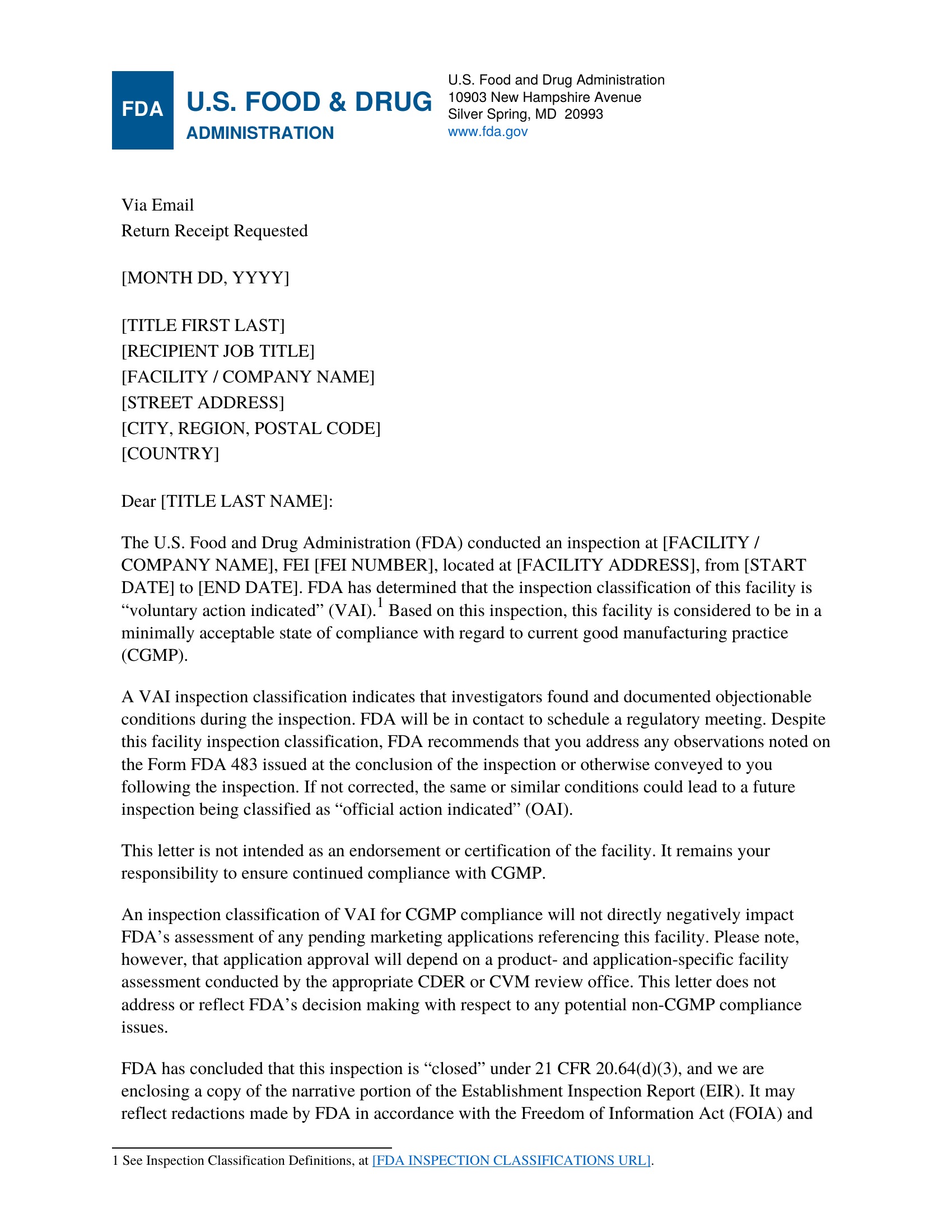
The sample image at the top of this page shows an FDA Establishment Inspection Report (EIR) Closeout Letter, one of the most commonly apostilled FDA letter types. A standard FDA EIR Closeout Letter contains:
- FDA letterhead with the FDA logo in the upper-left and "U.S. FOOD & DRUG ADMINISTRATION" header
- FDA headquarters address — 10903 New Hampshire Avenue, Silver Spring, MD 20993
- Delivery method line ("Via Email" / "Return Receipt Requested")
- Issue date and full recipient address block (including foreign address details when sent to overseas facilities)
- Inspection summary paragraph identifying the facility, FEI (FDA Establishment Identifier) number, facility address, and inspection dates
- Inspection classification — typically "No Action Indicated (NAI)," "Voluntary Action Indicated (VAI)," or "Official Action Indicated (OAI)"
- References to CGMP compliance (current good manufacturing practice) and Form FDA 483 (Inspectional Observations)
- Closeout language citing 21 CFR 20.64(d)(3)
- Reference to the enclosed Establishment Inspection Report (EIR) narrative under Freedom of Information Act (FOIA) provisions
- Signature of the FDA Center director or other authorized FDA official
The same federal apostille pathway applies to all FDA and USDA letters — including Free Sale Certificates, Certificates to Foreign Government, USDA APHIS export certificates, USDA Free Sale Certificates, and USDA phytosanitary certificates.
Common FDA & USDA Letter Types Eligible for Apostille
"FDA/USDA certified letter" is a category — not a single document. Multiple FDA centers and USDA agencies issue export and regulatory letters, each documenting a different aspect of U.S. regulatory status. All federally signed FDA/USDA letters follow the same federal apostille pathway.
| Letter Type | Issuing Agency | What It Documents |
|---|---|---|
| FDA Establishment Inspection Report (EIR) Closeout Letter | FDA (CDER, CDRH, CFSAN, CBER, or CVM) | Conclusion of an FDA inspection of a manufacturing facility, with classification (NAI / VAI / OAI), CGMP compliance status, and inspection closeout under 21 CFR 20.64(d)(3). The letter type shown in the sample at the top of this page. |
| FDA Certificate of Free Sale (CFS) | FDA — typically CFSAN for food, dietary supplements, cosmetics | Confirmation that a product is freely sold in the U.S. and not subject to recall or import restrictions — required for foreign registration of food, supplements, and cosmetics. |
| FDA Certificate to Foreign Government (CFG) | FDA — typically CDER (drugs) or CDRH (medical devices) | Confirmation that a U.S.-manufactured drug or medical device may be legally marketed in the U.S. — required for foreign registration of pharmaceuticals and devices. |
| FDA Certificate of Exportability | FDA | For products that are not approved for U.S. sale but meet export-eligibility requirements under FD&C Act §§ 801(e) or 802. |
| USDA APHIS Export Certificate (animals, plants, biologics) | USDA Animal and Plant Health Inspection Service (APHIS) | Federal certification of animal products, live animals, plants, plant products, and biologics destined for foreign markets. |
| USDA APHIS Phytosanitary Certificate | USDA APHIS (PCIT system) | Confirmation that plants and plant products meet phytosanitary import requirements of the destination country — required by foreign agricultural regulators. |
| USDA FSIS Export Certificate | USDA Food Safety and Inspection Service (FSIS) | Federal certification of meat, poultry, and egg products for export to foreign markets. |
| USDA Free Sale Certificate | USDA AMS (Agricultural Marketing Service) or other USDA agency | Confirmation that an agricultural product is freely sold in the U.S. — required for foreign import licensing and registration. |
| USDA Organic Certification & Export Letters | USDA AMS National Organic Program | Federal certification of organic compliance for export to countries that recognize the USDA Organic seal. |
Our team handles federal apostille processing for any FDA or USDA letter signed by an authorized federal official — confirm with us at order intake which letter type you have, and we will route it accordingly.
What They Are Used For Internationally
FDA and USDA certified letters are required for U.S. exporters seeking to enter foreign markets, register products with foreign regulators, or satisfy commercial documentation requirements abroad. Common international use cases include:
- Foreign regulatory registration of U.S. pharmaceuticals — FDA Certificate to Foreign Government (CFG) is typically required by foreign drug regulators (China NMPA, EU EMA, Saudi SFDA, Korea MFDS, Brazil ANVISA, India CDSCO, UAE MOHAP, and many others) as part of foreign drug approval and import licensing.
- Foreign medical device registration — FDA CFG or Certificate of Exportability is required by foreign medical device regulators for product registration in international markets.
- Foreign food and dietary supplement market entry — FDA Certificate of Free Sale (CFS) is the standard documentary requirement for U.S. food, dietary supplement, and cosmetic exporters entering foreign markets.
- International trade and customs clearance — foreign customs authorities require federally authenticated FDA/USDA letters as part of import documentation for many regulated product categories.
- Foreign distributor and licensing agreements — overseas business partners and foreign distributors commonly require federally authenticated FDA/USDA letters as evidence of U.S. regulatory standing before signing distribution contracts.
- Foreign agricultural import permits — USDA APHIS phytosanitary certificates are required for U.S. plant and plant-product exports to virtually all foreign markets.
- Foreign meat, poultry, and egg product imports — USDA FSIS export certificates are mandatory for U.S. meat exporters under most foreign import regimes.
- Foreign government tenders and procurement — federally authenticated FDA/USDA letters are commonly required for U.S. exporters bidding on foreign government health, food, or agricultural procurement contracts.
- Foreign organic-equivalence recognition — USDA organic certifications are required for exports to countries with USDA Organic equivalence agreements.
- Foreign legal proceedings and trade disputes — federally authenticated FDA/USDA letters serve as authoritative evidence of U.S. regulatory standing in international litigation.
Foreign authorities require federal authentication because they cannot independently verify that an FDA or USDA letter is a legitimate U.S. government document.
How to Obtain an FDA or USDA Certified Letter
Each FDA Center and USDA agency has its own request process. Below are the most common pathways. Once the underlying federal letter has been issued, our office handles the federal apostille step.
FDA Certificates of Free Sale (CFS) and Certificates to Foreign Government (CFG)
FDA export certificates are requested through the FDA's Export Certificate program, with the specific submission process depending on the FDA Center responsible for the product:
- CDER (Center for Drug Evaluation and Research) — for human drugs.
- CDRH (Center for Devices and Radiological Health) — for medical devices via the CDRH Export Certification system.
- CFSAN (Center for Food Safety and Applied Nutrition) — for food, dietary supplements, and cosmetics.
- CBER (Center for Biologics Evaluation and Research) — for biologics.
- CVM (Center for Veterinary Medicine) — for veterinary drugs and animal feed.
Processing times vary by Center and certificate type, ranging from approximately 20 business days for routine CDRH device certificates to several months for complex CDER drug certificates. FDA fees apply.
FDA Establishment Inspection Report (EIR) Closeout Letter
EIR Closeout Letters are issued automatically by the FDA Center responsible for the inspected facility at the conclusion of an FDA inspection. They are typically sent to the facility by email and return receipt mail. Companies seeking apostille of an EIR letter generally already have the letter in hand from the FDA Center; if a duplicate or replacement is needed, contact the FDA Center that conducted the inspection.
USDA APHIS Export Certificates and Phytosanitary Certificates
USDA APHIS export and phytosanitary certificates are requested through the APHIS Import & Export portal using the PCIT (Phytosanitary Certificate Issuance and Tracking) system or other APHIS-specific systems depending on the product type. APHIS field offices issue certificates locally; processing is typically 1 to 5 business days for routine plant products.
USDA FSIS Export Certificates
USDA FSIS export certificates (for meat, poultry, and egg products) are issued through FSIS PHIS (Public Health Information System) and signed at FSIS-inspected establishments by FSIS personnel.
USDA AMS Free Sale and Organic Letters
USDA AMS (Agricultural Marketing Service) free sale certificates and organic export documentation are requested through AMS — specific requirements vary by commodity and product type.
Federal Apostille Eligibility — Federally Signed & Certified vs. Notary + State Apostille
Federal apostilles by the U.S. Department of State are only available for documents that have been signed and certified by a federal official. This is the core eligibility rule and the most common point of confusion. There are two valid pathways depending on how the document was issued — and choosing the wrong one is the most frequent reason apostille submissions are rejected.
| Pathway | When It Applies | How It Works | Who Authenticates |
|---|---|---|---|
| Pathway A — Federal Apostille | Document is signed and certified by a federal official (e.g., an FDA Center director, FDA inspection officer, USDA APHIS officer, USDA FSIS inspector, or other federal agency official) | Document submitted directly to the U.S. Department of State as-is — no notary, no state involvement. | U.S. Department of State, Office of Authentications (Washington, D.C.) |
| Pathway B — Notary + State Apostille | Document is not federally signed (e.g., a private commercial document such as a manufacturer's self-issued Certificate of Analysis, a corporate Free Sale declaration, an internal quality assurance letter, or any document on the company's own letterhead) | A notary public certifies the signature on the document; the document is then submitted to the Secretary of State of the state where the notary is commissioned. | State Secretary of State (the state where the document was notarized) |
Pathway A — When the FDA/USDA Letter Qualifies for Federal Apostille
An FDA or USDA letter qualifies for a federal apostille only when it has been issued by FDA or USDA itself — that is, an authentic letter on official agency letterhead, bearing the agency's seal, and the digital or wet signature of an authorized federal officer (FDA Center director, USDA APHIS officer, FSIS inspector, etc.). In this form, the document is already a federally certified record, and it is submitted to the U.S. Department of State without notary involvement.
This is the standard pathway for FDA Certificates of Free Sale, FDA Certificates to Foreign Government, FDA EIR Closeout Letters, USDA APHIS export certificates, USDA phytosanitary certificates, USDA FSIS export certificates, and similar federally issued documents.
Pathway B — When the Notary + State Apostille Route Is Required Instead
If a document is not federally signed and certified — for example, a manufacturer's own Certificate of Analysis on company letterhead, a private Free Sale declaration signed by a corporate officer, a quality assurance letter prepared internally, or any commercial document the company itself produced — it cannot be federally apostilled. In that case, the proper route is:
- The signing officer signs the document in front of a notary public, who certifies the signature.
- The notarized document is submitted to the Secretary of State of the state where the notary is commissioned for a state apostille.
- The state apostille certifies the notary's commission, which in turn certifies the corporate officer's signature.
The state apostille route is internationally valid under the same Hague Apostille Convention as the federal route — but the authenticating authority is the state, not the federal government, because the underlying document does not bear a federal officer's signature. Many foreign markets accept private commercial documents through the state apostille route when an FDA/USDA letter is not strictly required.
If you are unsure which pathway applies to your specific document, our team will review it as part of order intake and route it correctly — either through the U.S. Department of State for federally signed records, or through the appropriate state for notary-based commercial documents.
Why Federal Authentication Is Required
Apostille and authentication authority in the United States is divided between state Secretaries of State and the U.S. Department of State based on the issuing authority of the document.
| Issuing Authority | Examples | Where Authenticated |
|---|---|---|
| State or local government / private documents notarized in a state | State birth certificates, marriage licenses, notarized commercial documents, notarized affidavits, state-licensed professional records, corporate documents on company letterhead with notarized signatures | Secretary of State of the issuing state |
| Federal government | FDA letters (CFS, CFG, EIR), USDA letters (APHIS, FSIS, AMS, phytosanitary), FBI Identity History Summary, Certificate of Naturalization (USCIS), Consular Report of Birth Abroad, IRS letters, SSA letters, VA letters, federal court documents, DD-214 military records | U.S. Department of State, Office of Authentications — Washington, D.C. |
Because FDA and USDA are federal agencies, their certified letters cannot be apostilled at the state level. State authorities have no jurisdiction to authenticate federal documents, and any state apostille placed on a federally signed FDA/USDA letter is invalid and will be rejected by the receiving foreign government or regulator.
Federal authentication is required to:
- Verify that the document was issued by a legitimate U.S. federal agency
- Confirm the authenticity of the agency's letterhead, seal, and authorized officer's signature
- Enable formal recognition by foreign regulators, customs authorities, and trade partners under international law
travel.state.gov — Authenticate Your Document
Document Preparation Requirements
To be eligible for federal authentication, the FDA or USDA letter must meet all federal submission standards. Even minor deviations can cause rejection — and given the lead times of obtaining FDA/USDA letters in the first place, rejections at the apostille stage can delay foreign market entry by weeks or months.
Acceptable Formats
- Original FDA/USDA-issued letter on official agency letterhead, with federal seal or letterhead-equivalent identifier and authorized officer's signature.
- Agency-issued PDF generated from the relevant FDA or USDA portal (CFG portal, PCIT, FSIS PHIS, etc.) — printed unaltered in full color.
- For USDA APHIS phytosanitary certificates, the original signed paper certificate issued at the inspection point is generally required.
Strict Preparation Rules
- Submit the document exactly as issued by the federal agency — no edits, modifications, or additions.
- Do not notarize the document. Notarization automatically invalidates a federal record.
- Do not add certification wording, cover letters, or apostille request stamps to the face of the document.
- Do not alter, cover, or "enhance" any signatures, seals, or letterhead elements.
- Do not edit, resize, reformat, or compress agency-issued PDFs before printing.
- Printed copies must match the agency-issued PDF exactly — including margins, color, pagination, and letterhead.
- Do not laminate, hole-punch, staple over the seal, or write on the document.
- Use a high-quality color printer if printing the agency PDF — black-and-white or low-resolution prints are commonly rejected.
- Submit all pages of multi-page certificates and EIR-attached reports in original order.
- For shipments where the foreign authority requires multiple copies of the same letter, order multiple originals from FDA/USDA — do not photocopy.
Step-by-Step Apostille Process
Obtain FDA/USDA Letter
Request your FDA or USDA letter through the appropriate agency portal — FDA Export Certificate program (CDER, CDRH, CFSAN, CBER, or CVM), USDA APHIS PCIT, USDA FSIS PHIS, or USDA AMS. Confirm the destination country requires the specific letter type before ordering.
Order & Document Review
Submit your order online and send us the federally issued letter. Our team verifies the document is in proper form before any submission to the Department of State.
Department of State Submission
We hand-deliver your document to the U.S. Department of State, Office of Authentications in Washington, D.C., along with the federal authentication request form (DS-4194) and the appropriate federal fee.
Apostille or Authentication Issued
The Department of State issues either an Apostille (Hague Convention countries) or an Authentication Certificate (non-Hague countries), affixed directly to your document.
Embassy Legalization (If Required)
For non-Hague countries — common in pharmaceutical and food exports to the Middle East, parts of Asia, and select African markets — we forward the authenticated document to the destination country's embassy or consulate in Washington, D.C., for final legalization.
Certified Translation (Optional)
If your destination country requires the document in another language, we provide certified translations — commonly Spanish, Portuguese, French, Chinese, Japanese, Korean, Arabic, Vietnamese, German, Italian, and others.
How to Visually Confirm the Document Is Ready
Before submitting your FDA or USDA letter for federal authentication, verify that all of the following are present and intact. (Refer to the sample image at the top of this page for what a properly issued FDA letter looks like — other agency variants follow similar conventions.)
- Issuing agency letterhead — for FDA, the FDA logo and "U.S. FOOD & DRUG ADMINISTRATION" header with the Silver Spring, MD address; for USDA, the USDA letterhead with the agency-specific subheader (APHIS, FSIS, AMS, etc.)
- Document title or subject line clearly identifying the type of certificate or letter
- Issue date
- Recipient address block (for letters addressed to specific facilities or companies)
- Substantive certifying language describing the regulatory status, inspection result, free sale eligibility, or export clearance
- Reference numbers and identifiers — FEI numbers, application numbers, certificate numbers, lot numbers, etc.
- Signature line and signature block of the certifying federal official
- Federal seal — embossed, printed, or digital — depending on agency format
- Clean print quality with no fading, smudging, compression artifacts, or alignment issues
- No handwriting, highlighting, stamps, or annotations beyond the original agency content
- All pages of multi-page documents, in original order, with original page numbering
Common Reasons FDA/USDA Letter Submissions Are Rejected
The Department of State and foreign regulators routinely reject FDA/USDA letter submissions for a small set of recurring issues. All are preventable.
1. Notarized FDA/USDA Letter
A notary public has no authority to certify federal records, and adding a notary stamp visibly alters the document. Fix: never notarize an FDA or USDA letter.
2. State-Level Apostille Attempts
Submissions routed to a state Secretary of State are returned unprocessed because FDA/USDA are federal agencies. Fix: ensure submission is routed to the U.S. Department of State, Office of Authentications.
3. Photocopies or Scans Submitted Instead of Originals
Photocopies and scans of FDA/USDA letters are not acceptable. Fix: request the appropriate number of originals directly from the issuing agency. For shipments to multiple foreign markets, order one original per destination.
4. Wrong Federal Letter Type for the Destination
Submitting an FDA EIR Closeout Letter when the foreign regulator requires a Certificate to Foreign Government (CFG) — or vice versa — wastes weeks of waiting time. Fix: confirm with the foreign authority before initiating the FDA/USDA request.
5. Wrong Agency Letter
Foreign meat importers usually require a USDA FSIS export certificate, not an FDA letter; foreign plant importers require USDA APHIS phytosanitary, not FSIS. Fix: match the agency to the product category.
6. Missing or Misordered Pages
Multi-page FDA EIR closeout letters with attached EIR narratives must be submitted with all pages, in original order. Fix: never separate the closeout letter from its attached EIR.
7. Edited or Reformatted PDFs
Cropped, resized, or "flattened" PDF prints lose the federal letterhead alignment and digital integrity. Fix: print the original agency-issued PDF exactly as issued, in full color, on standard letter-size paper.
8. Black-and-White or Low-Resolution Prints
The FDA logo, USDA seal, and other agency-specific elements require full-color, high-resolution printing. Fix: use a quality color printer.
9. Letter Too Old for Foreign Regulatory Requirement
Foreign regulators often require letters issued within the last 6 to 12 months — sometimes within 90 days for time-sensitive foreign drug approvals. Fix: verify validity rules with the foreign authority before ordering, and request a fresh letter if needed.
Hague Convention vs. Non-Hague Countries
The final form of authentication depends on whether the destination country is a member of the 1961 Hague Apostille Convention:
| Destination Type | What You Receive | Additional Steps | Examples (common FDA/USDA export destinations) |
|---|---|---|---|
| Hague Convention country | Apostille issued by U.S. Department of State | None — document is ready for use abroad. | Mexico, Spain, Italy, Portugal, France, Germany, Netherlands, UK, Brazil, Argentina, Colombia, Chile, Japan, South Korea, India, Australia, Philippines, China. |
| Non-Hague country | Authentication Certificate from U.S. Department of State | Embassy or consulate legalization required after authentication. | Saudi Arabia, UAE (verify current status), Qatar, Kuwait, Egypt, Iran, Iraq, Vietnam, Cambodia, Pakistan, Bangladesh. |
Many of the world's largest pharmaceutical and food markets are non-Hague jurisdictions that require embassy legalization in addition to the federal authentication — particularly Gulf and Middle East markets and certain South and Southeast Asian markets. We handle both authentication and embassy legalization in-house in Washington, D.C. View our Country Guide for the latest list.
Processing Times & Validity
Total turnaround for FDA/USDA letter apostille depends on three stages: federal agency issuance of the letter, the U.S. Department of State's authentication processing, and (when required) embassy legalization. Because FDA/USDA letter issuance times can be the longest stage, exporters should plan well in advance of foreign filing deadlines.
- FDA CDRH device export certificates: approximately 20 business days routine processing.
- FDA CDER drug export certificates: several weeks to several months depending on certificate type and complexity.
- FDA CFSAN food/supplement/cosmetic CFS: typically 4 to 8 weeks.
- FDA EIR Closeout Letters: issued automatically at the conclusion of an FDA inspection — already in the company's possession.
- USDA APHIS phytosanitary certificates: typically 1 to 5 business days at the inspection point.
- USDA FSIS export certificates: issued at the FSIS-inspected establishment, generally same-day or next-day for routine shipments.
- U.S. Department of State authentication: currently 10–12 business days for routine processing (subject to government workload — expedited service available through our office).
- Embassy legalization: varies widely by country — typically 3 business days to 4 weeks.
- Validity for foreign use: FDA/USDA letters typically must be issued within the last 6 to 12 months for foreign regulatory purposes; certain time-sensitive drug or device approvals require letters issued within 90 days. Confirm with the destination country's regulator.
Use our Processing Time Estimator for a country-specific projection.
Why Choose Federal Apostille and Notary Processing
We are a Washington, D.C.-based document processing service specializing exclusively in federal authentications. FDA and USDA letter apostilles are one of our most-requested commercial services among U.S. exporters — pharmaceutical companies, medical device manufacturers, food and dietary supplement producers, cosmetics companies, and agricultural exporters.
- Hand-delivery to the U.S. Department of State, Office of Authentications — no mail delays.
- $120 flat-rate pricing with all government authentication fees included — no hidden costs.
- Pre-submission review by federal-document specialists who catch the most common rejection issues (notarization, missing pages, wrong agency letter type) before they cost you weeks of foreign-market entry delay.
- Coverage of all FDA and USDA letter types — Certificate of Free Sale, Certificate to Foreign Government, EIR Closeout Letter, Certificate of Exportability, USDA APHIS export certificates, USDA APHIS phytosanitary certificates, USDA FSIS export certificates, USDA AMS organic and free sale certificates, and others.
- Embassy legalization for non-Hague countries handled in-house in Washington, D.C. — critical for Middle East, Gulf, and select Asian markets.
- Certified translations in Chinese, Japanese, Korean, Spanish, Portuguese, French, Arabic, Vietnamese, German, Italian, and other languages commonly required for foreign regulatory filings.
- Worldwide tracked shipping via FedEx, UPS, and DHL — direct to your foreign distributor or in-country regulatory consultant.
- Real-time order tracking from intake through delivery — important when foreign filing deadlines are at stake.
- Bulk and recurring service for exporters with regular international shipping needs.
- Over 10 years of experience processing federal authentications for U.S. exporters.
Frequently Asked Questions
What is an FDA or USDA certified letter and why does it need to be apostilled?
An FDA or USDA certified letter is an official federal document issued by the U.S. Food and Drug Administration or the U.S. Department of Agriculture documenting the regulatory status, inspection result, free sale eligibility, or export clearance of a U.S. product or facility. Foreign governments require these letters to be federally apostilled by the U.S. Department of State so the issuing federal agency's signature and seal can be legally recognized abroad — most commonly to register U.S.-manufactured pharmaceuticals, medical devices, food, supplements, cosmetics, or agricultural products in foreign markets.
How do I obtain an FDA Certificate of Free Sale or Certificate to Foreign Government (CFG)?
FDA Export Certificates — including Certificates of Free Sale and Certificates to Foreign Government (CFG) — are requested through the FDA's online CFG application system at the relevant FDA Center: CDER (drugs), CDRH (medical devices), CFSAN (food, supplements, cosmetics), CBER (biologics), or CVM (veterinary). Processing time varies by Center and certificate type, but typically ranges from 20 business days to several months. Once received, the certificate is ready for federal apostille processing.
How do I obtain a USDA APHIS export certificate or phytosanitary certificate?
USDA export certificates are issued by the appropriate USDA agency depending on the product type — APHIS (Animal and Plant Health Inspection Service) for plants, animals, and biologics; FSIS (Food Safety and Inspection Service) for meat, poultry, and egg products; AMS (Agricultural Marketing Service) for organic and other commodity certifications. Phytosanitary certificates are typically issued through APHIS's PCIT (Phytosanitary Certificate Issuance and Tracking) system. Once issued by USDA on official letterhead and signed by an authorized federal officer, the certificate can be apostilled.
Can a state Secretary of State apostille my FDA or USDA letter?
No. FDA and USDA letters are signed by federal officials, so only the U.S. Department of State, Office of Authentications can apostille them. State apostilles on federally signed documents are invalid and will be rejected by foreign governments. (State apostilles are only the correct route for documents that are not federally signed — for example, a manufacturer's Certificate of Analysis on company letterhead with a notarized corporate signature, or a private Free Sale declaration signed by a corporate officer.)
What is the difference between a federal apostille and a state apostille?
A federal apostille is issued by the U.S. Department of State and applies to documents signed and certified by a federal official — including FDA letters, USDA letters, USCIS certificates, FBI Identity History Summaries, SSA letters, VA letters, and federal court documents. A state apostille is issued by a state Secretary of State and applies to documents that are not federally signed but are notarized by a notary public commissioned in that state — such as private commercial documents, manufacturer's Certificates of Analysis, corporate Free Sale declarations, powers of attorney, and notarized affidavits. Both are recognized internationally under the Hague Apostille Convention; the difference is solely about who signed the underlying document. We handle both — see Federal vs. State Apostille Eligibility above for full details.
What is an FDA Establishment Inspection Report (EIR) Closeout Letter?
An FDA EIR Closeout Letter is a federal letter issued at the conclusion of an FDA inspection of a manufacturing facility (the type shown in the sample at the top of this page). It documents the inspection classification (NAI / Voluntary Action Indicated / Official Action Indicated), the facility's FEI (FDA Establishment Identifier) number, references to current good manufacturing practice (CGMP) compliance, and closes out the inspection under 21 CFR 20.64(d)(3). Foreign regulators and foreign business partners often request this letter — federally apostilled — as proof that a U.S. facility has been FDA-inspected and is in acceptable regulatory standing.
I'm exporting to multiple foreign markets — do I need a separate apostilled letter for each country?
Yes, in most cases. Each foreign regulator typically requires its own original apostilled letter — or at minimum its own original federally issued FDA/USDA letter that we then apostille. Photocopies of an apostilled letter are not generally accepted by foreign authorities. Order one original from FDA/USDA per destination country, then submit all originals together for federal apostille. Bulk processing is available.
How long is my FDA/USDA letter valid for foreign use?
Most foreign regulators require letters issued within the last 6 to 12 months. Time-sensitive drug and medical device approvals may require letters within 90 days. USDA phytosanitary certificates and FSIS export certificates are typically tied to specific shipments and have very short validity windows tied to the shipment dates. Always confirm the foreign authority's specific freshness rule before ordering.
Do non-Hague countries (like Saudi Arabia, UAE, China) require additional steps?
Non-Hague countries require embassy legalization in addition to the federal authentication. After the U.S. Department of State issues the authentication certificate, the document is forwarded to the destination country's embassy or consulate in Washington, D.C., for final legalization. We handle this step in-house — common destinations include Saudi Arabia, UAE (verify current status), Qatar, Kuwait, Egypt, Vietnam, Cambodia, Iran, Iraq. (China became a Hague Convention member, so it now requires only apostille — confirm current status.)
Will I need a certified translation of the apostilled letter?
Many foreign regulators require certified translations into the official language of the destination country. We offer certified translations alongside the apostille service so that everything is delivered ready-to-file. Chinese, Japanese, Korean, Spanish, Portuguese, French, Arabic, Vietnamese, German, and Italian translations are among the most commonly requested for FDA/USDA documents.
Can you help me obtain the FDA/USDA letter from the federal agency?
The federal agency requires the regulated entity (the manufacturer, exporter, or facility owner) to initiate the request directly through the appropriate agency portal. We do not submit FDA Export Certificate or USDA agency requests on your behalf, but we can provide guidance on which letter type the destination country requires. Once you have the federally issued letter in hand, we handle the federal apostille process from there.
Do I need to be in Washington, D.C. or visit your office in person?
No. We work with U.S. exporters nationwide and internationally. You can submit your federally issued FDA/USDA letter by mail or courier, and we handle the in-person submission to the Department of State and any required embassy legalization on your behalf.
Summary
FDA and USDA certified letters — including FDA Certificates of Free Sale, FDA Certificates to Foreign Government, FDA Establishment Inspection Report Closeout Letters, USDA APHIS export and phytosanitary certificates, USDA FSIS export certificates, and USDA AMS commodity certificates — are essential federal documents for U.S. exporters seeking foreign regulatory registration, market entry, and international trade clearance. Because FDA and USDA are federal agencies, these letters can only be apostilled by the U.S. Department of State — never by a state Secretary of State. Originals must be submitted exactly as issued: never notarized, never altered, never reformatted.
Federal Apostille and Notary Processing handles every step — from document review through final embassy legalization — so that your FDA or USDA letter is delivered abroad in legally recognized form for foreign regulatory filings, foreign market entry, foreign distributor agreements, customs clearance, and international trade documentation.
Ready to Get Your FDA/USDA Letter Apostilled?
$120 flat rate. Hand-delivered to the U.S. Department of State. 10–12 business day turnaround. Embassy legalization for non-Hague markets handled in-house. Bulk and recurring exporter service available.
