Document Filter
U.S. Federal Court Document Apostille
A document issued by a U.S. federal court — pleading, order, judgment, decree, or certified case record — is a federal public document. Its apostille path runs through the U.S. Department of State Office of Authentications, with the Clerk of Court certification as the predicate step and, for certain destinations, the U.S. Department of Justice as an intermediate seal authority.
We coordinate the federal apostille chain in Washington, D.C. — Clerk certification, U.S. Department of Justice authentication of the court seal when required, U.S. Department of State apostille, and embassy legalization for non-Hague destinations — so your federal court document is delivered ready for foreign use.
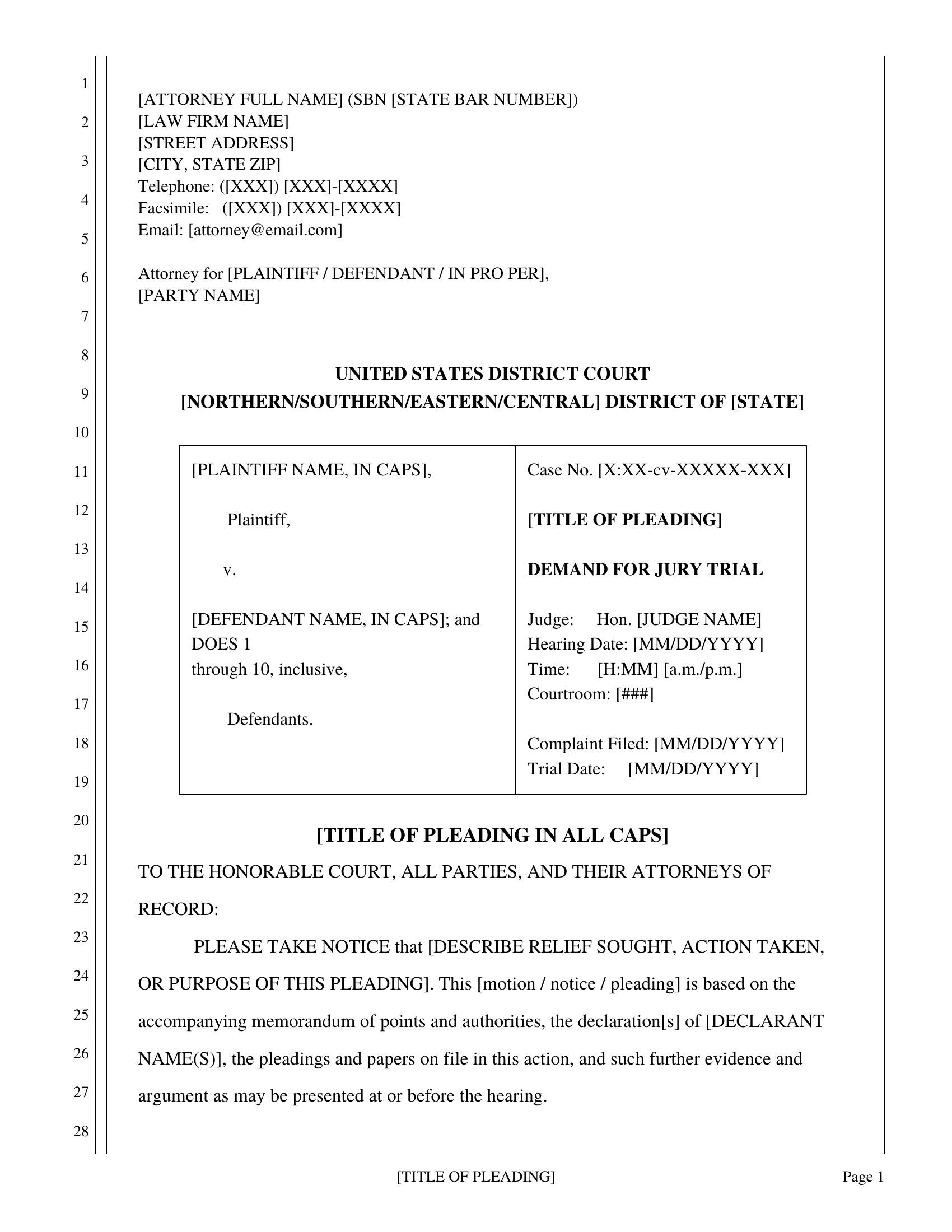
Sample federal court pleading on standard 28-line numbered pleading paper. For apostille, the document must be a certified copy issued by the Clerk of the Court bearing the court‘s raised seal — not a litigant‘s working draft.
10+ Years
Federal Experience
D.C. Based
Hand-Delivered Submissions
Full Coverage
All Federal Documents
Worldwide
Destination Coverage
On This Page
- What This Document Is
- Federal Courts Whose Documents Qualify
- Federal Court Documents Commonly Apostilled
- Why the Federal Apostille Route Applies
- The Clerk of Court Certification
- Two Paths Through Federal Authentications
- Required Format from the Clerk
- How to Prepare Your Document
- Step-by-Step Process
- How to Visually Confirm the Apostille
- Common Rejection Reasons
- Non-Hague Destinations: Embassy Legalization
- Processing Times & Validity
- Why Choose Us
- Frequently Asked Questions
What This Document Is
A U.S. federal court document is any public record issued by a court established under Article III of the U.S. Constitution or by an Article I federal tribunal of record. These include U.S. District Courts, U.S. Bankruptcy Courts, U.S. Courts of Appeals, the U.S. Court of International Trade, the U.S. Tax Court, the U.S. Court of Federal Claims, and the U.S. Court of Appeals for the Armed Forces, among others.
Federal court documents are commonly authenticated for foreign use when the proceeding involves an international party, foreign assets, foreign recognition of a U.S. judgment, or cross-border immigration or family matters. Examples:
- Enforcement of a U.S. federal court money judgment abroad
- Recognition of a U.S. Chapter 11 or Chapter 15 bankruptcy order in foreign insolvency proceedings
- Recognition of a U.S. federal naturalization order by a foreign government for dual citizenship or family reunification
- Use of a federal court order in a foreign immigration or visa case
- Use of a certified federal docket entry or pleading in foreign litigation as evidence of a parallel proceeding
- Recognition of a federal intellectual property judgment abroad
- Production of a certified pleading in support of a foreign Hague evidence request
Federal Courts Whose Documents Qualify
The Department of State Office of Authentications accepts properly certified documents from the following federal courts:
| Court | Typical Documents |
|---|---|
| U.S. District Courts (94 districts) | Pleadings, orders, judgments, decrees, certified dockets, certificates of facts, naturalization orders. |
| U.S. Bankruptcy Courts | Petition orders, discharge orders, Chapter 11 confirmation orders, Chapter 15 recognition orders, certified docket entries. |
| U.S. Courts of Appeals (13 circuits) | Appellate opinions, mandates, orders, certified records on appeal. |
| U.S. Court of International Trade | Customs and international trade orders, judgments, decrees. |
| U.S. Tax Court | Decisions, orders, certified records of proceedings. |
| U.S. Court of Federal Claims | Judgments and orders in claims against the United States. |
| U.S. Court of Appeals for the Armed Forces | Military appellate opinions and orders. |
State courts are different. If your document is from a
state court (state superior, district, family, probate, or municipal), the
apostille route runs through that state‘s Secretary of State, not the U.S.
Department of State. See our state-level apostille page for that process.
Federal Court Documents Commonly Apostilled
Any document that the Clerk of the Court will certify and seal is eligible. The most commonly apostilled federal court documents are:
- Certified copies of judgments and orders — money judgments, declaratory judgments, injunctions, decrees.
- Certified copies of pleadings — complaints, answers, motions, briefs (typically for evidentiary use in foreign proceedings).
- Certificates of facts — formal court certifications of recorded facts (e.g., a party‘s status as a litigant, a case‘s disposition).
- Certified case dockets — full or partial docket sheets certified by the Clerk.
- Naturalization orders and certificates issued by a U.S. District Court (note that the Certificate of Naturalization itself is a USCIS document; the underlying federal court order is a court document).
- Bankruptcy court orders — confirmation orders, discharge orders, Chapter 15 recognition orders.
- Appellate mandates and opinions issued by U.S. Courts of Appeals.
Why the Federal Apostille Route Applies
Federal court documents are signed and sealed by an officer of the U.S. federal government — the Clerk of the Court. The Clerk‘s commission is federal, not state. As with all federally-signed documents, the certifying authority is the U.S. Department of State Office of Authentications, which maintains signature samples of federal court clerks.
State Secretaries of State do not maintain federal court clerk signatures on file and cannot authenticate them. The federal route is mandatory.
The Clerk of Court Certification (Predicate Step)
Before any apostille can be issued, the document must be certified by the Clerk of the Court. The Clerk‘s certification is the predicate — the signature and seal that the U.S. Department of State (and the U.S. Department of Justice, when used) will authenticate.
To obtain a Clerk-certified copy:
- Contact the Clerk‘s office of the court that issued the document. Each district has its own clerk‘s office and fee schedule.
- Request a certified copy (not a plain photocopy) of the specific document needed. Specify the case caption, case number, and the document type and date.
- Pay the certification fee (varies by court — typically $11 to $32 per certified copy, plus a per-page copying fee).
- Request the certified copy for international use — some clerks issue a slightly different form of certification (including a "triple seal" or attestation by the Chief Judge or designated district judge) when the document is destined abroad.
- Confirm the Clerk‘s raised or embossed court seal is affixed (not just a flat ink stamp), as some embassies require an embossed seal.
Two Paths Through Federal Authentications
Federal court documents reach the U.S. Department of State by one of two paths. Most destinations accept Path A; certain destinations and certain court documents follow Path B.
Path A — Direct: Clerk → U.S. Department of State
STEP 1
Federal Court Clerk
Certified copy with court seal
→
STEP 2
U.S. Department of State
Federal apostille
→
STEP 3
Embassy or Consulate
Only if non-Hague destination
The U.S. Department of State authenticates the Clerk‘s signature directly. This is the most common path and works for the majority of federal court documents and destinations.
Path B — Triple-Seal: Clerk → DOJ → U.S. Department of State
STEP 1
Federal Court Clerk
Certified copy with court seal
→
STEP 2
U.S. Department of Justice
DOJ authenticates court seal
→
STEP 3
U.S. Department of State
Apostille over DOJ seal
Under Path B, the U.S. Department of Justice issues a "triple-seal" certification — the DOJ authenticates the Clerk‘s seal, and then the U.S. Department of State Office of Authentications places the apostille over the DOJ seal. This path is used when:
- The destination country requires the DOJ intermediate certification by its own consular practice;
- The Clerk of the Court is from a smaller specialty court whose signature is not on file at the Department of State directly;
- The destination country‘s embassy specifically requests the DOJ seal as a precondition to legalization (non-Hague chain).
Path B (where applicable) is then followed by embassy legalization if the destination is non-Hague.
Required Format from the Clerk of Court
For the certified copy to be accepted by the U.S. Department of State Office of Authentications, it must contain:
- The Clerk‘s typed (printed) full name and title ("Clerk of the United States District Court for the [District]" or "Deputy Clerk").
- The Clerk‘s original (wet) signature — not a stamp or facsimile.
- The court‘s raised or embossed seal.
- The date of certification (recent — many embassies require certification within the last 3 to 6 months).
- The court‘s certification language, typically beginning "I, [Clerk Name], Clerk of the United States [Court], do hereby certify..."
- The full case caption, case number, and document title clearly identified.
- Original certified copy — not a photocopy of the certified copy.
How to Prepare Your Document
Obtain a Certified Copy from the Clerk
Contact the Clerk‘s office of the issuing federal court. Provide the case caption, case number, document type, and the number of certified copies needed. Specify that the certified copy is for international use — many clerks have a separate process and form for international certifications.
Verify Required Elements
Before sending the certified copy for apostille, verify that all elements above (Clerk‘s name, signature, court seal, date, case identification, original certification) are present and legible.
Determine Path A vs. Path B
For most destinations and most federal court documents, Path A applies. Path B applies when (a) the destination country‘s embassy specifically requires the DOJ certification, or (b) the source court is one whose clerk‘s signature requires the DOJ intermediate step. Our team confirms the correct path during order intake.
Step-by-Step Process
1
Obtain Certified Copy from the Clerk
Contact the issuing federal court‘s Clerk‘s office and request a certified copy of the document for international use. Confirm the Clerk‘s signature, court seal, and certification date.
2
Document Review
Submit your order to us and forward the Clerk-certified copy. Our team verifies that the certification is in proper form before submitting for federal authentication.
3
U.S. Department of Justice (Path B Only)
If your destination requires the triple-seal path, we submit the Clerk-certified copy to the U.S. Department of Justice for authentication of the court seal. The DOJ certification is added before the document proceeds to the Department of State.
4
U.S. Department of State Apostille
We hand-deliver the document to the U.S. Department of State Office of Authentications in Washington, D.C. The Department issues the federal apostille (for Hague destinations) or authentication certificate (for non-Hague destinations).
5
Embassy Legalization (Non-Hague Destinations Only)
For non-Hague destinations, we submit the apostilled document to the destination country‘s embassy or consulate in Washington, D.C. for final legalization.
6
Certified Translation & Return Shipping
If your destination requires the document in another language, we provide certified translations alongside the federal apostille. Final delivery is via tracked, insured shipping.
How to Visually Confirm the Apostille
A properly apostilled federal court document will display the following attached together to the underlying document:
- The certified court document bearing the Clerk‘s signature, the court‘s raised seal, and the certification language.
- Path B only: U.S. Department of Justice certification — a separate certificate on DOJ letterhead authenticating the Clerk‘s seal.
- The U.S. Department of State Apostille or Authentication — issued on Department of State letterhead, bearing the Department of State seal and signature of an Authentication Officer.
- For non-Hague destinations only: an embassy or consular legalization stamp or certificate.
- For destination countries requiring translation: a certified translation in the destination language attached alongside.
Common Reasons Submissions Are Rejected
1. Photocopy Submitted Instead of Clerk-Certified Original
The U.S. Department of State authenticates Clerk signatures only on original certified copies — not on photocopies, scans, or e-filed versions. Fix: obtain a fresh Clerk-certified copy directly from the court.
2. State Court Document Submitted as Federal
State court documents (state superior, family, probate, municipal) cannot enter the federal route. They go through the state Secretary of State. Fix: confirm the issuing court is federal (its caption will name a "United States" court).
3. Missing Court Seal
An apostille requires the original court‘s raised or embossed seal, not just an ink stamp. Fix: return to the Clerk and request a properly sealed certified copy.
4. Certification Date Too Old
Many non-Hague country embassies require certification within the last 3 to 6 months. Fix: obtain a fresh certified copy shortly before initiating the apostille chain.
5. Submitted to State Secretary of State Instead of U.S. Department of State
State Secretaries of State will reject federal court documents — the Clerk‘s signature is not on the state‘s signature file. Fix: route the document to the U.S. Department of State Office of Authentications.
6. Path A Used When Path B Is Required
Certain destination embassies require the DOJ intermediate seal. If Path A is used and the embassy requires Path B, the document will be rejected at the embassy stage. Fix: confirm destination requirements at intake; route through DOJ when required.
7. Embassy Translation Requirement Missed
Many non-Hague country embassies require certified translation into the destination language. Fix: coordinate certified translation alongside the federal apostille.
Non-Hague Destinations: Adding Embassy Legalization
For destinations that are not Hague Convention members, the federal apostille alone is not enough — the document must also be legalized by the destination country‘s embassy or consulate in Washington, D.C. Common non-Hague destinations for federal court documents include Saudi Arabia, Qatar, Kuwait, Egypt, Vietnam, Iran, Iraq, Pakistan, and certain African and South Asian countries.
China joined the Hague Convention in November 2023; the UAE and Canada joined in 2024. Documents bound for those destinations no longer require embassy legalization — federal apostille alone is sufficient.
Processing Times & Validity
- Federal court Clerk certification: 1 to 14 business days depending on the court; some clerks offer same-day service for in-person requests.
- U.S. Department of Justice (Path B only): approximately 2 to 4 weeks for triple-seal certification.
- U.S. Department of State Office of Authentications: currently 10 to 12 business days for routine processing.
- Embassy / consulate legalization (non-Hague only): 3 business days to 4 weeks varies by country.
- Total realistic timeline — Path A, Hague destination: 2 to 4 weeks.
- Total realistic timeline — Path B, non-Hague destination: 6 to 12 weeks.
Why Choose Federal Apostille and Notary Processing
- Federal court specialization. We work with U.S. District Court clerks across all 94 districts, U.S. Bankruptcy Courts, and U.S. Courts of Appeals in all 13 circuits.
- Both apostille paths handled in-house. Path A (direct) and Path B (triple-seal via DOJ) — coordinated as a single workflow.
- D.C. proximity. Our office at 1050 Connecticut Ave NW is steps from the U.S. Department of State, the U.S. Department of Justice, and the major embassies. We hand-deliver, not mail.
- Clerk-side coordination. We work directly with court clerks to obtain certifications in the correct international format and freshness.
- Pre-submission review — catching format and seal issues before submission to federal authorities.
- Certified translations in Arabic, Vietnamese, Farsi, Spanish, and other languages required by non-Hague country embassies.
- Worldwide tracked shipping via FedEx, UPS, and DHL.
- Real-time order tracking from intake through delivery.
Frequently Asked Questions
What kinds of federal court documents need an apostille?
Any document issued by a U.S. federal court that needs to be used abroad — most commonly money judgments, orders, decrees, certified pleadings, bankruptcy orders, and naturalization orders. The specific document type does not change the route; what changes the route is whether the destination is a Hague Convention member.
Can I apostille a document I drafted myself, like my own complaint?
No — not directly. The Clerk of the Court must first certify the document. Your working draft, an unfiled pleading, or even a filed pleading downloaded from PACER is not yet a certified document. Request a Clerk-certified copy from the issuing court.
What is the difference between Path A and Path B?
Path A goes directly from the Clerk of the Court to the U.S. Department of State for apostille. Path B adds an intermediate certification by the U.S. Department of Justice, which authenticates the Clerk‘s seal before the Department of State issues the apostille. Path B is used when the destination country requires it, or when the source court‘s clerk signature requires it.
Do I need to be in Washington, D.C. to use your service?
No. We work with clients nationwide. You can mail or courier the Clerk-certified document to our D.C. office, and we handle the federal authentication and embassy legalization on your behalf.
How do I get a certified copy from the Clerk of the Court?
Contact the Clerk‘s office of the issuing court. Provide the case caption, case number, document type, and number of certified copies needed. Specify the certification is for international use. Many courts accept requests by mail or in person; some accept email or fax. Pay the certification and copying fees. We can assist with this step on request.
Are state court documents the same as federal court documents?
No. State court documents (from state superior, family, probate, municipal, or other state courts) follow a state-level apostille route through that state‘s Secretary of State. Only documents from courts named "United States" or designated as federal Article I tribunals follow the federal route.
What about PACER-downloaded documents — can those be apostilled?
No. PACER provides electronic access to court filings, but the downloads are not certified copies. They lack the Clerk‘s wet signature and raised court seal that the apostille process requires. A Clerk-certified copy must be obtained separately.
How long is the Clerk‘s certification valid?
A Clerk‘s certification does not formally expire, but many non-Hague country embassies require certifications issued within the last 3 to 6 months. For Hague destinations, validity is generally indefinite for the apostille step itself, though the receiving foreign authority may impose its own freshness rules.
I need a federal court order recognized in a foreign court — does an apostille help?
The apostille is the first step but typically not the only one. The apostille authenticates the U.S. court document‘s signatures and seals; the foreign court then applies its own rules of recognition and enforcement (such as the New York Convention for arbitral awards, the Hague Convention on Recognition and Enforcement of Judgments, or bilateral treaty arrangements). The apostille is a procedural prerequisite, not a substantive guarantee of recognition.
How long does the full process take?
Path A to a Hague destination: typically 2 to 4 weeks total. Path A to a non-Hague destination: 5 to 8 weeks total (including embassy time). Path B to a non-Hague destination: 6 to 12 weeks total. Expedited service is available at the federal apostille stage through our office.
Ready to Apostille Your Federal Court Document?
Federal apostille of U.S. District Court, Bankruptcy Court, and Court of Appeals documents at the U.S. Department of State. Triple-seal certification through the U.S. Department of Justice when required. Embassy legalization for non-Hague destinations.
Start My Order Call (760) 469-2997