SSA Certificate of Coverage Apostille
Federal authentication of the SSA Certificate of Coverage — the official Social Security Administration document under a Totalization Agreement that proves a U.S. worker temporarily on assignment abroad remains covered under U.S. Social Security and is exempt from foreign social security taxes.
Hand-delivered submission in Washington, D.C. Pre-submission review by federal-document specialists. Embassy legalization handled in-house for non-Hague countries.
What This Document Is
An SSA Certificate of Coverage is an official federal document issued by the Social Security Administration's Office of International Programs (Baltimore, MD) under a U.S. Totalization Agreement — also called a Social Security Agreement or Bilateral Social Security Agreement. The certificate documents that a worker on a qualifying international assignment remains covered under the U.S. Social Security system and is therefore exempt from the host country's social security taxes for the duration of the certificate.
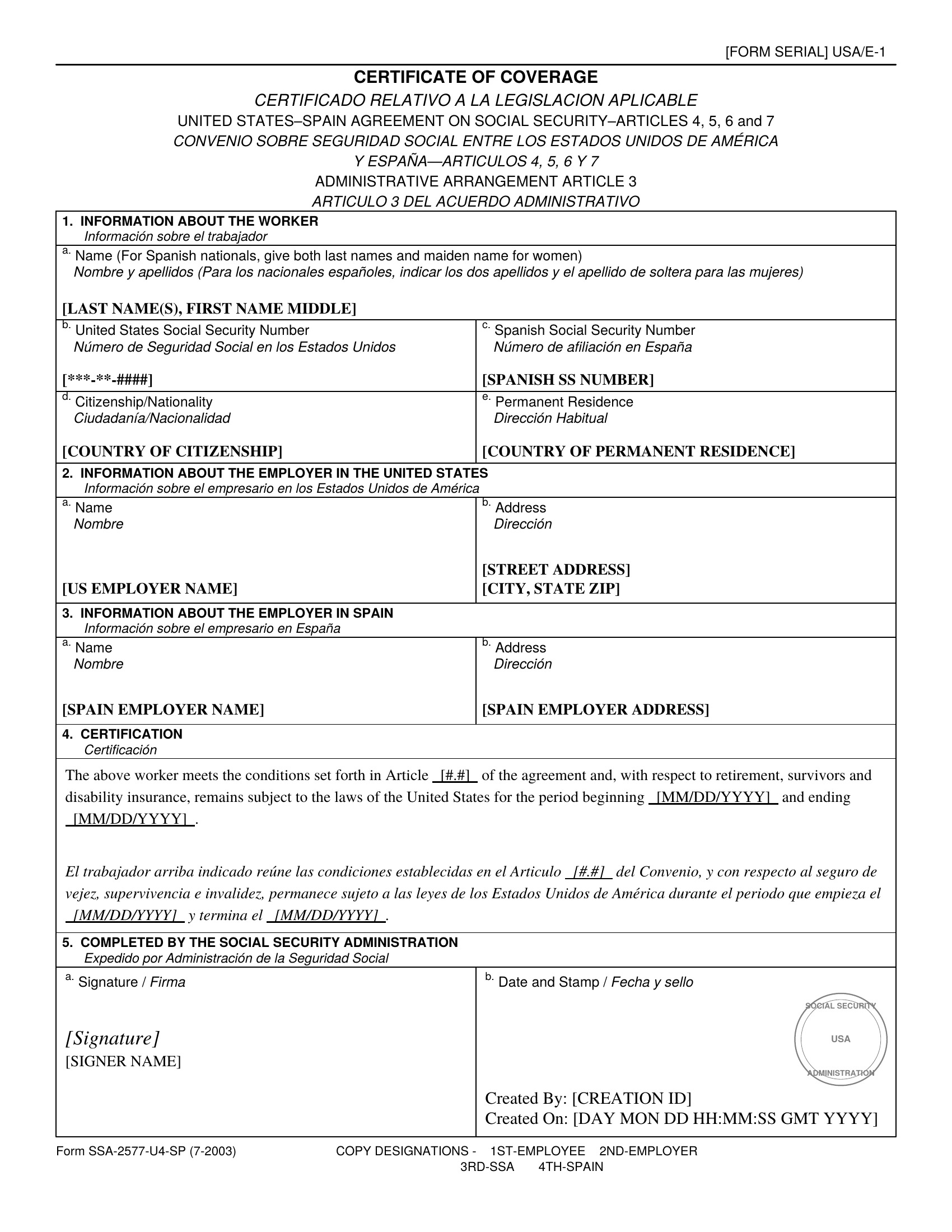
The sample at the top of this page — Form SSA-2577-U4-SP, the U.S.–Spain version of the certificate — illustrates the standard SSA Certificate of Coverage structure. Every country's Totalization Agreement uses its own country-specific form variant in the SSA-2577 series, but all share the same core structure:
- Form serial number (USA/[country code]-1) in the upper-right corner
- Title in English and the partner country's language — "CERTIFICATE OF COVERAGE" / "CERTIFICADO RELATIVO A LA LEGISLACION APLICABLE" (the Spanish version on the sample)
- Reference to the underlying bilateral agreement and the specific articles (typically Articles 4, 5, 6, and 7 of the agreement, plus Article 3 of the Administrative Arrangement)
- Section 1 — Information about the Worker: name, U.S. Social Security number, host country social security number, citizenship/nationality, permanent residence
- Section 2 — Information about the Employer in the United States: name and address of the U.S. employer
- Section 3 — Information about the Employer in the Host Country: name and address of the foreign employer or assignment location
- Section 4 — Certification: formal certification that the worker meets the conditions of a specified article of the agreement, including the exact begin and end dates of the U.S. coverage period
- Section 5 — Completed by the Social Security Administration: signature of the authorized SSA officer, date, and SSA seal/stamp
- Bottom of the form: copy designations indicating four distribution copies — 1st to Employee, 2nd to Employer, 3rd retained by SSA, 4th sent to the host country's social security authority
The SSA Certificate of Coverage is signed by an authorized federal SSA officer, which makes it eligible for federal apostille processing through the U.S. Department of State, Office of Authentications.
- SSA — U.S. International Social Security Agreements
- SSA — Agreement Descriptions and Country-Specific Forms
- SSA — Certificate of Coverage Application Links
- IRS — Totalization Agreements Overview
- SSA Office of International Programs telephone: 410-965-7306
U.S. Totalization Agreements — How They Work
A Totalization Agreement is a bilateral treaty between the United States and a foreign country that coordinates the two countries' Social Security systems. Each agreement serves two principal purposes:
- Eliminate dual Social Security taxation. Without a totalization agreement, a U.S. worker temporarily sent abroad — or a foreign worker temporarily sent to the U.S. — could be required to pay Social Security taxes to both countries on the same earnings. The certificate proves which country's system applies, exempting the worker from the other country's contributions.
- Allow workers to "totalize" credits across both systems. Workers whose careers are divided between the U.S. and an agreement country can combine credits from both systems to qualify for retirement, disability, or survivors benefits — useful particularly for workers who would not otherwise meet the minimum-credits threshold in either country alone.
The Certificate of Coverage is the documentary product of the first purpose: it is the formal proof a worker presents to the host country's tax or social security authority to claim exemption from local social security contributions. Without the certificate, the host country will typically assess social security contributions on the worker's earnings — even if the worker is also paying into the U.S. system.
The "Detached Worker" Rule
The most common basis for a Certificate of Coverage is the detached worker exemption. Under most U.S. Totalization Agreements, a worker who is:
- Sent by a U.S. employer
- To work temporarily in the agreement country
- For an expected period of 5 years or less
... remains covered under U.S. Social Security and is exempt from the host country's social security system for the duration of the assignment. Some agreements allow extensions beyond 5 years upon application.
Other Coverage Bases
Certificates of Coverage can also be issued under other rules established by specific agreements, including:
- Self-employed workers — typically covered by the country where they reside; the certificate documents the applicable coverage
- Government employees — special rules apply to U.S. government employees stationed abroad
- Flight crew, mariners, and other special categories — covered by industry-specific rules in some agreements
- Long-term assignments — extensions beyond the standard 5-year detached worker period
Current Totalization Agreement Countries
As of 2026, the United States has Totalization Agreements in force with 30 countries. Each agreement uses its own country-specific SSA Certificate of Coverage form (the sample shown above is the U.S.–Spain version, Form SSA-2577-U4-SP).
| Region | Countries with Totalization Agreements |
|---|---|
| Western Europe | Austria, Belgium, Denmark, Finland, France, Germany, Greece, Iceland, Ireland, Italy, Luxembourg, Netherlands, Norway, Portugal, Spain, Sweden, Switzerland, United Kingdom |
| Central & Eastern Europe | Czech Republic, Hungary, Poland, Slovakia, Slovenia |
| Asia–Pacific | Australia, Japan, South Korea |
| Americas | Brazil, Canada, Chile, Uruguay |
Notable Gaps — Countries Without Totalization Agreements
Several major destinations for U.S. workers do not have Totalization Agreements with the United States. Workers sent to these countries may face dual social security taxation:
- China, India, Mexico, Singapore, Thailand, Indonesia, the Philippines — significant gaps in the Asia–Pacific region
- The United Arab Emirates, Saudi Arabia, Qatar, Kuwait, and most other Gulf states
- Most of Latin America outside Brazil, Chile, and Uruguay — including Mexico, Argentina, Colombia, Peru, Costa Rica, Panama
- Most of Africa
If your destination country is not on the totalization list, an SSA Certificate of Coverage cannot be issued — and your tax planning will need to consider potential dual social security exposure under both U.S. and host country rules.
What It Is Used For Internationally
The SSA Certificate of Coverage is presented to the host country's tax or social security authority as the documentary proof of U.S. coverage. Common international use cases include:
- Foreign social security tax exemption. The primary use — the certificate exempts the worker (and the employer) from the host country's social security contributions during the certified coverage period.
- Foreign payroll setup. Host country employers and payroll providers require the certificate to correctly exclude the worker from local social security payroll withholdings.
- Foreign tax return filings. Many host countries require the certificate (or a copy) to be attached to the worker's local tax return or filed separately with the local tax authority.
- Foreign work permit and residence applications. Some countries' work permit or long-term residence applications require documentary proof of the worker's social security coverage arrangement.
- Foreign payroll audits. When foreign tax or social security authorities audit a U.S. multinational's local payroll, the certificate is the standard documentary defense against assessed local social security contributions.
- Cross-border employment compliance. Global mobility programs and expatriate compensation packages routinely include Certificate of Coverage processing as a standard step in the international assignment workflow.
- Self-employed expatriate tax planning. Self-employed Americans who become tax residents in agreement countries use the certificate (in conjunction with their host-country coverage) to allocate self-employment tax between systems.
- Foreign government contracts and procurement. Some foreign government contracts require contractors to document their workers' social security arrangements.
Foreign tax and social security authorities often require federal authentication (apostille) of the SSA-issued certificate before they will accept it as valid. While the underlying Totalization Agreement is a treaty obligation, the certificate itself is a federal U.S. document — and the apostille provides the international authentication that ensures it will be recognized.
How to Obtain an SSA Certificate of Coverage
U.S. employers and self-employed individuals apply directly to the SSA's Office of Earnings and International Operations in Baltimore. The applicant is generally the U.S. employer for employees on international assignment, or the worker themselves for self-employed cases.
Step-by-Step Application Process
- Confirm the host country has a Totalization Agreement with the United States (see the country list above).
- Identify the correct SSA form for the specific country agreement. The SSA maintains country-specific application links at ssa.gov/international/CoC_link.html. The form shown in the sample at the top of this page is SSA-2577-U4-SP for U.S.–Spain assignments.
- Complete the application with the worker's identifying information, U.S. and host country employer details, assignment dates, and other required information.
- Submit to SSA's Office of Earnings and International Operations — either online through SSA's portal (for some country agreements) or by mail to:
Social Security Administration
Office of Earnings & International Operations
P.O. Box 17741
Baltimore, MD 21235-7741 - SSA processes the application — typically 4 to 8 weeks for routine processing.
- SSA issues the certificate — the original is sent to the U.S. employer, who provides copies to the employee and to the host country's social security authority. Section 5 of the certificate is completed by SSA with signature, date, and seal.
When to Apply
The SSA recommends applying before the assignment begins — ideally at least 6 to 8 weeks in advance. Retroactive applications are possible but create complications: the host country may have already assessed local social security contributions on earnings before the certificate took effect, and recovering those contributions can be administratively difficult.
Application Method by Country
Many country agreements now support online application through SSA's portal. Other agreements require a paper Form SSA-2577 (country-specific variant) submitted by mail. Check the SSA Country List linked above for the current application method for your specific agreement.
Federal Apostille Eligibility — Federally Signed & Certified vs. Notary + State Apostille
Federal apostilles by the U.S. Department of State are only available for documents that have been signed and certified by a federal official. This is the core eligibility rule and the most common point of confusion. There are two valid pathways depending on how the document was issued — and choosing the wrong one is the most frequent reason apostille submissions are rejected.
| Pathway | When It Applies | How It Works | Who Authenticates |
|---|---|---|---|
| Pathway A — Federal Apostille | Document is signed and certified by a federal official (e.g., an SSA Office of International Programs officer, IRS officer, USCIS officer, FBI section chief) | Document submitted directly to the U.S. Department of State as-is — no notary, no state involvement. | U.S. Department of State, Office of Authentications (Washington, D.C.) |
| Pathway B — Notary + State Apostille | Document is not federally signed (e.g., a self-prepared affidavit, a U.S. employer's internal HR letter, or a private payroll service's coverage statement) | A notary public certifies the signature on the document; the document is then submitted to the Secretary of State of the state where the notary is commissioned. | State Secretary of State (the state where the document was notarized) |
Pathway A — When the Certificate of Coverage Qualifies for Federal Apostille
An SSA Certificate of Coverage qualifies for a federal apostille only when it has been issued by the SSA itself — that is, an authentic certificate on official SSA letterhead/form, bearing the SSA seal and the signature of an authorized SSA Office of International Programs officer in Section 5. In this form, the document is already a federally certified record, and it is submitted to the U.S. Department of State without notary involvement.
This is the standard pathway for all SSA Certificates of Coverage. If you have an SSA-issued Form SSA-2577 (any country variant) in hand, you are on this pathway.
Pathway B — When the Notary + State Apostille Route Applies
If a document is not federally signed and certified — for example, a U.S. employer's own HR letter describing the employee's assignment, a payroll provider's internal coverage statement, or a self-prepared affidavit explaining the worker's coverage status — it cannot be federally apostilled. In that case, the proper route is the state apostille pathway: notarized by a notary public commissioned in a U.S. state, then apostilled by that state's Secretary of State. Important: Foreign tax authorities generally do not accept employer letters or self-prepared statements as substitutes for the SSA-issued Certificate of Coverage — only the official SSA certificate carries the legal weight to claim Totalization Agreement exemption.
If you are unsure which pathway applies, our team will review your documentation at order intake and route each document correctly — the SSA Certificate of Coverage through the U.S. Department of State for federal apostille, and any supporting notarized documents through the appropriate state Secretary of State.
Why Federal Authentication Is Required
Apostille and authentication authority in the United States is divided between state Secretaries of State and the U.S. Department of State based on the issuing authority of the document.
| Issuing Authority | Examples | Where Authenticated |
|---|---|---|
| State or local government / private documents notarized in a state | State birth certificates, marriage licenses, notarized affidavits, employer HR letters notarized by a U.S. notary, state-licensed professional records | Secretary of State of the issuing state |
| Federal government | SSA Certificate of Coverage, SSA Benefit Verification Letter, FBI Identity History Summary, Certificate of Naturalization (USCIS), Certificate of Citizenship, Consular Report of Birth Abroad, IRS letters, VA letters, federal court documents, DD-214 military records, FDA/USDA letters | U.S. Department of State, Office of Authentications — Washington, D.C. |
Because the SSA is a federal agency, the Certificate of Coverage cannot be apostilled at the state level. State authorities have no jurisdiction to authenticate federal documents, and any state apostille placed on an SSA-issued certificate is invalid and will be rejected by the receiving foreign tax or social security authority.
Federal authentication is required to:
- Verify that the document was issued by a legitimate U.S. federal agency
- Confirm the authenticity of the SSA letterhead, seal, and Office of International Programs officer's signature
- Enable formal recognition by foreign tax and social security authorities under international law
travel.state.gov — Authenticate Your Document
Document Preparation Requirements
To be eligible for federal authentication, the SSA Certificate of Coverage must meet all federal submission standards. Even minor deviations can cause rejection — and given the lead times of obtaining the underlying SSA certificate (typically 4 to 8 weeks), rejections at the apostille stage can significantly delay foreign filing.
Acceptable Format
- Original SSA-issued certificate mailed by the SSA's Office of Earnings and International Operations — bearing the SSA-2577 (country-specific) form, official SSA seal in Section 5, and the wet or digital signature of an authorized SSA officer.
- Some SSA agreements support digital issuance through SSA's portal — when printed unaltered in full color, this is generally acceptable, but confirm with the destination country whether they require the SSA-mailed paper original.
Strict Preparation Rules
- Submit the certificate exactly as issued by SSA — no edits, modifications, or additions.
- Do not notarize the certificate. Notarization automatically invalidates a federal record.
- Do not add certification wording, cover letters, or apostille request stamps to the face of the document.
- Do not alter, cover, or "enhance" any signatures, seals, or letterhead elements.
- Do not separate the four-copy form (Employee, Employer, SSA, host country) — submit the certificate copy that the SSA designates for foreign use (typically the Employer or host country copy, in original).
- Do not edit, resize, reformat, or compress agency-issued PDFs before printing.
- Printed copies must match the SSA-issued certificate exactly — including bilingual layout, margins, color, pagination, and the SSA seal.
- Do not laminate, hole-punch, staple over the seal, or write on the certificate.
- For multiple foreign destinations (rare, since each certificate is country-specific), request multiple originals from SSA — do not photocopy.
Step-by-Step Apostille Process
Obtain SSA Certificate of Coverage
Apply to the SSA's Office of Earnings and International Operations using the country-specific Form SSA-2577 variant. Apply before the international assignment begins, ideally 6 to 8 weeks in advance.
Order & Document Review
Submit your order online and send us the SSA-issued certificate. Our team verifies the document is in proper form before any submission to the Department of State.
Department of State Submission
We hand-deliver your certificate to the U.S. Department of State, Office of Authentications in Washington, D.C., along with the federal authentication request form (DS-4194) and the appropriate federal fee.
Apostille or Authentication Issued
The Department of State issues either an Apostille (Hague Convention countries — most Totalization Agreement countries are Hague members) or an Authentication Certificate (non-Hague countries), affixed directly to your certificate.
Embassy Legalization (If Required)
For the small number of non-Hague Totalization Agreement countries (mostly historic — virtually all current Totalization Agreement countries are Hague members), we forward the authenticated document to the destination country's embassy for final legalization.
Certified Translation (Optional)
Although the SSA Certificate of Coverage is already bilingual (English plus the partner country's official language), some host country tax authorities may require additional translation or certification — we coordinate certified translations as needed.
How to Visually Confirm the Document Is Ready
Before submitting your SSA Certificate of Coverage for federal authentication, verify that all of the following are present and intact. (Refer to the sample image at the top of this page for the structure of a properly issued certificate.)
- SSA-2577 form variant (country-specific — e.g., SSA-2577-U4-SP for Spain, SSA-2577-IT for Italy, SSA-2577-GE for Germany) — the form number appears in the bottom-left corner
- Form serial USA/[country code]-1 in the upper-right corner
- Bilingual title: "CERTIFICATE OF COVERAGE" plus the partner-language equivalent
- Reference to the bilateral Totalization Agreement and the specific articles being applied (typically Articles 4, 5, 6, and 7)
- Section 1 fully populated with worker information (name, U.S. SSN, host country SS number, citizenship, residence)
- Section 2 fully populated with U.S. employer information (name, address)
- Section 3 fully populated with host country employer/assignment information
- Section 4 completed with the certification statement and the specific begin and end dates of U.S. coverage
- Section 5 completed by SSA — signature of an authorized SSA Office of International Programs officer, signer's printed name, date of issuance, and SSA seal/stamp
- Copy designation footer (1ST-EMPLOYEE 2ND-EMPLOYER 3RD-SSA 4TH-[HOST COUNTRY])
- Clean print quality with no fading, smudging, or compression artifacts
- No handwriting, highlighting, stamps, or annotations beyond the original SSA content
Common Reasons Certificate of Coverage Submissions Are Rejected
The Department of State and foreign tax authorities routinely reject Certificate of Coverage submissions for a small set of recurring issues. All are preventable.
1. Notarized Certificate of Coverage
A notary public has no authority to certify federal records, and adding a notary stamp visibly alters the document. Fix: never notarize an SSA Certificate of Coverage.
2. State-Level Apostille Attempts
Submissions routed to a state Secretary of State are returned unprocessed because SSA is a federal agency. Fix: ensure submission is routed to the U.S. Department of State, Office of Authentications.
3. Substituting an Employer HR Letter for the SSA Certificate
U.S. employers sometimes prepare their own HR letters describing the employee's international assignment and Social Security coverage. These are not substitutes for the SSA-issued Certificate of Coverage — foreign tax authorities will not accept them in lieu of the official SSA document. Fix: apply for the proper SSA certificate before submitting for apostille.
4. Photocopies or Scans Submitted Instead of Originals
Photocopies and scans of the SSA Certificate of Coverage are generally not accepted. Fix: use the original SSA-issued certificate copy designated for foreign use (typically the Employer or host country copy in original).
5. Wrong Country's Form
The SSA-2577 form is country-specific. A U.S.–Spain certificate (SSA-2577-U4-SP) cannot be used for an assignment in Italy or Germany; each agreement has its own form variant. Fix: apply for the correct country-specific form based on the destination of the assignment.
6. Edited or Reformatted PDFs
Cropped, resized, or "flattened" PDF prints lose the SSA form's structural integrity and the seal alignment. Fix: print the SSA-issued PDF exactly as issued, in full color, on standard letter-size paper.
7. Certificate Outside Its Validity Period
The Certificate of Coverage specifies exact begin and end dates of U.S. coverage. Foreign authorities may reject a certificate whose period has expired (or has not yet begun). Fix: verify the certificate is current; if expired, apply for a new certificate covering the current assignment period.
8. Mismatched Worker Information
The worker's name, U.S. SSN, citizenship, and host country SS number must match other supporting documentation. Fix: verify all data on the certificate matches the worker's identity documents and host country records.
Hague Convention vs. Non-Hague Countries
The final form of authentication depends on whether the destination country is a member of the 1961 Hague Apostille Convention. Most current Totalization Agreement countries are Hague Convention members — which simplifies the apostille process for SSA Certificates of Coverage compared to other federal documents:
| Destination Type | What You Receive | Additional Steps | Totalization Examples |
|---|---|---|---|
| Hague Convention country | Apostille issued by U.S. Department of State | None — document is ready for use abroad. | Spain, Italy, Germany, France, UK, Netherlands, Portugal, Greece, Poland, Czech Republic, Slovakia, Hungary, Slovenia, Sweden, Norway, Denmark, Finland, Ireland, Luxembourg, Austria, Belgium, Switzerland, Iceland, Japan, South Korea, Australia, Brazil, Argentina (if applicable), Chile, Uruguay, Canada. |
| Non-Hague country | Authentication Certificate from U.S. Department of State | Embassy or consulate legalization required after authentication. | Virtually all current U.S. Totalization Agreement countries are Hague Convention members. The few historically non-Hague destinations have largely joined the Convention in recent years (e.g., China 2023, UAE 2024, Canada 2024 — though China and UAE do not currently have Totalization Agreements with the U.S.). |
Hague Convention membership changes periodically. Federal Apostille and Notary Processing verifies the destination country's current status as part of every order.
Processing Times & Validity
Total turnaround depends on two stages: the SSA's issuance of the underlying Certificate of Coverage, and the U.S. Department of State's authentication processing. Plan well in advance of the assignment start date.
- SSA Certificate of Coverage issuance: typically 4 to 8 weeks for routine processing through the Office of Earnings and International Operations. Some country agreements with online application support may be faster; complex or non-routine cases may take longer.
- U.S. Department of State authentication: currently 10–12 business days for routine processing (subject to government workload — expedited service available through our office).
- Embassy legalization (rare for Totalization countries): varies by country — typically not required since most Totalization Agreement countries are Hague members.
- Validity period: the SSA Certificate of Coverage is valid for the specific begin and end dates listed in Section 4. Under the detached worker rule, this is typically up to 5 years, with possible extensions on application.
- Total realistic timeline: 6 to 12 weeks from initial SSA application to fully apostilled certificate ready for foreign filing. Apply well before the assignment start date.
Use our Processing Time Estimator for a country-specific projection.
Why Choose Federal Apostille and Notary Processing
We are a Washington, D.C.-based document processing service specializing exclusively in federal authentications. SSA Certificate of Coverage apostilles are one of our most-requested services among U.S. multinational corporations, international HR teams, expatriate tax accountants, and self-employed Americans coordinating cross-border Social Security obligations.
- Hand-delivery to the U.S. Department of State, Office of Authentications — no mail delays.
- $120 flat-rate pricing with all government authentication fees included — no hidden costs.
- Pre-submission review by federal-document specialists who catch the most common rejection issues (notarization, employer HR letter substitutions, wrong country form variant) before they cost you time and money.
- Coverage of all 30 Totalization Agreement countries — Spain, Italy, Germany, France, UK, Japan, South Korea, Australia, Brazil, Chile, Uruguay, and all other current agreement countries.
- Bundling with related federal documents — global mobility teams frequently need the Certificate of Coverage apostilled alongside the worker's SSA Benefit Verification Letter, U.S. employment verification, or other federal records; we coordinate all of these together.
- Bulk and recurring service for multinational employers with regular international mobility programs.
- Embassy legalization for the small number of non-Hague destinations handled in-house in Washington, D.C.
- Certified translations in Spanish, Italian, German, French, Portuguese, Korean, Japanese, and other languages — even though the SSA certificate is already bilingual, some host country authorities require additional certified translations.
- Worldwide tracked shipping via FedEx, UPS, and DHL.
- Real-time order tracking from intake through delivery — particularly important when assignment start dates are tight.
- Over 10 years of experience processing federal authentications for international assignments.
Frequently Asked Questions
What is an SSA Certificate of Coverage?
An SSA Certificate of Coverage is an official document issued by the Social Security Administration's Office of International Programs under a U.S. Totalization Agreement (also called a Social Security Agreement). It certifies that a worker temporarily on assignment abroad remains covered under the U.S. Social Security system and is therefore exempt from the host country's social security taxes for the duration of the certificate. The certificate uses country-specific SSA forms — for example, Form SSA-2577-U4-SP for U.S.–Spain assignments, shown in the sample at the top of this page.
How do I obtain an SSA Certificate of Coverage?
U.S. employers and self-employed individuals apply directly to the Social Security Administration's Office of Earnings and International Operations in Baltimore, MD. The application form varies by destination country — see ssa.gov/international/CoC_link.html for the correct country-specific application link. Submit the application before the assignment begins (or as early as possible if already abroad) — SSA processing typically takes 4 to 8 weeks. Once issued, the SSA mails the certificate to the employer, who provides copies to the employee and to the host country's social security authority.
Why does an SSA Certificate of Coverage need to be apostilled?
Foreign tax authorities and foreign social security agencies often require U.S. federal documents to be apostilled by the U.S. Department of State before they will accept them as valid proof of U.S. Social Security coverage. While the Totalization Agreement itself establishes the legal framework, the apostille provides the formal international authentication that the underlying SSA certificate is a genuine U.S. government document. Without proper authentication, the host country may not honor the U.S. coverage exemption.
Can a state Secretary of State apostille my SSA Certificate of Coverage?
No. The SSA Certificate of Coverage is signed by an SSA federal official, so only the U.S. Department of State, Office of Authentications can apostille it. State apostilles on federally signed documents are invalid and will be rejected by foreign governments. (State apostilles are only the correct route for documents that are not federally signed — for example, a self-prepared affidavit notarized by a notary public, or a U.S. employer's HR letter signed by a corporate officer and notarized.)
How long is an SSA Certificate of Coverage valid?
Most Totalization Agreements provide a "detached worker" exemption of up to 5 years for employees sent by a U.S. employer to work in the host country. Some agreements allow extensions beyond 5 years upon application. The Certificate of Coverage itself specifies the exact begin and end dates of the U.S. coverage period — and the worker is exempt from the host country's social security taxes only during that specific period. After 5 years (or the certificate's end date), the worker generally becomes subject to the host country's social security system.
Which countries have Totalization Agreements with the U.S.?
As of 2026, the United States has Totalization Agreements with 30 countries: Australia, Austria, Belgium, Brazil, Canada, Chile, Czech Republic, Denmark, Finland, France, Germany, Greece, Hungary, Iceland, Ireland, Italy, Japan, Luxembourg, Netherlands, Norway, Poland, Portugal, Slovakia, Slovenia, South Korea, Spain, Sweden, Switzerland, United Kingdom, and Uruguay. Notable gaps include China, India, Mexico, Singapore, the UAE, Thailand, the Philippines, and most other Latin American and African countries. For these non-agreement countries, an SSA Certificate of Coverage cannot be issued.
Can my U.S. employer just write a letter instead of obtaining the SSA certificate?
Generally, no. Foreign tax authorities want to see the official SSA-issued Certificate of Coverage with the SSA seal and authorized SSA signer — not a U.S. employer's internal HR letter or payroll provider's statement. The certificate is the documentary product of the underlying Totalization Agreement, and only the SSA can issue it. An employer-prepared letter, even if notarized and state-apostilled, is generally not an acceptable substitute. Apply for the proper SSA certificate well in advance of the assignment.
What if my assignment lasts longer than 5 years?
Most Totalization Agreements provide for the detached worker exemption only up to 5 years. Some agreements allow extensions beyond 5 years upon application — typically requiring both the U.S. SSA and the host country's social security authority to agree to the extension. If your assignment is expected to exceed 5 years, consult with the SSA's Office of International Programs (410-965-7306) and with the host country's social security authority well in advance. In some cases, the worker becomes subject to the host country's social security system after 5 years, even if the U.S. employment relationship continues.
Am I exempt from U.S. self-employment tax if I have a Certificate of Coverage from a totalization country?
Self-employment tax rules under Totalization Agreements are nuanced and vary by agreement. The general rule is that self-employed individuals are covered by the social security system of the country where they reside. If you are a self-employed U.S. citizen residing in a Totalization Agreement country and covered under that country's social security system, you are generally exempt from U.S. self-employment tax on those earnings — and you may need a Certificate of Coverage from the host country's social security authority (not the SSA) to claim that exemption with the IRS. Consult with an expatriate tax advisor for your specific situation.
Will I need a certified translation of the apostilled certificate?
The SSA Certificate of Coverage is already bilingual — English and the partner country's language are printed side by side on the form. For most Totalization Agreement countries, no additional translation is required for the certificate itself. However, some host country tax authorities may require additional certified translations of supplementary documents (employment contracts, payroll records, etc.) or may require certified translation of any side-letter accompanying the certificate. We coordinate certified translations as needed.
Is the Certificate of Coverage related to a Tax Treaty?
No — Totalization Agreements and Tax Treaties are different international agreements that serve different purposes. Totalization Agreements coordinate Social Security taxes (FICA/SECA in the U.S.) and Social Security benefits between two countries. Income Tax Treaties coordinate income tax obligations and prevent double taxation of income. Both can apply simultaneously to the same expatriate worker, but they operate independently. A Certificate of Coverage addresses only the Social Security side; income tax matters are addressed by IRS Form 6166 (Certificate of U.S. Residency) and other tax treaty documents.
Do I need to be in Washington, D.C. or visit your office in person?
No. We work with clients nationwide and internationally. You can submit your SSA Certificate of Coverage by mail or courier, and we handle the in-person submission to the Department of State on your behalf. For multinational HR teams managing multiple expatriate assignments, we offer bulk and recurring service workflows.
Summary
The SSA Certificate of Coverage is the official federal document that proves U.S. Social Security coverage for workers temporarily on international assignment under a U.S. Totalization Agreement. The certificate exempts the worker (and employer) from the host country's social security contributions for the duration of the assignment — typically up to 5 years under the standard detached worker rule. Foreign tax authorities require the certificate to honor the Totalization Agreement exemption, and most require the certificate to be federally apostilled by the U.S. Department of State as the formal international authentication.
Because SSA is a federal agency, the Certificate of Coverage can only be apostilled by the U.S. Department of State — never by a state Secretary of State. Originals must be submitted exactly as issued by SSA: never notarized, never altered, never reformatted. Federal Apostille and Notary Processing handles every step — from document review through final embassy legalization where required — so your SSA Certificate of Coverage is delivered abroad in legally recognized form for foreign payroll setup, foreign tax filings, foreign work permit applications, and cross-border employment compliance.
Ready to Get Your SSA Certificate of Coverage Apostilled?
$120 flat rate. Hand-delivered to the U.S. Department of State. 10–12 business day turnaround. Bulk and recurring service for multinational employers and global mobility teams. Coverage for all 30 Totalization Agreement countries.
