

FBI Rejection Letter Apostille
Federal authentication of the FBI's Unsuccessful Identity History Summary Check letter — the official FBI document issued when fingerprint impressions cannot be read by the Next Generation Identification system. Required as alternative proof for foreign immigration, marriage, residency, and dual citizenship.
Hand-delivered submission in Washington, D.C. Pre-submission review by federal-document specialists. Embassy legalization handled in-house for non-Hague countries.
What This Document Is
An FBI Rejection Letter — formally titled an "Unsuccessful Identity History Summary (IdHS) Check Request" — is the official document issued by the FBI's Criminal Justice Information Services (CJIS) Division when fingerprint impressions submitted for a standard FBI background check could not be successfully searched. It is issued under the authority of U.S. Department of Justice Order 556-73, the same federal regulation that authorizes the FBI to provide Identity History Summaries to individuals.
The letter is not a denial of a background check, and it is not an adverse finding against the applicant. It is the FBI's official documentation that:
- The applicant submitted fingerprints for an Identity History Summary check
- The FBI's CJIS Division attempted to search the fingerprints through the Next Generation Identification (NGI) System — the FBI's modern automated fingerprint identification database
- The fingerprint impressions were not of sufficient quality to complete a successful search
- The applicant is invited to resubmit fingerprint impressions, but when legible prints cannot be obtained, "it is at the discretion of the agency requiring the fingerprinting to offer alternative procedures"
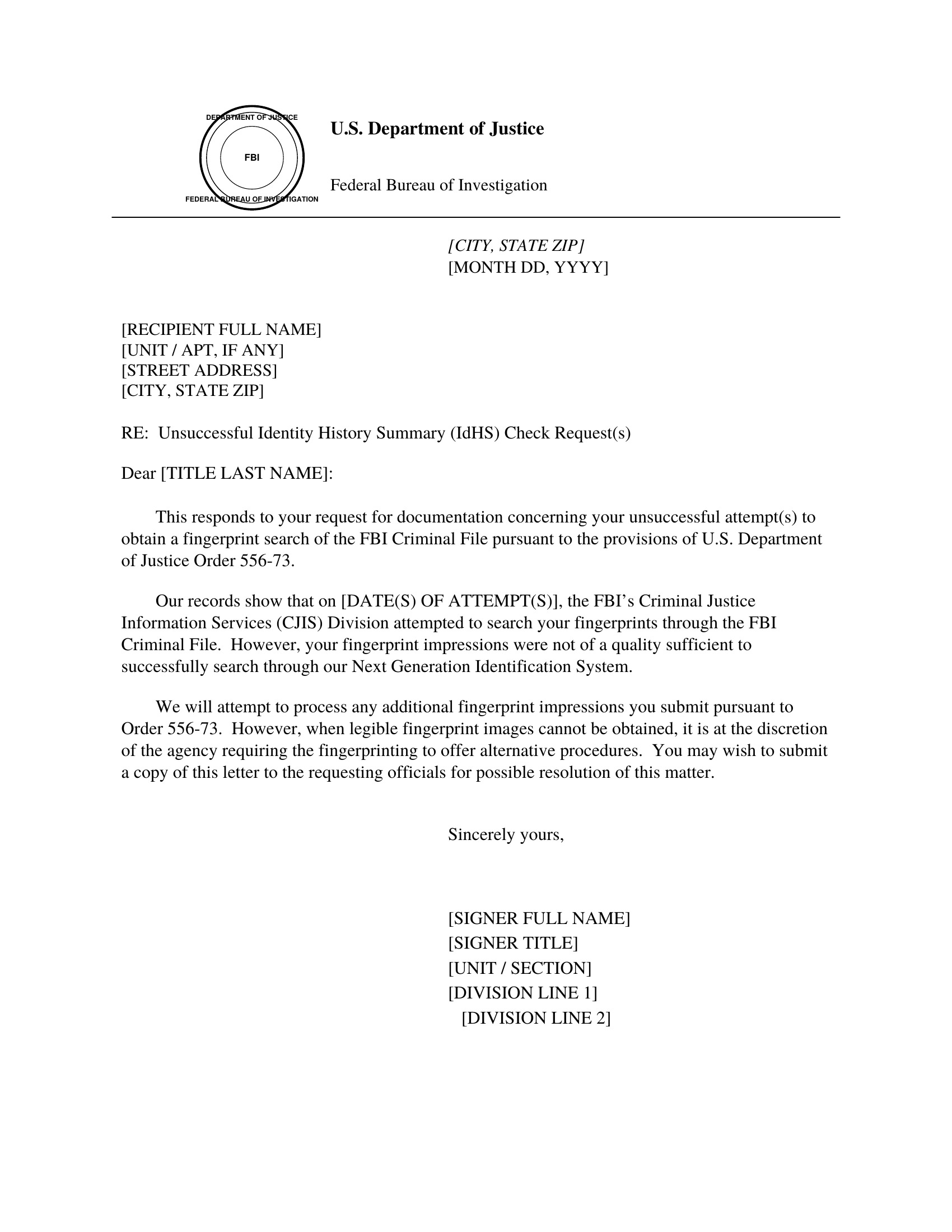
The sample image at the top of this page shows a properly issued FBI Rejection Letter on FBI letterhead. A complete FBI Rejection Letter contains:
- U.S. Department of Justice / Federal Bureau of Investigation letterhead with the FBI seal
- City, State ZIP and issue date in the upper-right
- Recipient name and address block
- Subject line: "RE: Unsuccessful Identity History Summary (IdHS) Check Request(s)"
- Salutation ("Dear [Title Last Name]:")
- Statutory authority citation: U.S. Department of Justice Order 556-73
- Description of the unsuccessful search attempt through the FBI Criminal File and Next Generation Identification System, including dates of attempted searches
- Closing language inviting resubmission and noting that alternative procedures may be offered at the discretion of the requesting agency
- Signature block of an authorized FBI CJIS Division officer with full name, title, unit/section, and division
Because the FBI Rejection Letter is issued by the FBI under federal authority, it is eligible for federal apostille processing through the U.S. Department of State, Office of Authentications — the same pathway used for standard FBI Identity History Summaries.
Why Fingerprints Get Rejected — and Who This Affects
The FBI rejects fingerprints when they are not of sufficient quality to be successfully searched through the Next Generation Identification system. The NGI is highly automated and requires clear ridge detail to complete a search; even relatively minor fingerprint degradation can cause rejection. The common causes affect specific groups of people more than others:
| Cause | Who Is Typically Affected | Outlook for Resubmission |
|---|---|---|
| Naturally worn fingerprints (aging) | Adults over 60, and older people generally — fingerprint ridges naturally flatten and wear with age | Typically permanent — resubmission rarely improves quality. |
| Manual labor occupations | Construction workers, gardeners, mechanics, plumbers, dishwashers, food service workers, factory workers, agricultural workers, healthcare workers — anyone whose hands experience repeated abrasion, chemicals, or moisture | May improve with extended time away from the work; often persistent for long-term workers. |
| Chemotherapy treatment | Cancer patients currently in or recently completing chemotherapy — certain chemo drugs (notably capecitabine) cause temporary "fingerprint loss" | Often improves several months after chemotherapy ends — resubmission worth trying. |
| Skin conditions affecting fingertips | People with eczema, psoriasis, contact dermatitis, hyperhidrosis, scleroderma, or other dermatological conditions affecting the fingertips | May improve with treatment of the underlying condition; varies widely. |
| Recent burns, cuts, or scarring | People with recent injuries to fingertips, surgical scars, or significant calluses | Typically improves as the injury heals; resubmission after healing usually recommended. |
| Certain medications | People taking certain medications affecting skin texture, peripheral circulation, or sweat gland function | Often improves after medication is adjusted or discontinued (where medically appropriate). |
| Adermatoglyphia (rare congenital condition) | People born without fingerprint ridges — extremely rare | Permanent — alternative documentation always required. |
| Improper fingerprinting technique | Anyone whose original prints were taken by an inexperienced fingerprinter or with improper technique | Often resolves with resubmission by a professional fingerprinter or FBI-approved channeler. |
For many applicants — particularly older adults, manual workers, and those with persistent skin conditions — the FBI Rejection Letter is the practical outcome, even after multiple attempts. The letter then becomes the official alternative documentation for foreign authorities.
What It Is Used For Internationally
Foreign authorities typically require an FBI Identity History Summary (a clean "no record" criminal background check) as part of foreign immigration, marriage, residency, dual citizenship, and certain employment applications. When the FBI cannot complete the search because of fingerprint quality, the FBI Rejection Letter — properly federally apostilled — serves as the official alternative documentation. Common use cases include:
- Foreign immigration and residency applications — many countries' immigration systems will accept the FBI Rejection Letter (combined with state-level criminal background checks) when an FBI check cannot be completed.
- Foreign marriage — foreign marriage registrars often require an FBI background check or equivalent; the Rejection Letter combined with state checks is the accepted alternative in most jurisdictions.
- Dual citizenship by descent applications — Italian, Irish, German, Polish, and other consulates often require an FBI background check; the Rejection Letter provides the alternative documentation when prints can't be read.
- Foreign retirement-visa applications — Mexico, Spain, Portugal, Costa Rica, Panama, the Philippines, and similar destinations require criminal-history clearance; the Rejection Letter is the documented alternative for applicants with persistent fingerprint issues.
- Foreign work permits and employment authorization — particularly for sectors and countries requiring criminal-history clearance for non-citizens.
- Foreign professional licensing — medical, legal, financial, and other regulated professions abroad commonly require U.S. criminal-history clearance.
- Foreign adoption proceedings — adoption authorities require comprehensive background checks; the Rejection Letter pairs with state-level checks as the accepted alternative.
- Foreign government and international organization employment — UN, NATO, and similar organizations may require criminal-history clearance for U.S. citizens applying for positions.
Foreign authorities accept the FBI Rejection Letter because it is itself an official federal document confirming, under FBI authority, that the applicant attempted to obtain a standard FBI Identity History Summary and the FBI's automated system could not complete the search. Combined with state-level criminal background checks from every U.S. state where the applicant has resided, the package provides comparable assurance to a completed FBI check.
How to Obtain an FBI Rejection Letter
An FBI Rejection Letter is issued automatically by the FBI's CJIS Division when fingerprint impressions submitted for an Identity History Summary check fail the NGI System's quality threshold. The applicant does not request the Rejection Letter directly — it is the result of an unsuccessful background-check attempt. The process therefore begins with submitting fingerprints for a standard FBI Identity History Summary check:
Method 1 — Submit Fingerprints Through the FBI eDO (Electronic Departmental Order) System
The FBI's eDO portal at edo.cjis.gov allows individuals to submit fingerprint cards directly to the FBI. The applicant pays the FBI processing fee (currently $18 per check), submits an FD-258 fingerprint card with prints taken at a local law enforcement agency or professional fingerprinter, and waits for the FBI's response. If the prints are unreadable, the FBI issues the Rejection Letter directly to the applicant.
Method 2 — Submit Through an FBI-Approved Channeler
The FBI has approved a number of commercial channelers that can submit fingerprint requests on behalf of applicants. Channelers typically return results faster than the FBI's direct eDO process. If prints are unreadable, the FBI issues the Rejection Letter, which the channeler then forwards to the applicant.
Method 3 — Submit Through a State or Local Police Department
Some state and local police departments offer fingerprinting and FBI submission services. Results — including any Rejection Letter — are typically returned through the submitting agency.
Should You Resubmit Fingerprints, or Apostille the Rejection Letter?
This is one of the most important practical decisions facing applicants who have received an FBI Rejection Letter. The right answer depends on the cause of the rejection and the timeline of the foreign filing.
When to Resubmit Fingerprints
- If the original prints were taken with poor technique — a professional fingerprinter or FBI-approved channeler often produces better-quality prints than an inexperienced fingerprinter.
- If the cause is a transient condition — recent chemotherapy ending, healing burns or cuts, recovering skin conditions — wait until the condition resolves and resubmit.
- If you have time before your foreign filing deadline — resubmission is typically the preferred outcome if achievable, since a clean FBI Identity History Summary is more universally accepted than a Rejection Letter plus state checks.
When to Apostille the Rejection Letter
- If multiple resubmission attempts have failed — typically after 2 to 3 attempts, the cause is likely persistent.
- If the cause is permanent — aged fingerprints, long-term manual labor effects, scleroderma, adermatoglyphia, or other persistent conditions.
- If your foreign filing deadline is tight — each FBI submission cycle takes weeks; the Rejection Letter you already hold is the document you actually have.
- If your destination country is known to accept the Rejection Letter alternative — many do, particularly when paired with state-level criminal background checks.
The Combined-Documentation Approach
Many applicants take a hybrid approach: apostille the FBI Rejection Letter AND obtain state-level criminal background checks (and state apostilles) from every U.S. state where they have resided. This provides the foreign authority with both the official FBI documentation of unreadable prints AND independent state-level criminal records confirming no criminal history. Most foreign immigration and marriage authorities accept this combination as the practical equivalent of a clean FBI Identity History Summary.
Federal Apostille Eligibility — Federally Signed & Certified vs. Notary + State Apostille
Federal apostilles by the U.S. Department of State are only available for documents that have been signed and certified by a federal official. This is the core eligibility rule and the most common point of confusion. There are two valid pathways depending on how the document was issued — and choosing the wrong one is the most frequent reason apostille submissions are rejected.
| Pathway | When It Applies | How It Works | Who Authenticates |
|---|---|---|---|
| Pathway A — Federal Apostille | Document is signed and certified by a federal official (e.g., an FBI CJIS Division officer, USCIS officer, SSA officer, VA Regional Office Director) | Document submitted directly to the U.S. Department of State as-is — no notary, no state involvement. | U.S. Department of State, Office of Authentications (Washington, D.C.) |
| Pathway B — Notary + State Apostille | Document is not federally signed (e.g., a self-prepared affidavit stating the applicant has no criminal record, a personal copy of the Rejection Letter the applicant has retyped, or a state criminal background check from a state agency) | A notary public certifies the signature on the document; the document is then submitted to the Secretary of State of the state where the notary is commissioned. | State Secretary of State (the state where the document was notarized) |
Pathway A — When the FBI Rejection Letter Qualifies for Federal Apostille
An FBI Rejection Letter qualifies for a federal apostille only when it has been issued by the FBI itself — that is, an authentic letter on FBI / Department of Justice letterhead, bearing the FBI seal and the signature of an authorized FBI CJIS Division officer. In this form, the document is already a federally certified record, and it is submitted to the U.S. Department of State without notary involvement.
This is the standard and only correct pathway for the FBI Rejection Letter. If you have the FBI's letter in hand on official FBI letterhead, you are on this pathway.
Pathway B — When the Notary + State Apostille Route Applies
If a document is not federally signed and certified — for example, a self-prepared affidavit explaining that fingerprints could not be read, or a state-level criminal background check from a state agency — it cannot be federally apostilled. State documents and notarized affidavits follow the state apostille route through the state Secretary of State. Note that state-level criminal background checks are commonly required alongside the federally-apostilled FBI Rejection Letter as part of the combined-documentation approach described above.
If you are unsure which pathway applies, our team will review your documentation at order intake and route each document correctly — the FBI Rejection Letter through the U.S. Department of State for federal apostille, and any state-level criminal background checks through the appropriate state Secretary of State.
Why Federal Authentication Is Required
Apostille and authentication authority in the United States is divided between state Secretaries of State and the U.S. Department of State based on the issuing authority of the document.
| Issuing Authority | Examples | Where Authenticated |
|---|---|---|
| State or local government / private documents notarized in a state | State criminal background checks, state birth certificates, marriage licenses, notarized affidavits, state-licensed professional records | Secretary of State of the issuing state |
| Federal government | FBI Rejection Letter, FBI Identity History Summary, Certificate of Naturalization (USCIS), Certificate of Citizenship, Consular Report of Birth Abroad, IRS letters, SSA letters, VA letters, federal court documents, DD-214 military records, FDA/USDA letters | U.S. Department of State, Office of Authentications — Washington, D.C. |
Because the FBI is a federal agency, an FBI Rejection Letter cannot be apostilled at the state level. State authorities have no jurisdiction to authenticate federal documents, and any state apostille placed on an FBI Rejection Letter is invalid and will be rejected by the receiving foreign government.
Federal authentication is required to:
- Verify that the document was issued by a legitimate U.S. federal agency
- Confirm the authenticity of the FBI letterhead, seal, and CJIS officer's signature
- Enable formal recognition by foreign governments under international law
travel.state.gov — Authenticate Your Document
Document Preparation Requirements
To be eligible for federal authentication, the FBI Rejection Letter must meet all federal submission standards. Even minor deviations can cause rejection.
Acceptable Format
- Original FBI-issued letter mailed by the FBI's CJIS Division to the applicant — bearing FBI letterhead, FBI seal, and the authorized officer's signature.
- Some FBI channelers deliver the FBI Rejection Letter as a downloaded PDF — when printed in full color, unaltered, this is generally acceptable but confirm with the destination country whether they require the FBI-mailed paper original.
Strict Preparation Rules
- Submit the document exactly as issued by the FBI — no edits, modifications, or additions.
- Do not notarize the document. Notarization automatically invalidates a federal record.
- Do not add certification wording, cover letters, or apostille request stamps to the face of the document.
- Do not alter, cover, or "enhance" any signatures, seals, or letterhead elements.
- Do not edit, resize, reformat, or compress the file before printing (for channeler-delivered PDFs).
- Printed copies must match the original exactly — including margins, color, pagination, and letterhead.
- Do not laminate, hole-punch, staple over the seal, or write on the document.
- Use a high-quality color printer if printing a channeler-delivered PDF.
- For multiple foreign destinations, request multiple FBI Rejection Letters from the FBI — do not photocopy.
Step-by-Step Apostille Process
Receive FBI Rejection Letter
Submit fingerprints to the FBI through the eDO system, an FBI-approved channeler, or a local police agency. If your fingerprints cannot be successfully read, the FBI issues the Rejection Letter directly to you.
Order & Document Review
Submit your order online and send us the FBI Rejection Letter. Our team verifies the document is in proper form before any submission to the Department of State.
Department of State Submission
We hand-deliver your FBI Rejection Letter to the U.S. Department of State, Office of Authentications in Washington, D.C., along with the federal authentication request form (DS-4194) and the appropriate federal fee.
Apostille or Authentication Issued
The Department of State issues either an Apostille (Hague Convention countries) or an Authentication Certificate (non-Hague countries), affixed directly to your FBI Rejection Letter.
Embassy Legalization (If Required)
For non-Hague countries, we forward the authenticated document to the destination country's embassy or consulate in Washington, D.C., for final legalization.
State Criminal Checks & Translation (Optional)
We can coordinate state-level criminal background check apostilles and certified translations alongside your FBI Rejection Letter apostille — frequently required as part of the combined-documentation package for foreign authorities.
How to Visually Confirm the Document Is Ready
Before submitting your FBI Rejection Letter for federal authentication, verify that all of the following are present and intact. (Refer to the sample image at the top of this page for what a properly issued FBI Rejection Letter looks like.)
- FBI letterhead — "U.S. Department of Justice / Federal Bureau of Investigation" with the FBI circular seal in the upper-left
- City, State ZIP and issue date in the upper-right
- Recipient's full name and address block
- Subject line clearly stating "RE: Unsuccessful Identity History Summary (IdHS) Check Request(s)"
- Salutation ("Dear [Title Last Name]:")
- Reference to U.S. Department of Justice Order 556-73 as the statutory authority
- Description of the unsuccessful search attempt through the FBI Criminal File and Next Generation Identification (NGI) System
- Dates of attempted searches (referenced in the body of the letter)
- Closing language inviting resubmission and noting alternative procedures may be offered at the discretion of the requesting agency
- Signature line and signature block of the authorized FBI CJIS Division officer — including full name, title, unit/section, and division identification
- Clean print quality with no fading, smudging, or compression artifacts
- No handwriting, highlighting, stamps, or annotations beyond the original FBI content
Common Reasons FBI Rejection Letter Submissions Are Rejected
The Department of State and foreign governments routinely reject FBI Rejection Letter submissions for a small set of recurring issues. All are preventable.
1. Notarized FBI Rejection Letter
A notary public has no authority to certify federal records, and adding a notary stamp visibly alters the document. Fix: never notarize an FBI Rejection Letter.
2. State-Level Apostille Attempts
Submissions routed to a state Secretary of State are returned unprocessed because the FBI is a federal agency. Fix: ensure submission is routed to the U.S. Department of State, Office of Authentications.
3. Photocopies or Scans Submitted Instead of Originals
Photocopies and scans of an FBI Rejection Letter are not acceptable. Fix: request original copies directly from the FBI; for multiple destinations, request multiple originals.
4. Edited or Reformatted PDFs
Cropped, resized, or "flattened" PDF prints of channeler-delivered letters lose the FBI letterhead alignment and seal integrity. Fix: print the original FBI-issued PDF exactly as issued, in full color, on standard letter-size paper.
5. Black-and-White or Low-Resolution Prints
The FBI seal, letterhead, and signature require full-color, high-resolution printing to be legible and verifiable. Fix: use a quality color printer.
6. Letter Too Old for Foreign Authority's Freshness Window
Many foreign authorities require FBI documentation issued within the last 3 to 6 months. Fix: verify validity rules with the receiving authority before ordering, and request a fresh FBI submission if needed.
7. Missing Supporting State Criminal Background Checks
This is not technically an apostille rejection, but it's the most common foreign-authority rejection — foreign authorities often will not accept the FBI Rejection Letter alone, requiring state-level criminal background checks as supporting documentation. Fix: coordinate state criminal checks from every U.S. state where you have resided, apostilled at the state level, and submit them together with the apostilled FBI Rejection Letter.
8. Foreign Authority Will Not Accept Rejection Letter
Some foreign authorities — particularly certain Gulf state and Asian jurisdictions — require an actual completed FBI Identity History Summary and will not accept the Rejection Letter as an alternative. Fix: if resubmission with better-quality prints is at all possible, pursue it; otherwise consult with the foreign consulate about supplementary documentation options.
Hague Convention vs. Non-Hague Countries
The final form of authentication depends on whether the destination country is a member of the 1961 Hague Apostille Convention:
| Destination Type | What You Receive | Additional Steps | Examples |
|---|---|---|---|
| Hague Convention country | Apostille issued by U.S. Department of State | None — document is ready for use abroad. | Mexico, Spain, Italy, Portugal, France, Germany, Netherlands, UK, Costa Rica, Panama, Brazil, Argentina, Colombia, Japan, South Korea, India, Australia, Philippines, China, UAE. |
| Non-Hague country | Authentication Certificate from U.S. Department of State | Embassy or consulate legalization required after authentication. | Saudi Arabia, Qatar, Kuwait, Egypt, Vietnam, Cambodia, Iran, Iraq, Pakistan, Bangladesh. |
Hague Convention membership changes periodically. Federal Apostille and Notary Processing verifies the destination country's current status as part of every order. View our Country Guide for the latest list.
Processing Times & Validity
Total turnaround depends on three stages: the FBI's issuance of the underlying Rejection Letter, the U.S. Department of State's authentication processing, and (when required) embassy legalization.
- FBI fingerprint submission and Rejection Letter issuance: typically 3 to 5 business days via the eDO system; 24 to 48 hours via approved channeler. The Rejection Letter is issued at the same speed as a successful Identity History Summary would be.
- U.S. Department of State authentication: currently 10–12 business days for routine processing (subject to government workload — expedited service available through our office).
- Embassy legalization: varies widely by country — typically 3 business days to 4 weeks.
- Validity for foreign use: FBI Rejection Letters typically must be issued within the last 3 to 6 months for foreign immigration, marriage, and residency purposes. Confirm with the destination country.
Use our Processing Time Estimator for a country-specific projection.
Why Choose Federal Apostille and Notary Processing
We are a Washington, D.C.-based document processing service specializing exclusively in federal authentications. FBI Rejection Letter apostilles are one of our most-requested services among applicants whose fingerprints could not be successfully read for foreign immigration, marriage, and residency purposes.
- Hand-delivery to the U.S. Department of State, Office of Authentications — no mail delays.
- $120 flat-rate pricing with all government authentication fees included — no hidden costs.
- Pre-submission review by federal-document specialists who catch the most common rejection issues (notarization, missing pages, edited PDFs) before they cost you time and money.
- Combined-documentation packages — we coordinate the federal apostille of the FBI Rejection Letter alongside state-level criminal background check apostilles from every U.S. state where you have resided, providing the comprehensive package most foreign authorities require.
- Embassy legalization for non-Hague countries handled in-house in Washington, D.C.
- Certified translations in Spanish, Portuguese, Italian, French, German, Arabic, Vietnamese, Chinese, and other languages commonly required for foreign immigration filings.
- Worldwide tracked shipping via FedEx, UPS, and DHL.
- Real-time order tracking from intake through delivery — particularly important when foreign filing deadlines are at stake.
- Over 10 years of experience processing federal authentications for foreign immigration matters.
Frequently Asked Questions
What is an FBI Rejection Letter?
An FBI Rejection Letter is the informal industry name for an FBI Unsuccessful Identity History Summary (IdHS) Check letter — the official document issued by the FBI's Criminal Justice Information Services (CJIS) Division when fingerprint impressions submitted for an FBI background check were not of sufficient quality to be successfully searched through the FBI's Next Generation Identification (NGI) System. It is issued under U.S. Department of Justice Order 556-73 and serves as official documentation that the applicant attempted to obtain an FBI background check but the search could not be completed.
Why would my fingerprints be rejected by the FBI?
The FBI rejects fingerprints when they are not of sufficient quality to be successfully searched through the Next Generation Identification System. Common causes include: worn fingerprints due to aging; significant manual labor (construction, gardening, mechanics, food service, healthcare); skin conditions affecting the fingertips such as eczema, psoriasis, or scarring; ongoing or recent chemotherapy treatment; certain medications affecting skin texture; recent burns or injuries to the fingertips; and rare congenital conditions such as adermatoglyphia. The FBI's NGI system requires clear ridge detail to complete a search.
What do I do if I receive an FBI Rejection Letter?
The FBI Rejection Letter itself notes that you may submit a copy to the agency requiring the fingerprinting (in international contexts, this is typically a foreign embassy, consulate, immigration authority, or marriage registrar) for possible resolution. For foreign use, the letter must first be apostilled by the U.S. Department of State, then submitted to the foreign authority. Many foreign authorities accept the FBI Rejection Letter combined with state-level criminal background check(s) as an acceptable alternative to a completed FBI Identity History Summary.
Can a state Secretary of State apostille my FBI Rejection Letter?
No. The FBI Rejection Letter is issued by the FBI's Criminal Justice Information Services (CJIS) Division — a federal agency. Only the U.S. Department of State, Office of Authentications can apostille it. State apostilles on federally signed documents are invalid and will be rejected by foreign governments. (State apostilles are only the correct route for documents that are not federally signed — for example, state criminal background checks or notarized affidavits.)
Should I try to resubmit fingerprints, or just get the rejection letter apostilled?
Generally, you should make at least one resubmission attempt — fingerprint quality can sometimes be improved by using a professional fingerprinting service or trying again after time has passed (for example, after chemotherapy ends, after skin conditions heal, or after a period away from manual labor). However, if multiple attempts have failed or the cause is permanent (such as aged fingerprints or adermatoglyphia), the FBI Rejection Letter combined with state-level criminal background checks from every state of residence is typically the practical alternative.
Do foreign authorities accept the FBI Rejection Letter as an alternative to a clean background check?
Many do — particularly when combined with state-level criminal background checks from every U.S. state where the applicant has resided. Acceptance varies by country and use case. European countries pursuing dual-citizenship-by-descent applications (Italy, Ireland, Germany, Poland), Latin American retirement-visa programs (Mexico, Costa Rica, Panama), and most Asian and Pacific destinations generally accept the combination. Some Gulf state and Middle East jurisdictions may insist on a completed FBI Identity History Summary; if resubmission with better-quality prints is at all possible, those destinations may require it.
What is the difference between a federal apostille and a state apostille?
A federal apostille is issued by the U.S. Department of State and applies to documents signed and certified by a federal official — including the FBI Rejection Letter, FBI Identity History Summary, USCIS certificates, SSA letters, VA letters, and federal court documents. A state apostille is issued by a state Secretary of State and applies to documents that are not federally signed but are notarized by a notary public commissioned in that state — including state-level criminal background checks, notarized affidavits, and self-declared statements. Both are recognized internationally under the Hague Apostille Convention; the difference is solely about who signed the underlying document. We handle both — see Federal vs. State Apostille Eligibility above for full details.
Should I get state criminal background checks too?
Yes, generally. Most foreign authorities expect a combined-documentation package when an FBI Rejection Letter is used in lieu of a clean FBI Identity History Summary. The package typically includes: (1) the federally apostilled FBI Rejection Letter, (2) state-level criminal background checks from every U.S. state where you have resided, each apostilled by the issuing state, and (3) optionally, a notarized affidavit explaining the fingerprint issue. We can coordinate all of these elements through our Federal Apostille and Notary Processing service and the related state-level apostille service.
How long is my FBI Rejection Letter valid for foreign use?
Most foreign authorities require FBI documentation (including Rejection Letters) issued within the last 3 to 6 months. Some accept up to 12 months. Confirm with the destination country, and request a fresh FBI submission if your existing letter is older than the destination country's freshness rule.
Will I need a certified translation of the apostilled letter?
Many countries require a certified translation into the official language of the destination country — particularly for foreign immigration and marriage filings. We offer certified translations alongside the apostille service so that everything is delivered ready-to-file. Spanish, Italian, Portuguese, French, German, Arabic, Vietnamese, and Chinese translations are among the most commonly requested.
Can you help me obtain the FBI Rejection Letter from scratch?
The FBI requires the applicant to submit fingerprints directly through the eDO system, an FBI-approved channeler, or a local police agency. We do not submit fingerprints on your behalf, but we can provide guidance on the request process. Once you have the FBI Rejection Letter in hand, we handle the federal apostille process from there.
Do I need to be in Washington, D.C. or visit your office in person?
No. We work with clients nationwide and internationally. You can submit your FBI Rejection Letter and any state-level criminal background checks by mail or courier, and we handle the in-person submissions to the Department of State and state Secretary of State offices on your behalf.
Summary
The FBI Rejection Letter — formally an Unsuccessful Identity History Summary Check — is the official federal document issued by the FBI's CJIS Division when fingerprint impressions cannot be read by the Next Generation Identification system. For applicants whose fingerprints are worn, scarred, or otherwise unreadable due to age, manual labor, chemotherapy, skin conditions, or other causes, the Rejection Letter is the official alternative documentation accepted by many foreign immigration, marriage, residency, and dual citizenship authorities. Because the FBI is a federal agency, only the U.S. Department of State — never a state Secretary of State — can apostille the Rejection Letter for international use.
Most foreign authorities accept the federally apostilled FBI Rejection Letter when combined with state-level criminal background checks from every U.S. state where the applicant has resided. Federal Apostille and Notary Processing handles every step — federal apostille of the FBI Rejection Letter, state apostilles of the supporting state criminal background checks, certified translations, and embassy legalization for non-Hague countries — so the complete combined-documentation package is delivered abroad in legally recognized form.
Ready to Get Your FBI Rejection Letter Apostilled?
$120 flat rate. Hand-delivered to the U.S. Department of State. 10–12 business day turnaround. Combined-documentation packages with state criminal background check apostilles available.
